Table of Content

What causes parts fitment errors, and how does AI stop them?
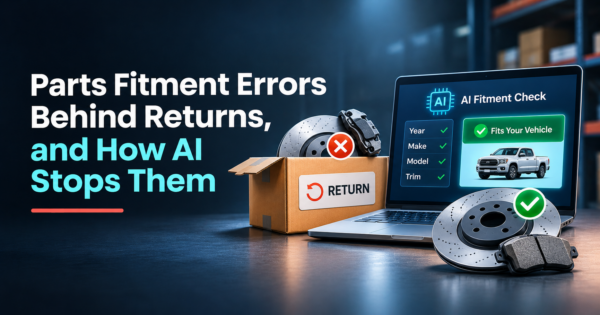
Parts fitment errors come from bad vehicle data: a part tied to the wrong trim, engine or model year, a missing qualifier, or a supplier number matched to the wrong product. AI can catch many of them by flagging mismatched rows before import, while a person approves every fitment record before it goes live.
TL;DR
- Definition: parts fitment is the data that says which vehicles a part fits. One wrong row becomes a wrong-part order, and a wrong-part order becomes a return.
- Main causes: over-mapped model ranges, missing engine or position qualifiers, mismatched brand and part numbers, copied listings and stale rows nobody deleted.
- Measure first: tag every return with a reason code so fitment returns separate from picking mistakes and buyer-selection mistakes, then fix the worst brands and categories first.
- What AI does: it reads supplier text and OE numbers, compares them with existing fitment and proposes rows with a confidence level and the evidence behind each one.
- Where a person checks: low-confidence rows, new brands, trim and engine splits, mid-year changes and any row in a high-return category.
- Platform rules: per Amazon’s ACES guide, fitment matches on brand and normalized part number, and a wrong row stays until an exact delete is sent. On eBay, partial vehicle details expand to every trim and engine.
- Next step: if your supplier files need a working vehicle selector and a review queue, our ecommerce development team and AI integration services build and test that pipeline for parts sellers.
What is parts fitment, and why does a wrong fit end in a return?
Parts fitment is the data that records which vehicles a part fits, down to the trim, engine and position that decide whether it works. The eBay seller page on fitment defines it as information about the listed part that identifies the vehicle it fits. The word has a second meaning in wheels and tires, where it describes offset, bolt pattern and how a wheel sits in the fender. Here, parts fitment means fitment for repair and replacement parts such as brakes, filters, sensors, suspension and lighting, where a part either fits a vehicle or it does not.
An online shopper cannot hold the part against the car. The vehicle selector, the compatibility badge and the fitment table stand in for the counter person, so they are only as right as the rows behind them. When a row is wrong, the buyer installs the part, finds it does not fit and ships it back. The seller pays freight in both directions, inspects and restocks the part, answers the support ticket and sometimes loses the customer. Those costs are why auto parts returns are a data problem before they are a service problem.
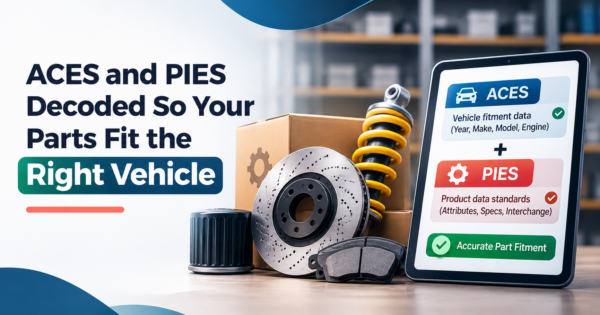
The Auto Care Association lists “reduced returns” among the benefits of its ACES fitment standard, which the association calls the aftermarket industry data standard for fitment. A vehicle is also far more than a year, make and model. The association’s VCdb vehicle database lists more than 175.5 thousand vehicle applications and more than 2.4 million vehicle system configurations, which is why two vehicles with the same name can need different parts. For what each standard and database holds, see our ACES and PIES guide.
Which parts fitment errors send parts back?
Most fitment errors are small data mistakes that look correct on the product page. The table lists the ones that recur, how each reaches a shopper and where to catch it.
| Error | What the shopper sees | How it gets in | How to catch it |
|---|---|---|---|
| Over-mapped range | A part marked as fitting trims or engines it does not fit. | Fitment written to a whole model range. On eBay, entering only year, make and model lists every matching trim and engine, as the eBay fitment page explains. | Compare each row with the supplier’s application notes. Amazon’s guide asks providers not to over-map. |
| Missing qualifier | The part fits the vehicle in the selector but not its engine, drive type or position. | A supplier note such as front, rear or a specific engine never reached a coded field. | Require engine and position values for the part types that depend on them. |
| Brand or part number mismatch | Fitment attached to the wrong product, or to nothing. | Amazon matches ACES records to listings on brand name and normalized part number, and two products can normalize to one number, per Amazon’s ACES guide. | Match on brand code plus part number plus part type, and test the match on a sample. |
| Unknown values | Rows missing without any message. | Amazon ignores application records whose tags, such as body type, map to an unknown value. | Count the rows dropped in each processing report. |
| Copied fitment | The same wrong row on many listings. | eBay lets sellers carry compatibility across with sell similar and relist, and says the seller must check the transferred data. | Review copied rows as if they were new. |
| Rows nobody deleted | Wrong fitment that stays live after the supplier fixed it. | Amazon treats ACES feeds as updates and needs an explicit delete record that matches the original add. | Send net-change feeds with deletes and keep the exact records you sent. |
| Free-text vehicles | A selector that finds nothing, or the wrong vehicle. | Vehicle names typed as text instead of coded to a vehicle list. | Resolve every vehicle to a coded value before import. |
| Model-year changes | A part that fit early in a year but not late in it. | Year-only mapping when a manufacturer changed the part during the model year. | Hold models with known mid-year changes for manual review. |
Several of these start in the supplier file, which is why a hand sample per brand before launch pays off. Our guide to auto parts product data management covers where catalog errors enter and how to audit them before they reach the store.
How do you tell a fitment return from any other return?
You tell them apart by recording a reason code on every return and reading it by brand and part type. A single “wrong part” label hides several different causes with four different owners. The table separates them.
| Return reason | Likely cause | Who fixes it |
|---|---|---|
| Does not fit, and the buyer used the selector | A wrong or over-mapped fitment row. | Whoever owns the catalog data |
| Does not fit, and the buyer skipped the selector | The vehicle step is optional or easy to miss. | Storefront owner |
| Fits the vehicle but is the wrong version | A missing engine, trim or position qualifier. | Whoever owns the catalog data |
| A different part arrived than the one ordered | A pick or pack error. | Warehouse |
| The supplier shipped a different revision | A supplier part change that the data did not follow. | Supplier manager |
Once the codes are in place, build the baseline this way.
- Pull 90 days of returns with their reason codes and the SKU, brand and supplier on each.
- Divide fitment returns by orders for the same part category, brand and supplier.
- Rank by return rate and by order volume, so a small brand with a bad rate does not outrank a large one with a modest rate and a big cost.
- Take the top of that list as the first review queue, and repeat the same calculation 30 and 60 days after the fixes.
The ranking tells you where review hours earn the most. It also gives you a number of your own to judge any tool against, which is more useful than a benchmark from another store.
How does AI map parts to vehicles?
AI maps parts to vehicles by reading every source that describes a part, turning that text into coded vehicle claims and scoring how well independent sources agree. The output is a set of proposed fitment rows with evidence, and nothing goes live from this step. A typical pipeline runs in six stages.
- Read the inputs. Supplier titles, descriptions, application notes, OE and interchange numbers, and any fitment you already hold.
- Extract the claims. Pull make, model, year range, engine and position out of free text, such as “2015 to 2019 front, 5.0L”.
- Resolve to codes. Map each claim to a coded vehicle in the standard vehicle list instead of keeping it as text.
- Cross-check. Compare the claim with independent signals: an OE number that maps to known applications, sibling parts from the same brand and platform, and any existing row for the same part number.
- Score. Rows where several signals agree rank high. Rows with one signal, or signals that conflict, rank low.
- Propose. Write each row to a staging table with its reason and evidence, and route it to the right review tier.
The honest limit is coverage. AI cannot find a fit that no source describes, and a language model can state a wrong fit as fluently as a right one, so every proposal is a draft. The LiftKits4Less case study describes AI-powered fitment automation on a Magento store that reduces manual fitment work while supporting more accurate product matching. For the wider set of catalog jobs AI handles, see AI automation for ecommerce stores, and for the build itself see our AI solutions for ecommerce.
What does AI get right, and where does a person check?
AI is reliable on clean, explicit inputs and unreliable where the source is vague, so the dividing line is the quality of the evidence, not the size of the catalog. The table shows where each task usually falls. Treat it as a starting point and measure each row on a sample of your own data.
| Task | AI is reliable when | A person checks when |
|---|---|---|
| Normalizing vehicle names | The supplier uses standard make and model names. | The brand uses nicknames, or the trim is sold in limited markets. |
| Reading year ranges | Ranges are explicit, such as 2015 to 2019. | The text says “and up”, “late production” or “see notes”. |
| Matching OE and interchange numbers | A number maps to one known part. | A number appears on several parts, or the part was superseded. |
| Extending fitment from sibling parts | Same brand, same platform, same part type. | The engine, body style or platform differs. |
| Finding duplicates and conflicts | Two rows contradict each other exactly. | Rows overlap only in part. |
| Reading position | The text states front or rear, left or right. | Position is implied by a diagram or a part number only. |
| Recommending a row for removal | A row contradicts the supplier’s own data. | The case is a judgment call. |
Route the proposed rows by confidence so reviewer time goes where the risk is.
- High confidence: several independent signals agree. Stage the rows automatically, and review a random sample to keep the score honest.
- Medium confidence: one strong signal and no conflict. A reviewer approves these in batches, with the evidence visible.
- Low confidence: a single weak signal or a conflict. A reviewer decides row by row, and the supplier is asked when the source is unclear.
New brands, trim and engine splits, and any category with a high return rate skip the high tier and go to review regardless of score.
How do you set up a fitment review queue that people can keep up with?
A review queue works when each decision takes seconds and nothing reaches the feed without a sign-off. Build it in seven steps.
- Show the reviewer the part, the supplier text, the proposed vehicles as coded values and the evidence for each, on one screen.
- Offer three actions only: accept, edit or reject, with a short reason required for the last two.
- Keep the step that proposes rows separate from the step that publishes them, so no row goes live on a model’s say-so.
- Review every row for new brands and high-return categories, and sample the rest at a rate you can sustain.
- Give the queue to someone who knows parts, such as a counter or catalog specialist, not only a data clerk.
- Log every edit and rejection by supplier, and turn repeated corrections into rules the AI step applies next time.
- Track the reject rate per supplier. A supplier whose rows keep getting rejected needs a conversation about its data, not more review time.
The log is the asset. It shows which suppliers send clean parts fitment data, which part types need a person and whether the AI step is improving, so you can widen or narrow the automatic tier on evidence.
What do eBay Motors and Amazon require for fitment data?
Each marketplace takes auto parts fitment in its own format, and several of its rules create errors when a seller overlooks them. The table summarizes the rules as of November 2026, taken from each platform’s own pages.
| Platform | How fitment is supplied | Rules that cause errors | Source |
|---|---|---|---|
| eBay Motors | The eBay page describes fitment as optional. Sellers add compatible vehicles in the listing form or from the parts catalog, or use downloadable Master Vehicle List files. Parts compatibility is supported in select Parts and Accessories categories. | Partial vehicle details expand to every matching trim and engine. Compatibility copied through sell similar or relist stays the seller’s responsibility to check. The vehicle list data may be used only to match vehicles to your eBay Motors listings. | eBay fitment page and Master Vehicle List page |
| Amazon Automotive | ACES XML sent through the Automotive Fitment Manager in Seller Central or Vendor Central, directly or through a third-party data provider. Amazon prefers data from the manufacturer or an approved provider. | Records match on brand name and normalized part number. Unknown values are ignored. Feeds are treated as updates, so a wrong row needs an exact delete. Matching can take up to one week for existing products and three weeks for new ones. Other providers’ ACES data may also be shown for your product. | Amazon’s ACES provider guide |
Two habits prevent most platform errors. First, keep one master fitment dataset and send each channel its own export, so a correction is made once. Second, read the processing report after every feed and treat each rejected or ignored row as a data question, not noise. Teams that run several channels can bring in marketplace management services or build the feed pipeline themselves.
Do YMM selectors and VIN lookups prevent wrong parts?
A year, make and model selector narrows a catalog to likely parts, but it prevents wrong parts only when the fitment data behind it carries the trim, engine and position the part depends on. YMM fitment is a lookup, not a guarantee. A selector built on over-mapped rows will confidently show a part that does not fit.
A VIN lookup identifies one specific vehicle. NHTSA’s vPIC Decode VIN service returns decoded VIN data built from information the manufacturers submit, supports partial VINs and recommends always sending the model year. It also accepts batches of up to 50 VINs. A decoded VIN gives you the vehicle’s attributes, such as engine and body style. Vehicle fitment data still decides whether a given part fits those attributes, so a VIN improves the input without fixing a bad row.
- Ask for engine or trim only for the part types that need it, so the selector stays short.
- Show the selected vehicle at the cart and at checkout, so a buyer sees what the store believes they drive.
- Return “no fit found” instead of the closest match when the data cannot answer.
How do you clean up the fitment data you already have?
Start with the returns, not the whole catalog. Cleaning every row at once stalls, while fixing the rows behind the worst return rates lets you see the effect sooner. Follow these steps.
- Rank brands and part types by fitment returns using the baseline from earlier.
- Export the fitment rows for those SKUs together with the supplier’s source files.
- Run the AI cross-check to find conflicts, over-mapped ranges and missing qualifiers, and send the findings to the review queue.
- Correct the source, meaning the supplier file or your master dataset, not only the store, so the next import does not bring the error back.
- Send corrected feeds to each channel, with delete records where the platform needs them, such as Amazon.
- Check the processing reports for ignored or rejected rows.
- Recalculate the return rate for the corrected categories 30 and 60 days later and compare it with the baseline.
The Sugar Auto Parts case study reports that year, make and model integration reduced returns on a marketplace that grew from 1.9 million to more than 6 million SKUs in under 12 months, as published on that page. For the import and validation side, our ACES and PIES guide explains how to load standard files without breaking fitment.
When should you bring in a developer for fitment work?
Bring in a developer when the problem is the pipeline, not a single bad file. The signs are a selector that cannot show engine or trim, supplier files that arrive in different formats every month, feeds to two or more channels that drift apart, or returns that stay flat after you fix the data by hand.
A developer builds the vehicle selector and storage, the import and validation steps, the staging table and review screen, and the channel exports. Our ecommerce development team builds this on Shopify, Magento and other platforms, and the LiftKits4Less case study was delivered with our Magento development services. If you are weighing who to hire, our guide to hiring ecommerce developers for auto parts lists the questions to ask. Share a sample supplier file and your worst return categories, and the first useful scope is usually a small audit and a review queue, not a rebuild.
Frequently Asked Questions
What is parts fitment?
Parts fitment is the data that records which vehicles a part fits, including the trim, engine and position that decide whether it works. Online stores use it to power the vehicle selector and the “fits your vehicle” message on a product page. When the data is wrong, the shopper orders a part that does not fit.
What is fitment data and where does it come from?
Fitment data is structured, machine-readable records that link a part number to the vehicles it fits. In the US aftermarket it is exchanged in ACES files, which the Auto Care Association maintains. It usually comes from the part manufacturer, a supplier or a fitment data provider, and a store then loads it into its catalog.
How do I know if a part will fit my vehicle?
Use the store’s vehicle selector or VIN lookup and look for a fits-your-vehicle message on the product page. Then compare the part number on the listing with the number on your old part, and read any notes about engine, position or trim. If the listing leaves a detail open, ask the seller before you order.
What vehicle information do I need to confirm fitment?
You need the year, make and model at a minimum, and for many parts you also need the trim, engine size and drive type. Brake, suspension and sensor parts often depend on those details. The VIN is the most reliable way to supply all of them at once, because it identifies one specific vehicle.
Can I return or exchange a wrong car part?
It depends on the seller’s return policy, so read it on the listing before you buy. Sellers commonly expect a part to be unused and in its original packaging, and many refuse parts that were installed. As a seller, state your fitment return terms plainly on the product page and at checkout so there is no argument later.
How can I find part interchange numbers?
Interchange data links part numbers that describe the same or an equivalent part, such as an OE number and its aftermarket equivalents. Start with the number printed on the part, then search it in the manufacturer’s catalog or a cross-reference tool from a parts supplier. Interchange only says two parts are equivalent, so fitment data still has to confirm the part works on your vehicle.
Is there an app for identifying car parts?
Apps can read a VIN or a part number, but identifying the vehicle is not the same as confirming a part fits it. Free VIN decoders such as NHTSA’s vPIC return the specifications of a vehicle, and a store’s selector or part-number search then matches that vehicle to parts. Whenever you can, check the number on the old part as the final test.
What is a good return rate for an auto parts store?
There is no single good rate, because it varies by part type, vehicle age and what a store counts as a return. Measure your own: wrong-fit returns divided by orders, by part category and by brand, over a fixed period. A rate that falls on the categories you fixed is a better target than a figure from another store.
How do you reduce returns on an auto parts store?
Tag every return with a reason code, find the brands and part types with the most wrong-fit returns, and correct the fitment rows behind them first. Add the engine, trim and position qualifiers the part needs, and show the selected vehicle at the cart and at checkout. Keep a person on the approval step for new brands and high-return categories.
Can AI check parts fitment on its own?
AI can propose and cross-check fitment rows, and it can flag conflicts a person would take hours to find. It should not publish fitment without a person, because a model can state a wrong fit with confidence and a wrong row sends the wrong part to a customer. Measure any tool on a sample of your own data before you rely on it.
Bottom Line
Parts fitment errors are data errors, and they show up as returns because the shopper is the last person to check the row. Measure fitment returns by reason, brand and part type, fix the rows behind the worst rates, and keep a person on the step that publishes fitment. Use AI to read supplier text, cross-check sources and rank proposed rows by confidence, and keep a person on every row the evidence cannot settle. A store that does both stops shipping the same wrong parts twice.