

01
A safety incident without objective evidence
When a worker is injured in an unmonitored zone, witness accounts fill the gaps and investigations slow down.
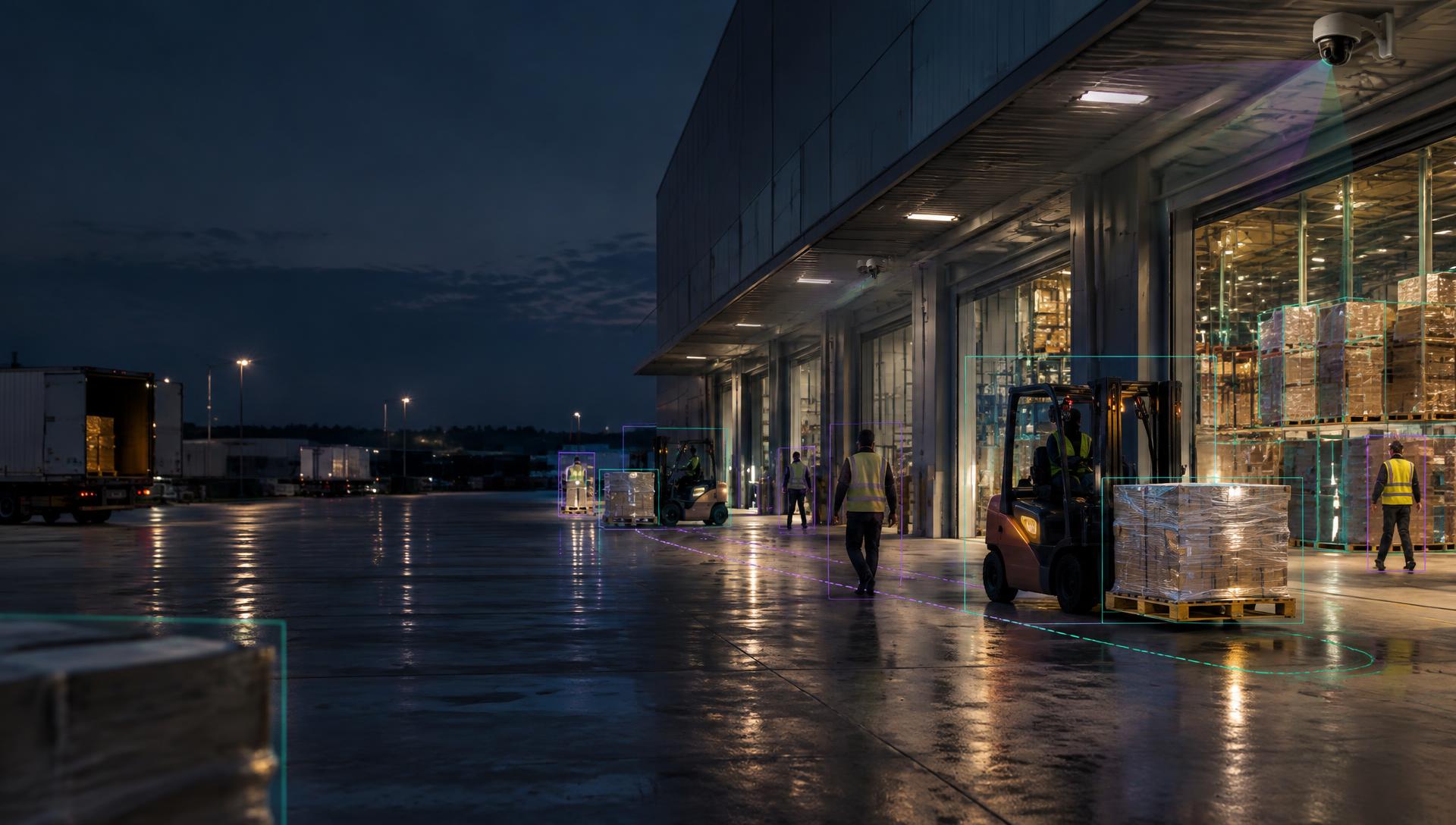
AI Video Intelligence
Turn the cameras you already have into a live monitoring layer for shipments, inventory, theft, safety and cold-chain failures—each event tied to the batch or shipment it affects.
The cost of not knowing
It becomes a liability, a loss or a dispute your team cannot prove. These are not security footnotes—they are operational events with a real cost.

01
When a worker is injured in an unmonitored zone, witness accounts fill the gaps and investigations slow down.
02
Without visual evidence tied to a timeframe, shrinkage becomes an untraceable write-off instead of a specific incident.
03
Without a visual load-out record, your team negotiates without proof of the shipment's actual condition.
04
A temperature failure that goes unseen is discovered only after the product—and the relationship—has already suffered.
05
Your team spends days counting manually, but the result is outdated before anyone can act on it.
Four operational pillars
Inspect, label and count every unit correctly before it leaves the line—without manual walk-throughs.
Measure equipment utilization, bottlenecks, queue times and gate transactions as they happen.
Monitor fence lines, restricted zones, parking slots and walkways across the site, day and night.
Detect PPE gaps, machine-guarding issues, gas leaks, fire, blocked exits and hazmat-zone events.
Computer vision solutions
As a provider of computer vision solutions for warehouses, this is what we deploy through AI surveillance and monitoring solutions. Some of this runs on cameras already mounted in your facility. Some needs cameras placed with intent, in the exact spot where they pay off. Either way, it's one system, not two.


The operational impact
| Capability | The problem | The impact |
|---|---|---|
| 01Loading / unloading verification | No way to confirm what was loaded matches what was billed | Resolve freight disputes with visual proof |
| 02Physical inventory verification | Manual counts are slow, disruptive and instantly stale | Maintain real-time stock accuracy |
| 03Theft & shrinkage detection | Losses surface weeks after the event | Flag loss at the exact time and location |
| 04Cold chain compliance | Failures appear only after product spoils | Catch excursions before a shipment is lost |
| 05PPE & safety compliance | Incidents are investigated only after the fact | Flag non-compliance before it escalates |
Designed around your stack
One connected monitoring layer—not another isolated feed your team has to watch.
We begin with your installed CCTV rather than forcing a hardware replacement.
Thermal, high-speed or depth-sensing cameras are added only where the return justifies them.
Every useful event links to the relevant shipment, batch or SKU—not a disconnected alert.
FAQ
No. We start with the cameras you already have and add new coverage only where it pays for itself.
No. The system is configured around events that affect operations, such as a missed scan, damaged pallet or safety violation, and links the video to the affected record.
Connecting existing CCTV to current workflows often takes weeks, not months. A focused deployment can typically go live in about six weeks.
No. Monitoring is configured around defined operational events and zones, not continuous individual tracking.
Timestamped, location-tagged video tied to a specific operational record gives teams objective evidence for disputes, audits and investigations.
See what your cameras can already tell you