Table of Content

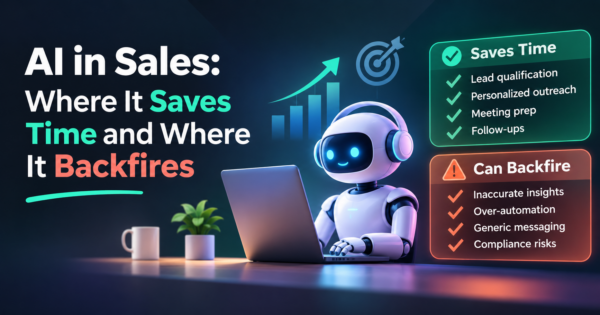
Salesforce asked 5,500 sales professionals in 27 countries how they spend their week, and reps said 70% of it goes to tasks that are not selling (State of Sales, July 2024). That is the case for AI in sales in one number. AI in sales means software that researches accounts, scores leads, drafts outreach, records calls, updates the CRM, forecasts deals and coaches reps, so sellers spend more of their day with buyers.
It is also a field with a lot of hype, so this guide is organized around where AI earns its keep, where it backfires and how to find out for your own team.
What does a rep week look like, and what can AI take back?
Start with the time, not the tool. Ask each rep to log one week, then rank tasks by hours. The table shows the usual suspects.
| Where the week goes | What AI can do about it | How safe is it |
|---|---|---|
| Researching accounts and contacts | Builds account briefs, enriches contact data, summarizes news | Safe, but verify names and numbers |
| Writing first-draft emails and call prep | Drafts a version grounded in what the CRM knows | Safe if the rep edits and sends |
| Notes, summaries and CRM updates | Transcribes calls, drafts the summary, fills fields | Safe, and the best first project |
| Scheduling and follow-up | Proposes times and reminders | Safe |
| Forecast and pipeline reviews | Flags stale deals and missing decision makers | Useful, with a manager challenging it |
| The conversations that close deals | Coaching feedback only | This is the work to protect |
The pattern is that AI is strongest in the first five rows and weakest in the last. Decide where the recovered hours will go before you buy anything, such as more buyer conversations or better account planning.
Where does AI fit across the sales process?
AI works at every stage, but the rep stays in the loop wherever a buyer sees the result. Start at Meet, where the work is easy to check and rarely reaches a buyer.
Which AI in sales claims should you doubt?
“AI will write all your outreach”
It writes a plausible first draft, and it will occasionally invent a detail such as a funding round that never happened. Ground it in verified data and keep the rep as the sender. Drafting is where AI saves time, and sending is where a mistake lands in front of a buyer. Rules on email, phone and text consent also differ by country and state, so confirm requirements with counsel before you automate anything that contacts a buyer without review. Our guide to AI email assistants compares tools that draft, sort and reply.
“More messages mean more meetings”
Easy drafting tempts teams to send more. Volume without targeting lowers reply rates and wears out lists. Judge outreach by replies and meetings booked, not messages sent, and cap volume per account. Fix targeting first with better data from data enrichment tools.
“A lead score replaces judgment”
A score ranks leads using past outcomes, so it inherits past bias: it keeps favoring the kind of buyer you already win. Treat it as a sorting aid, review it by segment, and let reps tell the model when it is wrong. Our guide to lead scoring models compares rules-based and predictive approaches and the data each needs.
“AI agents can run the pipeline for you”
An AI sales agent can take multi-step actions, such as researching an account, drafting the email, logging it in the CRM and proposing a meeting time. That is useful when a person approves anything a buyer sees. See our guide to AI sales agents for what they do and what they cost, and appointment scheduling software for the booking step.
“Our forecast will fix itself”
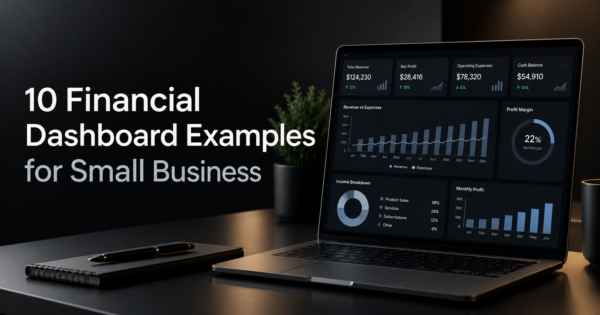
A model can compare a deal with past deals at the same stage and flag the ones with no recent buyer activity. It cannot fix a CRM full of stale stages. Reps dislike entering data, so an AI note-taker that updates the next step and close date after each call is often the most valuable feature. Track forecast error as the absolute difference between forecast and actual, divided by actual, by quarter. The numbers themselves are laid out in our sales dashboard examples.
What do the surveys actually show?
Salesforce’s sixth State of Sales report, published July 25, 2024, surveyed 5,500 sales professionals between March 8 and April 18, 2024. It found 81% of sales teams were experimenting with AI (40%) or had fully implemented it (41%), and that 83% of teams using AI saw revenue growth that year compared with 66% of teams not using AI. Reps named forecasting accuracy and personalized prospect communication among the areas where AI had the biggest impact. Salesforce sells AI and CRM products, the figures are self-reported and the revenue gap is a correlation, since teams that adopt AI may already be better resourced.
What does your CRM need before AI for sales can help?
AI for sales is only as good as the records it reads. Duplicate accounts, empty fields and unlogged activity are the usual reasons pilots disappoint, so check the basics first.
| Check | Why it matters | Fix before the pilot |
|---|---|---|
| Duplicate accounts and contacts | Scores and summaries attach to the wrong record | Merge duplicates and set a matching rule |
| Stage definitions | Forecasts compare deals that mean different things | One written definition per stage, enforced in the CRM |
| Required fields | Models cannot score what is blank | Make source, size and next step mandatory |
| Activity logging | Deal risk flags depend on recent buyer contact | Log calls and emails automatically instead of by hand |
| Closed-lost reasons | The model learns why deals die from them | A short, fixed list of reasons |
How do you run a pilot that proves it?
| Phase | What you do | What you measure |
|---|---|---|
| Days 1 to 30 | Log one rep week, clean duplicates and make key CRM fields required, then start call summaries and CRM updates for a pilot group | Selling time (buyer-facing hours / total hours), CRM completeness |
| Days 31 to 60 | Add outreach drafting and lead scoring for the pilot group, with approvals on anything a buyer sees | Speed to lead, reply and meeting rate, stage conversion |
| Days 61 to 90 | Compare the pilot group with a control group and decide what to expand | Forecast error, stage conversion versus control, hours saved against tool and review cost |
If the control group is not part of the plan, you will not know whether AI helped or the quarter was simply good. Whether you buy or build depends on how far your CRM and process are from the standard. AI features inside your CRM are fastest to start (see our CRM comparison), specialist tools do one job well, and a custom agent connected to your CRM and data fits your own rules. Our AI integration services build that last option, and our AI automation page lists the agents we build.
Frequently Asked Questions
What is AI in sales?
AI in sales is the use of software to research accounts, score leads, draft outreach, record and summarize calls, update the CRM, forecast deals and coach reps. Its main benefit is giving sellers more time with buyers by taking over repetitive preparation and admin work.
How is AI used in sales?
Common uses are lead scoring, account research, drafting emails, call transcription and summaries, automatic CRM updates, pipeline and forecast analysis, proposal drafting and call coaching. Most teams start with call summaries and CRM updates because they are easy to check.
Will AI replace salespeople?
It is more likely to change the job than remove it. AI can handle research, notes and first drafts, while trust, negotiation and judgment about a buyer’s situation remain human work.
What percentage of sales teams use AI?
In Salesforce’s 2024 State of Sales survey of 5,500 sales professionals, 81% of teams were experimenting with AI or had fully implemented it, split 40% experimenting and 41% fully implemented. Figures vary by survey and by year.
How much time do salespeople spend selling?
In the same Salesforce survey, reps reported spending 70% of their time on non-selling tasks. Other surveys report different splits, so measure your own team’s week before setting a target.
What is an AI sales agent?
An AI sales agent is software that can take multi-step actions in sales tools, such as researching an account, drafting an email, logging it in the CRM and proposing a meeting time. Most teams keep a person approving anything a buyer sees.
Is AI lead scoring accurate?
It can be, if the model has enough clean historical data and is checked against real outcomes. It performs poorly with sparse or duplicated CRM data, and it can reinforce past bias. Review scores by segment and retrain regularly.
Is it safe to automate sales emails with AI?
Drafting is low risk when a rep reviews and sends. Fully automated outbound carries more risk, including invented details, brand damage and consent rules that differ by country and state. Confirm requirements with counsel first.
How do you measure the ROI of AI in sales?
Compare a pilot group with a control group on selling time, speed to lead, stage conversion, forecast error and CRM completeness over at least a full sales cycle. Count the cost of the tool, setup and review time against the hours saved and the revenue change.
The verdict
AI in sales is worth doing for the preparation and admin that crowd out selling, and worth doubting wherever it speaks to a buyer without a person in the loop. Pick one low-risk use, measure it against a control group and expand only on evidence. If you want a sales agent connected to your CRM, talk to us about AI integration services.