Table of Content

What is AI contract review?
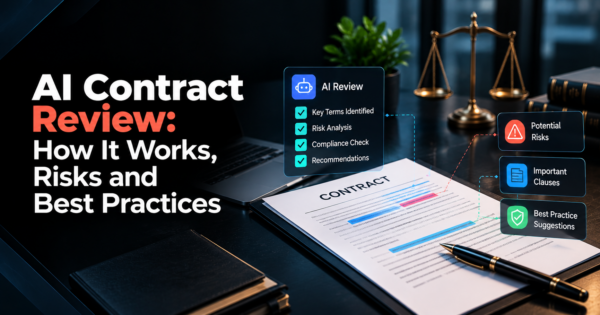
AI contract review uses language models and rules to read a contract, extract key terms such as parties, dates, payment terms, renewal and liability, compare them with your standard positions, and flag clauses that deviate or carry risk. It speeds up first-pass review. A qualified person still decides what to accept, negotiate or reject.
- AI contract review does three jobs well: extracting terms, comparing clauses with your playbook and flagging missing or unusual language.
- It does not replace legal judgment. Treat its output as a marked-up first pass for a lawyer or contract owner to confirm.
- Start with high-volume, low-risk contracts such as NDAs, order forms and renewals, where your standard positions are clear.
- Write your playbook first. A tool can only check against positions you have defined.
- Check confidentiality before uploading anything: where the data is stored, whether it trains models, who can access it and how long it is kept.
- Stanford researchers who tested commercial AI legal research tools found that hallucinations remained a problem. That study covered legal research, not contract review, but it is a reason to verify every flagged clause against the source text.
- CommercePundit builds contract workflows that connect review tools to your document storage, approvals and ERP or CRM.
What is AI contract review?
Contract review is the work of reading an agreement before you sign or renew it: finding the commercial terms, checking the risk allocation and comparing both against what your company normally accepts. AI contract review automates the reading and comparison. A model extracts the terms into structured fields, a rules layer checks them against your playbook, and the output is a short list of items that need a human decision.
It overlaps with compliance documentation because both depend on organized, searchable records, and it often sits next to the purchasing flow described in our purchase order process guide.
What can AI contract review do?
| Task | What the AI does | Human check |
|---|---|---|
| Term extraction | Pulls parties, effective date, term, renewal, notice period, payment terms and governing law into fields | Spot-check against the contract |
| Clause detection | Finds clauses such as indemnity, limitation of liability, termination, confidentiality and assignment | Confirm the clause is read in context |
| Playbook comparison | Compares each clause with your preferred, fallback and unacceptable positions | Approve fallbacks and escalate unacceptable terms |
| Missing-clause check | Flags clauses you normally require that are absent | Decide whether to add them |
| Summaries | Writes a plain-language summary and a list of key dates and obligations | Verify wording before sharing |
| Obligation tracking | Creates reminders for renewals, notices and deliverables | Confirm dates and owners |
What are the risks of using AI for contract review?
- Wrong or invented output. A model can misread a clause or state something the contract does not say. Every flag should link to the exact source text.
- Confidentiality. Contracts contain pricing, personal data and trade secrets. Review the vendor’s data handling, retention and training terms before uploading.
- Missed context. A clause can depend on a definition or exhibit elsewhere in the document or on a related agreement.
- Over-reliance. If reviewers stop reading because the tool said “low risk,” errors slip through.
- Unclear accountability. Decide who owns the final call on each contract type.
Which contracts should you start with?
| Contract type | Risk level | Good first use? | Notes |
|---|---|---|---|
| NDAs | Low to medium | Yes | Standard structure and clear playbook positions |
| Order forms and renewals | Low to medium | Yes | Key terms are dates, prices and auto-renewal |
| Vendor and SaaS agreements | Medium | Yes, with legal review | Liability, data protection and termination matter most |
| Customer master agreements | Medium to high | Assist only | Negotiation strategy needs a lawyer |
| Employment agreements | Medium to high | Assist only | Local law varies; use counsel |
| M&A, financing and litigation documents | High | No | Use qualified counsel |
| Regulated-industry contracts | High | Assist only | Compliance owners must sign off |
How do you set up AI contract review?
- Write the playbook. For each clause, define the preferred position, an acceptable fallback and what is never acceptable.
- Choose the contract types. Start with one or two high-volume types.
- Collect a test set. Use 20 to 50 past contracts with known outcomes to see where the tool is right and wrong.
- Run it alongside manual review for a month and compare results.
- Set escalation rules. Decide which flags go to legal, finance or the business owner.
- Connect storage and approvals. Link the tool to your document repository so reviewed terms and key dates flow to the right systems.
- Review quarterly. Update the playbook and re-test when contract language or risk appetite changes.
How can an AI agent monitor vendor contracts?
Review is a one-time event. Monitoring is ongoing. A vendor contract agent can read signed agreements, build a register of terms and dates, and watch for events that need action.
| Monitoring job | What the agent does | What a person does |
|---|---|---|
| Renewal alerts | Warns before auto-renewal and notice deadlines | Decides to renew, renegotiate or cancel |
| Price checks | Compares invoice prices with contract rates | Disputes discrepancies |
| Obligation tracking | Lists deliverables, service levels and reporting duties | Confirms performance |
| Spend and exposure | Totals commitments by vendor and category | Reviews concentration risk |
| Change detection | Flags amendments that differ from the base agreement | Approves or rejects the change |
These agents work best on top of structured data, which is why they are usually built with ERP and procurement systems. Our guides to AI agents in ERP and AI agent examples show similar patterns, and our AI integration services and AI automation teams build them.
What features should you look for in a tool?
Contract analysis and contract management often come from different products, so decide whether you need review, a repository with lifecycle tracking, or both. Our AI workflow automation tools and guide to integrating AI into your business help you judge how a tool fits your stack, and our enterprise software development team builds custom contract lifecycle workflows.
| Feature | Why it matters |
|---|---|
| Source-linked flags | Every finding points to the exact text so reviewers can verify quickly |
| Playbook support | Lets you encode your own preferred and fallback positions |
| Data controls | Clear storage location, retention, access controls and no training on your data without consent |
| Audit trail | Records who reviewed, changed or approved each item |
| Integrations | Connects to your document storage, e-signature, CRM and ERP |
| Export of structured data | Lets you move extracted terms into reporting and obligation tracking |
| Admin and permissions | Controls who can see sensitive contracts |
Price and features vary by vendor and change often, so request current pricing and a security review from each supplier rather than relying on a roundup.
What mistakes hurt contract review projects?
- No playbook, so the tool has nothing to compare against.
- Uploading sensitive contracts before checking data handling.
- Skipping the test set, so error rates are unknown.
- Treating the summary as the contract. The signed text governs.
- Ignoring signed contracts after review, which leaves renewals and obligations untracked.
Frequently Asked Questions
What is AI contract review?
AI contract review uses language models and rules to extract key terms from a contract, compare clauses with your standard positions and flag risks or missing language. It produces a first-pass review that a qualified person confirms.
Can AI review contracts accurately?
It can be accurate on standard terms and clear clauses, but it can also misread context or state things the contract does not say. Test it on your own past contracts and verify every flagged clause against the source text.
Will AI replace contract lawyers?
AI speeds up reading and comparison, so lawyers and contract managers spend less time on routine review and more on negotiation and judgment. Decisions about risk and strategy still need a qualified person.
What are the risks of using AI for contract review?
The main risks are incorrect or invented output, exposure of confidential information, missed context across related documents and over-reliance by reviewers. Source-linked flags, data controls and human sign-off reduce them.
Is it safe to upload contracts to an AI tool?
It depends on the vendor. Check where data is stored, how long it is kept, who can access it, whether it is used to train models and what security certifications the vendor holds. Ask your legal or security team to review before uploading.
What contracts should I start with?
Start with high-volume, lower-risk documents such as NDAs, order forms and renewals, where your standard positions are clear. Use AI as an assistant on higher-risk agreements and keep counsel in charge.
What is a contract playbook?
A playbook lists, for each clause, your preferred wording, acceptable fallbacks and positions you will not accept. AI tools compare incoming contracts against it, so a clear playbook is the foundation of good results.
How much does AI contract review software cost?
Pricing varies widely by vendor, volume and features, and many vendors quote custom pricing. Request current quotes and compare total cost, including security review and integration work.
Can AI track contract renewals and obligations?
Yes. After extracting dates, notice periods and obligations, an agent can build a register and send alerts before renewals and deadlines. A person should confirm the dates and decide the action.
How do I build an AI contract review workflow?
Write the playbook, pick one or two contract types, test on past contracts, run alongside manual review, set escalation rules and connect the tool to your document storage and approval systems.
Bottom Line
AI contract review is worth adopting when you treat it as a fast, source-linked first pass guided by your own playbook, with a person making the final call and clear data controls in place. Begin with standard contracts, measure results against past decisions, then add monitoring for renewals and obligations. If you want a review and monitoring workflow connected to your systems, talk to us about AI integration services or AI automation.