Table of Content

How is AI used in retail?
AI in retail is used mainly to forecast demand and manage inventory, personalize search and recommendations, answer customer questions, and cut manual work in stores and back offices. The uses with the best-documented return are tied to a number you can measure, such as stockouts or order value. Others, such as cashierless checkout, have been scaled back where they did not pay.
- Best-documented returns come from demand forecasting and inventory, search and recommendations, and customer service. Weaker or format-dependent returns come from cashierless checkout, dynamic pricing and returns reduction.
- Salesforce attributed $262 billion, or 20% of all retail sales, to AI and agents in the 2025 holiday season (November 1 to December 31). Its article does not explain how “influenced” is measured, so treat it as directional.
- Walmart’s CEO said on the February 19, 2026 earnings call that customers who use its Sparky assistant have an order value about 35% higher than those who do not. It is a comparison of users and non-users, not proof that Sparky caused the gap.
- Amazon scaled back Just Walk Out in its Fresh grocery stores in April 2024 and replaced it with Dash Carts, a reminder that a technology can work and still lose to a cheaper design.
- Returns are the cost AI has not fixed: Salesforce reported that 14% of holiday online purchases had already been returned, up 10% from the year before.
- Start with one measurable problem, a baseline and a human approval step. The 90-day plan below shows how.
- CommercePundit builds AI for retail and ecommerce teams, from forecasting models to shopping assistants.
How is AI used in retail today?
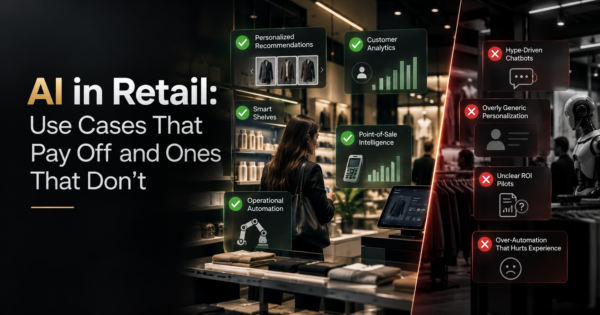
AI in the retail industry covers four jobs: knowing what to stock (forecasting and replenishment), helping shoppers find and choose (search, recommendations and assistants), serving customers faster (service agents) and reducing manual work (pricing, content and store operations). For retailers, the useful question about AI for retailers is not “where can we use AI” but “which of these has evidence of paying off, and what does it need from our data”.
| Use case | What AI does | What the evidence says | Verdict |
|---|---|---|---|
| Demand forecasting and replenishment | Predicts sales by product and store, suggests orders | Vendor-reported lifts; depends on clean sales and stock data | Pays off when data is clean |
| Search, recommendations and personalization | Ranks results and suggests products from behavior | Salesforce links AI to a fifth of holiday sales; method unclear | Pays off, measure it |
| Customer service and shopping assistants | Answers questions, tracks orders, helps choose | Walmart reports 35% higher order value for users; correlation only | Promising, test with a control group |
| Pricing and promotions | Suggests price and discount changes | No public independent evidence cited here | Depends, keep price rules and approval |
| Cashierless checkout | Detects what shoppers take using cameras and sensors | Amazon replaced it in Fresh stores with Dash Carts | Depends on store format |
| Returns reduction | Improves size, fit and product information | Returns still reached 14% of holiday purchases | Unproven, measure before scaling |
| Shelf monitoring and computer vision | Spots gaps, misplaced items and planogram errors | Few public results; requires cameras and rollout | Depends on scale |
| Generative content | Drafts product copy, images and emails | Saves time; quality and accuracy need review | Pays off with editing |
Which AI in retail use cases pay off?
1. Retail demand forecasting and replenishment
What it does: A model predicts how much of each product each store or warehouse will sell, then suggests orders and transfers. It replaces spreadsheets that miss promotions, seasons and local patterns.
Evidence: Public results are vendor-reported. A case study published by invent.ai about the footwear retailer FLO reports 12% less lost sales and 4.7% more revenue, and a Visionet case study reports $100 million lower inventory carrying costs and 87% to 94% forecast accuracy. Both are the vendors’ own claims about their own clients.
Choose it if you carry many products across stores or channels and stock errors are costly. Watch for messy product IDs and missing stock history, which break forecasts. Our guides to ecommerce inventory management and AI in logistics cover the stock and fulfillment side.
2. Search, recommendations and personalization
What it does: Orders search results, product lists and emails by what each shopper is likely to want, using browsing, purchase and catalog data.
Evidence: Salesforce’s 2025 holiday report attributes $262 billion, or 20% of all retail sales, to AI and agents through personalized recommendations and deeper customer engagement. The report does not define how “AI-influenced” is measured, and it blends first-party and third-party data with market assumptions. It is a useful sign of scale, not a result you can copy.
Choose it if you have enough traffic and catalog depth for tests to reach a result. Watch for recommending out-of-stock items and for personalization that feels invasive. See our ecommerce personalization strategies for tactics that work with first-party data.
3. Customer service and shopping assistants
What it does: Answers order, delivery and policy questions, helps shoppers compare products and hands hard cases to people.
Evidence: Walmart’s CEO John Furner said on the fourth-quarter earnings call on February 19, 2026 that customers who use the Sparky assistant have an order value about 35% higher than customers who do not, and a Walmart executive said about half of app users have tried it (Modern Retail). The report gives no method and does not say whether users and non-users are otherwise alike, so shoppers who already spend more may simply be more likely to use the assistant.
Choose it if support volume is repetitive and your order and policy data is accessible. Watch for assistants that invent policy or stock details. Read AI chatbots for ecommerce before choosing a tool.
Which AI retail use cases depend on your store?
4. Pricing and promotions
What it does: Suggests price and discount changes using demand, competitor prices and stock levels.
Choose it if you have many products and frequent price changes. Watch for automatic changes without limits. Set floors, ceilings and an approval step for large moves, and track customer complaints and margin, not only sales.
5. Cashierless checkout and store automation
What it does: Cameras and sensors detect what a shopper takes, so no scan is needed at the register.
Evidence: Amazon announced in April 2024 that it would remove Just Walk Out from its Amazon Fresh grocery stores and move to Dash Carts, where shoppers scan items with a camera on the cart; reports counted 27 of 44 Fresh locations affected, with Just Walk Out continuing at Amazon Go and at more than 130 third-party venues (Retail Dive). Amazon cited customer feedback. The lesson is about fit: a technology that works in a small convenience format may not suit a large grocery trip.
Choose it if your store is small, fast-turn and high-traffic. Watch for installation cost, store redesign and shopper habits.
6. Returns reduction
What it does: Improves size and fit guidance, product descriptions and images so fewer items come back.
Evidence: Salesforce reported that more than $181 billion of global online purchases made between November 1 and December 31, 2025 had already been returned, about 14% of all purchases and 10% more than the year before. We found no independent study showing that AI tools cut that rate.
Choose it if returns for fit or “not as described” are your largest cost. Watch for claims of reduced returns without a before-and-after baseline.
7. Shelf monitoring and computer vision
What it does: AI in retail stores mostly shows up as shelf monitoring, checkout technology and staff tools. Cameras spot empty shelves, misplaced products and price-tag errors, and alert staff.
Choose it if you run many stores and manual shelf checks are expensive. Watch for hardware rollout, privacy rules for in-store cameras and false alerts that train staff to ignore the system. Our AI solutions for ecommerce team builds these systems with retailers.
8. Generative AI in retail: content and merchandising
What it does: Drafts product descriptions, category copy, emails and ad variants, and helps merchandisers summarize reviews.
Choose it if your catalog is large and copy is thin or inconsistent. Watch for made-up specifications and generic wording. Keep a person approving anything that states a material, size, claim or price. Our list of generative AI examples shows how other companies use it.
What do the big retail AI numbers really mean?
- “$262 billion influenced by AI.” This is Salesforce’s estimate across more than 1.5 billion shoppers in 89+ countries, and the article does not say how influence was measured. Use it as scale, not as an expected return.
- “35% higher order value for Sparky users.” A company claim comparing users with non-users, with no method given.
- “12% less lost sales.” A vendor case study about one client.
- “Brands with shopper agents grew 6.2% vs 3.9%.” Salesforce says brands such as Pandora, SharkNinja and Funko that deployed their own AI agents averaged 6.2% year-over-year sales growth compared with 3.9% for others. Companies that invest in agents may differ in other ways too.
The practical rule: ask for the baseline, the comparison group and the time period before you accept any figure, including ours.
What is agentic AI in retail?
Agentic AI in retail refers to systems that act for the shopper or the retailer across several steps: finding a product, comparing options, checking stock and completing a purchase, or reordering inventory within a budget. Shopper-facing agents are new, and the evidence is early. Our guide to agentic commerce on Magento, WooCommerce and BigCommerce covers what store owners can prepare now, and our complete guide to AI in ecommerce covers the online side of the same shift.
How should a retailer start with AI in 90 days?
| Period | Focus | Output |
|---|---|---|
| Days 1 to 14 | Pick one problem with a number: stockouts, search conversion, support wait time or lost sales. Measure the baseline. | A baseline report and a target |
| Days 15 to 30 | Audit the data: product IDs, stock history, orders, customer service logs. Fix the gaps that block the use case. | A clean dataset and a data owner |
| Days 31 to 60 | Run a pilot in a few stores, categories or customer segments, with a control group and human approval. | Pilot results against the baseline |
| Days 61 to 90 | Decide: scale, adjust or stop. Document costs, errors and staff feedback. | A go or no-go decision with evidence |
If you want a partner to run the pilot, see our AI development services, AI integration services and predictive analytics services.
What are the risks of AI in retail?
- Bad data. Wrong stock counts or duplicate products produce confident wrong answers.
- Privacy. Personalization, in-store cameras and loyalty data come with consent and retention rules that vary by region.
- Made-up information. Assistants can state policies, sizes or stock that are not true. Ground them in your own data and test them.
- Over-automation. Price changes and refunds should have limits and approvals.
- Workforce change. Press summaries of the World Economic Forum’s 2025 Future of Jobs report say cashiers and ticket clerks are projected to see the largest decline among occupations. Plan training and role changes early.
Frequently Asked Questions
How can you use AI in retail?
Common uses are demand forecasting and replenishment, search and product recommendations, customer service and shopping assistants, pricing and promotion suggestions, and product content. Start with one problem that has a number you can measure, such as stockouts or support wait time.
What are five applications of AI in retail?
Demand forecasting, personalized recommendations, customer service assistants, shelf and inventory monitoring, and generative content for product pages and emails. Each needs different data, so pick the one that matches the problem you already have.
What are some AI in retail examples?
Walmart’s Sparky shopping assistant, personalized recommendations tied to Salesforce’s holiday sales figures, Amazon’s Just Walk Out checkout and Dash Carts, and forecasting systems from vendors such as invent.ai and Visionet. Most results are company-reported, so check the baseline.
How does AI help retail inventory?
Models predict demand by product and location, suggest reorder quantities and flag items likely to run out or overstock. The result depends on clean sales, stock and supplier data. Vendor case studies report fewer lost sales, but results differ by retailer.
What is generative AI in retail?
Generative AI in retail creates content such as product descriptions, category copy, emails and ad variants, and can summarize reviews for merchandisers. Review the output for invented specifications, claims and prices before publishing.
What is agentic AI in retail?
Agentic AI in retail means systems that carry out multi-step tasks, such as helping a shopper compare products and buy, or reordering stock within a budget. Shopper-facing agents are new, so test with approvals and a control group.
What are the benefits of AI in retail?
The documented benefits are better stock decisions, more relevant search and recommendations, faster service on repetitive questions, and less manual content work. Benefits depend on data quality and on measuring against a baseline.
Will AI replace retail jobs?
AI will change tasks more than it removes whole jobs, but some roles are exposed. Press summaries of the World Economic Forum’s 2025 report list cashiers and ticket clerks among the occupations projected to decline most. Retailers should plan retraining along with any rollout.
Is AI worth it for a small retailer?
It can be, if you use tools built into your platform, such as search, recommendations or support assistants, and you measure results. Custom models rarely pay off at small scale. Begin with one use case and a clear baseline.
Why did Amazon remove Just Walk Out from some stores?
Amazon said customer feedback drove the move in its Fresh grocery stores, where it replaced Just Walk Out with Dash Carts that scan items as shoppers add them. Just Walk Out continued in Amazon Go and at third-party venues, so the decision was about fit for large grocery trips.
Bottom Line
The strongest AI in retail uses are the ones tied to a number you can measure: stock decisions, search and recommendations, and repetitive customer questions. Be cautious with big headline figures and with technology that depends on a store format. Pick one problem, set a baseline, keep a human approving anything that changes prices or money, and decide on evidence after 90 days. If you want help building it, talk to us about AI solutions for ecommerce.