Table of Content

What is an ETL tool?
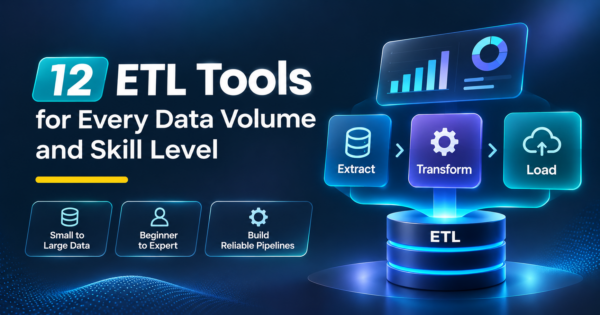
An ETL tool extracts data from source systems such as databases, SaaS apps and files, transforms it (cleans, joins and reshapes it) and loads it into a destination such as a data warehouse. Many modern tools load first and transform inside the warehouse, which is called ELT. Either way, the tool replaces hand-written scripts with scheduled, monitored data pipelines.
TL;DR
- The best ETL tool depends on your stack, your volume and who will run it. This list covers 12 tools grouped by type: managed services, open-source platforms, cloud-native services, enterprise suites and a few specialist pieces.
- Two of the 12, Apache Airflow and dbt, are not full ETL tools. Airflow orchestrates jobs and dbt handles the transform step. They are here because most stacks include them.
- Pick the group first. In our weighted example, a managed service wins for a small team with no data engineers, and an open-source or cloud-native option wins for an engineering-led team that is cost-sensitive. The weights decide, not the brand.
- Open source is not free. In our cost model, a self-hosted pipeline is more expensive than a managed one at low volume and cheaper at high volume, because engineer time is the largest cost.
- Pricing models and connector lists change often. This guide describes models in general terms; confirm current prices and connectors on each vendor’s site and run a two-week proof of concept with your own data.
- AI features such as schema mapping and failure summaries save time but do not replace data quality tests.
- CommercePundit builds data pipelines and the dashboards on top of them. See the last section.
ETL vs ELT: what is the difference?
| ETL | ELT | |
|---|---|---|
| Order of steps | Extract, transform in a separate engine, then load | Extract, load raw data into the warehouse, then transform there |
| Where transformation runs | On the ETL tool’s servers or a processing cluster | Inside the warehouse, usually with SQL |
| Good fit | Strict cleansing before data lands, sensitive data handling, legacy systems | Cloud warehouses with cheap storage and compute, fast iteration by analysts |
| Trade-off | More moving parts to run and scale | Raw data sits in the warehouse, so access controls matter |
| Typical tools | SSIS, Informatica, Talend, NiFi | Fivetran, Airbyte, Hevo with dbt in the warehouse |
The two are not rivals. Many teams use ELT for analytics and ETL for a few pipelines that must clean or mask data before it is stored. Most products on this list can do either; what differs is the default.
Which ETL tool should you look at first?
| Your situation | Look first at | Why |
|---|---|---|
| Small team, analysts but no data engineers, mainstream SaaS sources | Managed services (Fivetran, Hevo) | Connectors are maintained for you |
| Engineers on staff, many or unusual sources, cost control matters | Open source platforms (Airbyte, NiFi) with Airflow and dbt | Control and no per-row license fees, in exchange for operations work |
| Data already lives in one cloud | That cloud’s service (AWS Glue, Azure Data Factory) | Native security, billing and integration |
| SQL Server shop with on-premises sources | SSIS | Included with SQL Server licensing and familiar to the team |
| Large regulated enterprise with governance needs | Informatica or Qlik Talend | Data quality, lineage and compliance features |
| Warehouse-centric team that wants visual development | Matillion | Pushes work down to the warehouse with a visual designer |
| You already have extraction but need modeling | dbt | Handles the transform step with tested SQL |
What are the best ETL tools?
The table compares the 12 tools at a glance. Pricing models are described in general terms, because plans change; confirm current details with each vendor. Names are listed in groups, not ranked.
| Tool | Group | Deployment | Pricing model (general) | Best fit |
|---|---|---|---|---|
| Fivetran | Managed service | Hosted by the vendor | Usage-based, tied to data volume | No-maintenance connectors for analytics teams |
| Airbyte | Open-source platform | Self-hosted or hosted cloud | Free to self-host; paid cloud plans | Engineering-led teams that want control |
| Hevo Data | Managed service | Hosted by the vendor | Subscription tiers by volume | Smaller teams wanting no-code pipelines |
| Matillion | Managed or cloud-native | Runs against a cloud warehouse | Credit-based plans | Warehouse-centric teams with a visual designer |
| Informatica | Enterprise suite | Cloud platform | Enterprise subscription | Large regulated organizations |
| Qlik Talend | Enterprise suite | Cloud and on-premises | Subscription | Governance-heavy integration |
| AWS Glue | Cloud-native service | AWS | Pay for job run time | Data already on AWS |
| Azure Data Factory | Cloud-native service | Azure | Pay for activity runs and data movement | Microsoft-stack organizations |
| SSIS | On-premises tool | Windows and SQL Server | Included with SQL Server licensing | SQL Server shops |
| Apache NiFi | Open-source platform | Self-hosted | Free; you pay for hosting and operations | Flow-based routing, files and event data |
| Apache Airflow | Orchestrator (not full ETL) | Self-hosted or managed offerings | Free; you pay for hosting | Scheduling and monitoring pipelines in code |
| dbt | Transform layer (not full ETL) | Runs in your warehouse | Free core; paid hosted product | SQL transformations with tests |
1. Fivetran
Fivetran is a managed ELT service. Its connectors are maintained by the vendor, and it handles changes in source schemas automatically. Comparisons commonly note usage-based billing tied to data volume.
Best for: analytics teams that want pipelines without maintaining connectors. Watch out: cost grows with volume, and you control less of how data lands, so pair it with a transformation layer such as dbt.
2. Airbyte
Airbyte is a data movement platform with a large and growing connector catalog and a hosted cloud option. Its core can be self-hosted. Comparisons describe the core as source-available under the Elastic License 2.0 with the protocol under MIT, so check the license against your use.
Best for: engineering-led teams that want control or custom connectors. Watch out: self-hosting needs infrastructure skills, and connector quality varies by source.
3. Hevo Data
Hevo Data offers managed, no-code pipelines with some transformation while data is in flight, aimed at smaller teams that want a quick start.
Best for: small teams that need dependable pipelines without engineers. Watch out: confirm that the connectors you need exist and what the volume limits are on your plan.
4. Matillion
Matillion is a cloud-native, visual tool built around cloud warehouses. It pushes transformation work down into the warehouse and lets teams mix visual steps with SQL and code. Plans are generally credit-based and there is no open-source edition.
Best for: warehouse-centric teams where analysts and engineers work together. Watch out: credit use can be hard to forecast, so model it on a trial.
5. Informatica
Informatica sells an enterprise data integration platform that combines integration with data quality, governance and master data management.
Best for: large organizations with strict governance and many systems. Watch out: cost and implementation effort are higher than for lightweight tools, and most buyers use an implementation partner.
6. Qlik Talend
Talend joined Qlik in 2023 and offers data integration with data quality features. It suits teams that want visual design plus governance in one product line.
Best for: governance-heavy integration across cloud and on-premises systems. Watch out: product packaging has changed since the acquisition, so confirm what is included in current plans.
7. AWS Glue
AWS Glue is a serverless ETL service built on Spark, with a data catalog. It integrates natively with S3, Redshift and other AWS services and bills for the time jobs run.
Best for: teams whose data already lives on AWS. Watch out: it ties you to AWS and has a steeper learning curve than point-and-click tools. Our AWS cloud managed services team can help set it up.
8. Azure Data Factory
Azure Data Factory is Microsoft’s cloud service for building data pipelines and moving data between many sources. It bills mainly for activity runs and data movement.
Best for: organizations built on the Microsoft stack. Watch out: heavy transformation is often handled by other Azure services, so the full cost includes more than the factory itself.
9. SQL Server Integration Services (SSIS)
SSIS is Microsoft’s long-established ETL tool and is included with SQL Server licensing. It is a strong choice for SQL Server environments with on-premises sources.
Best for: SQL Server shops with existing packages and skills. Watch out: it is built around Windows and SQL Server and is less natural for cloud-first stacks.
10. Apache NiFi
Apache NiFi is an open-source tool for building data flows visually, with strong support for routing, files and event data.
Best for: flow-based integration and data in motion. Watch out: you run and scale it yourself, and it is not a warehouse modeling tool.
11. Apache Airflow
Apache Airflow is an open-source orchestrator. You define workflows as Python code, and it schedules, runs and monitors tasks. It is not an ETL tool on its own, but many ETL pipelines run under it.
Best for: engineering teams that want pipelines as code with dependencies and retries. Watch out: it needs hosting and engineering skill, and it does not move data by itself.
12. dbt
dbt handles the transform step of ELT. You write SQL models, and it builds them in your warehouse with tests and documentation. It does not extract or load data, so it pairs with a tool such as Fivetran or Airbyte.
Best for: analytics teams that want tested, version-controlled SQL transformations. Watch out: it is one piece of the stack, not a full pipeline.
How do the weights change the answer?
Score each group from 1 to 5 against criteria that matter to you, then weight the criteria so they add to 100. The scores below describe hypothetical archetypes, not ratings of any product. The point is how the weights move the result.
| Criterion | Weight: small team | Weight: engineering-led | Managed service | Open-source platform | Cloud-native service | Enterprise suite |
|---|---|---|---|---|---|---|
| Ease of setup | 25 | 10 | 5 | 2 | 3 | 2 |
| Connector coverage | 20 | 15 | 5 | 4 | 3 | 4 |
| Low maintenance | 25 | 10 | 5 | 2 | 4 | 3 |
| Cost at scale | 15 | 25 | 2 | 4 | 4 | 1 |
| Control and flexibility | 5 | 30 | 2 | 5 | 4 | 3 |
| Governance and security | 10 | 10 | 3 | 3 | 4 | 5 |
| Weighted score: small team, no engineers | 4.20 | 2.95 | 3.55 | 2.85 | ||
| Weighted score: engineering-led, cost-sensitive | 3.15 | 3.80 | 3.75 | 2.75 |
For the small team the managed service scores 4.20 and leads, because setup, connectors and low maintenance carry 70% of the weight. For the engineering-led team the open-source platform scores 3.80, just ahead of the cloud-native service at 3.75, because cost and control now carry 55%. Agree the weights with the people who will run the pipelines before anyone scores a product; otherwise the scoring just confirms a preference.
Is open source cheaper than a managed ETL service?
Often not at small scale, because the largest cost is the engineer time that keeps the pipelines running. The model below is illustrative. The monthly fees, hours and an engineer cost of $90 per hour are assumptions, so replace them with your quotes.
| Cost line | Managed service, low volume | Self-hosted open source, low volume | Managed service, high volume | Self-hosted open source, high volume |
|---|---|---|---|---|
| Platform or usage fee | $2,000 | $0 | $6,000 | $0 |
| Infrastructure | included | $600 | included | $900 |
| Maintenance hours per month | 2 | 25 | 2 | 25 |
| Maintenance cost at $90 per hour | $180 | $2,250 | $180 | $2,250 |
| Total per month | $2,180 | $2,850 | $6,180 | $3,150 |
At low volume the managed service costs $2,180 a month against $2,850 for self-hosting, so open source is the more expensive option. At high volume the managed fee grows to $6,000 while self-hosting costs $3,150, so open source wins. In the low-volume case, self-hosting would only break even if maintenance fell below about 18 hours a month. Do the same arithmetic with a real quote before you commit.
When do you need reverse ETL?
ETL and ELT move data into the warehouse. Reverse ETL moves modeled data back out into the tools where people work, such as a CRM, an ad platform or a support desk, so a sales team sees a customer health score inside the CRM and not in a dashboard they never open. Dedicated tools such as Hightouch and Census exist in this category, and some ELT vendors now offer it. Start with it when a clear business team needs warehouse data inside an operational tool and you already trust the data. Our guides to CRM and ERP integration and data enrichment tools cover the systems on the receiving end.
How do you choose the right data pipeline tools in two weeks?
| Days | Do this | Output |
|---|---|---|
| 1 to 2 | List your sources, destination, volume per month, refresh needs and who will operate the pipelines | A one-page requirement sheet |
| 3 to 4 | Shortlist three tools from different groups; check connectors for your top five sources | A shortlist with gaps noted |
| 5 to 9 | Build the same two pipelines in each tool with real (or masked) data; record setup time and problems | Comparable results |
| 10 to 11 | Estimate monthly cost at your volume and at triple the volume | A cost range per tool |
| 12 to 14 | Test failure handling: change a schema, break a source, restart a job; check alerts and logs | A reliability view and a recommendation |
The data you load usually feeds reports, so design the reporting side at the same time: see our Power BI dashboard examples, Google Analytics dashboard examples and Shopify analytics dashboards. Moving data between systems rather than into a warehouse is covered in our guide to data migration tools, and our Odoo ecommerce integrations and ecommerce ERP integration posts cover store and ERP data.
How does AI help with ETL?
- Mapping and code. Assistants can suggest field mappings and draft SQL or transformation code from a description. Review every mapping, because a plausible join on the wrong key quietly corrupts a report.
- Failure triage. Summaries of pipeline errors and likely causes shorten the time to fix a broken job.
- Documentation. Generated descriptions of tables and models help new team members, as long as someone checks them.
Keep automated data quality tests (null checks, row counts, uniqueness, freshness) in the pipeline whatever the AI suggests. Our AI integration services connect data pipelines to the AI assistants that use them.
What mistakes do teams make when choosing ETL tools?
| Mistake | What happens | Fix |
|---|---|---|
| Choosing by connector count alone | The three sources you need are the weak ones | Test your top five sources in a proof of concept |
| Ignoring engineer time | Open source looks free and ends up costlier | Model maintenance hours at a real hourly cost |
| Skipping data quality tests | Wrong numbers reach dashboards before anyone notices | Add freshness, volume and uniqueness tests to every pipeline |
| One tool for everything | A big-company suite for a small stack, or a light tool for a regulated one | Match the group to the size and governance need |
| No cost forecast at 3x volume | The bill surprises you after launch | Estimate cost at triple the volume during the trial |
| Treating Airflow or dbt as a full ETL tool | Nobody has built the extraction | List extraction, loading, orchestration and transformation separately |
Frequently Asked Questions
What is an ETL tool?
An ETL tool extracts data from sources, transforms it and loads it into a destination such as a data warehouse. It replaces ad hoc scripts with scheduled, monitored pipelines.
What is the difference between ETL and ELT?
ETL transforms data before loading it into the destination. ELT loads raw data first and transforms it inside the warehouse. ELT is common with cloud warehouses, and many tools can do both.
What are examples of ETL tools?
Examples include Fivetran, Airbyte, Hevo Data, Matillion, Informatica, Qlik Talend, AWS Glue, Azure Data Factory, SSIS and Apache NiFi, with Apache Airflow and dbt commonly used alongside them for orchestration and transformation.
Is AWS an ETL tool?
AWS offers AWS Glue, a serverless ETL service, along with other services that move and process data. AWS as a whole is a cloud platform, not a single ETL tool.
What are the best open source ETL tools?
Airbyte and Apache NiFi are open-source platforms for moving data, Apache Airflow orchestrates jobs and dbt handles transformations. Check each license against your use, and count the engineering time to run them.
Is SQL an ETL tool?
No. SQL is a language. You can transform data with SQL, and tools such as dbt run SQL models in a warehouse, but you still need a way to extract and load data and to schedule the work.
How much do ETL tools cost?
Prices vary widely by model: usage-based, credit-based, subscription, per-job or free with hosting costs. Compare total cost at your volume and at three times your volume, including engineer time.
Do I need an ETL tool to build a dashboard?
Not always. A dashboard can connect straight to one source. Once you combine several sources or need history and clean data, a pipeline into a warehouse saves a lot of manual work.
Can AI replace an ETL tool?
No. AI can help write mappings and explain failures, but you still need reliable extraction, scheduling, monitoring and data quality checks that run the same way every time.
Bottom Line
There is no single best ETL tool. Pick the group that matches your team and stack, weight the criteria that matter to you, model total cost including engineer time, and prove the choice with a two-week trial on your own data. If you want pipelines designed and built so the dashboards on top can be trusted, talk to us about our business intelligence dashboard services.