Table of Content

What is an AI governance framework?
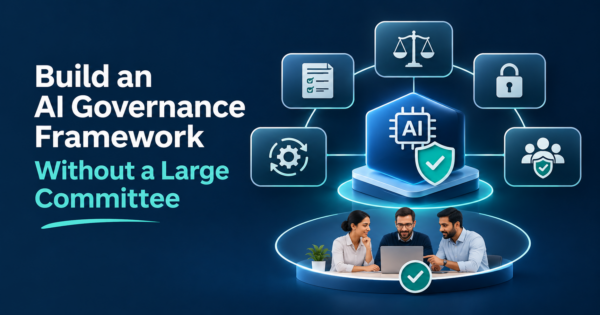
An AI governance framework is a short set of rules, owners and checks that decides which AI tools your business may use, what data they may touch and who reviews their output. A lean version needs one accountable executive, one policy owner, risk tiers, an approved tools list, human review steps, an audit trail and an incident process.
TL;DR
- An AI governance framework is a written policy, a named owner and a few repeatable checks. A mid-size business can run one without a standing committee.
- Name one accountable executive and one policy owner. The NIST AI Risk Management Framework asks that leadership take responsibility for AI risk decisions and that roles be documented. It does not ask for a committee.
- Sort every AI use into a risk tier. Drafting internal notes needs a light rule. Decisions about people, regulated data and systems that act on their own need approval, human review and logging.
- Keep an approved tools list and an inventory of AI systems, so you know what is running and who answers for it.
- Borrow the structure of the NIST framework (Govern, Map, Measure, Manage) and use ISO/IEC 42001 as a reference for running governance as a repeating cycle.
- Copy the one-page AI governance policy outline below, fill in the brackets and review it every quarter.
- If you want the controls built into your systems, such as access rules, logging and human approval steps, that is AI integration work our team handles.
- This guide is general information, not legal advice. Have counsel review your final policy.
What is an AI governance framework?
AI governance is the set of decisions, rules and responsibilities that control how a business chooses, uses and monitors AI. An AI governance framework is the written structure that turns those decisions into something people can follow: who is accountable, which tools are allowed, what data they may handle, when a person must review the output and what happens when something goes wrong.
People who search for a responsible AI framework are usually after the same thing from the ethics side. A responsible AI framework states principles such as fairness and transparency. A governance framework adds the operating detail: owners, approvals, records and enforcement. NIST lists seven characteristics of trustworthy AI in its AI Risk Management Framework: valid and reliable, safe, secure and resilient, accountable and transparent, explainable and interpretable, privacy enhanced, and fair with harmful bias managed. Use them as your principles, and use the rest of this guide to make them operational.
Why do mid-size businesses need AI governance without a large committee?
Most published AI governance guidance assumes a large company with a risk office, a legal department and a standing AI council. A mid-size business usually has none of those, yet its staff can paste customer data into a public chatbot or connect an agent to a shared drive in a few minutes. The risk starts before any formal AI project does.
A committee is one way to get accountability, but it is not the requirement. The NIST framework asks that roles, responsibilities and lines of communication for AI risk be documented and clear (its GOVERN 2.1 subcategory) and that executive leadership take responsibility for decisions about AI risk (GOVERN 2.3). It names no committee. You can meet both with named people, short written rules and a recurring review.
If you are still deciding which processes to automate, our guide to AI automation for small businesses covers where to start. This guide covers the rules to put around whatever you choose.
How do the NIST AI RMF and ISO/IEC 42001 fit into an AI governance framework?
Two published sources do most of the work, and neither needs to be adopted in full. NIST publishes the AI Risk Management Framework (AI RMF) for voluntary use. ISO publishes ISO/IEC 42001, an international standard for an AI management system. Both are written for organizations of any size, so you can borrow the parts that fit.
| Source | What it is | What to use it for |
|---|---|---|
| NIST AI RMF | A voluntary framework from the US National Institute of Standards and Technology. Its core has four functions: Govern, Map, Measure and Manage. Govern applies across all stages of AI risk management. | The structure of your framework and the questions to ask about each AI use. |
| NIST Generative AI Profile (NIST-AI-600-1) | A companion profile that helps organizations identify the risks specific to generative AI and suggests actions to manage them. | Tailoring your risk tiers for chatbots, writing tools and image generators. |
| NIST AI RMF Playbook | Suggested actions and references for each outcome in the four functions. NIST says to borrow as many or as few suggestions as fit your use case. | Choosing controls from a list instead of inventing them. |
| ISO/IEC 42001 | An international standard that specifies requirements for establishing, implementing, maintaining and continually improving an AI management system. ISO says it applies to organizations of any size that provide or use AI. | The habit of running governance as a cycle of policy, objectives, operation and improvement, and a reference point if customers ask which standard you follow. |
Use the NIST functions as the headings of your framework. Govern covers policy, roles and the inventory. Map describes each AI use and its context. Measure tests whether the system works and is safe. Manage covers monitoring, response and retirement. Use the ISO/IEC 42001 idea of a management system to justify a standing review, so the framework does not go stale after the first draft. Whether to pursue formal certification later is a separate decision, and nothing here requires it.
NIST states that AI RMF 1.0 is being revised, so check nist.gov for the current version before you quote section numbers in your own policy. The full text of ISO/IEC 42001 is sold by ISO, so read its overview and preview before deciding whether to buy it.
Who owns AI governance when you have no committee?
Replace the committee with six roles. Most of them are hats worn by people who already work for you, and one person can hold more than one, apart from the executive sponsor and the policy owner, who should be different people so the owner has someone to escalate to.
| Role | Owns | Decides |
|---|---|---|
| Executive sponsor (CEO, COO or similar) | Accountability for AI risk across the business. | Approves every high-risk use and any exception to the policy. |
| Policy owner (one named manager) | The AI governance policy, the approved tools list and the AI inventory. Runs the quarterly review. | Approves low-risk and medium-risk tools and use cases. |
| IT or security lead | Access controls, data connections, logging and the ability to switch a system off. | Whether a tool meets security and data requirements. |
| Legal or compliance reviewer (outside counsel is fine) | Legal, contract and privacy duties tied to AI use and vendor terms. | Whether a high-risk use or vendor contract can proceed, and who must be told after an incident. |
| Business owner of each AI use | Day-to-day accuracy, human review of output and the inventory entry for that system. | Whether the output is good enough to use. |
| Every employee | Following the policy, using approved tools and reporting problems. | Nothing alone. Asks the policy owner when unsure. |
The standing review replaces the committee meeting. Hold it quarterly, keep it short and use a fixed agenda: new tools requested, inventory changes, incidents, vendor renewals and policy changes.
How do you set AI risk tiers?
Risk tiers let you spend review effort where it matters. NIST asks that the level of risk management activity match the organization’s risk tolerance (GOVERN 1.3), and tiers are the practical way to do that. Assign the tier when a use is approved, and base it on the highest-risk fact about the use, not the average.
| Tier | What qualifies | Examples | Required controls |
|---|---|---|---|
| Tier 1: low | Internal use, no personal, customer or confidential data, and nothing happens without a person acting on it. | Drafting internal notes, summarizing public articles, brainstorming. | Approved tools only. Follow the data rules. |
| Tier 2: medium | Uses internal business data, or produces customer-facing content that a person edits before it goes out. | Support reply drafts, sales email drafts, internal knowledge search. | Named business owner. Sampled human review. Usage logs kept. Inventory entry. |
| Tier 3: high | Affects people or money, touches regulated or sensitive data, or acts on systems without a person approving each step. | Screening job applicants, credit or pricing decisions about individuals, agents that update records or send messages, health or financial data. | Executive sponsor approval. Legal review. Human approval before action. Full audit trail. Testing before launch and after every change. A way to switch it off. |
| Tier 4: not permitted | Anything the policy bans. | Entering restricted data into a tool that is not approved. Final decisions about people with no human review. | Blocked. Report it if found. |
When a use sits between two tiers, pick the higher one until the policy owner and the business owner agree it can come down.
What should an AI governance policy include?
An AI governance policy is the one document everyone reads, so keep it to a single page and link out to the approved tools list and the inventory. That way the policy does not need amending every time a tool changes. Copy this outline, replace the bracketed fields and have counsel review it before you publish it to staff.
One-page AI governance policy outline
- Purpose and scope. This policy covers every AI tool and AI feature used by [company name] staff and contractors, including AI features inside software we already use.
- Accountability. [Executive name] is accountable for AI risk. [Policy owner name] maintains this policy, the approved tools list and the AI inventory.
- Approved tools. Staff use only tools on the approved tools list. New tools are requested through [form or process] and approved by the policy owner and the IT lead.
- Data rules. [Restricted data classes] may never be entered into a tool unless the approved tools list clears that tool for that class of data.
- Risk tiers. Every AI use is assigned a tier. Tier 3 uses need approval from the executive sponsor and legal review before launch.
- Human review. A named person reviews AI output before it reaches a customer, a regulator or a decision about a person.
- Vendor review. Each AI vendor is reviewed against the vendor checklist before approval and again at renewal.
- Records and audit trail. Each tier 2 and tier 3 system records who used it, what for, which version and who reviewed the output. Records are kept for [retention period].
- Incidents. Staff report suspected AI incidents to [contact] immediately. The incident process in [document] applies.
- Training and review. Staff complete AI use training at [frequency]. The policy owner reviews this policy and the inventory every [interval] and after any tier 3 incident.
A policy that nobody can find or follow fails quietly. Publish it where staff already look, name the policy owner in it and add a one-line way to ask whether a tool is allowed.
How do you build an approved tools list and an AI inventory?
The approved tools list says what staff may use. The inventory records every AI system actually running. NIST names the inventory as a governance mechanism of its own (GOVERN 1.6), because you cannot govern what you cannot see.
For each approved tool, record the tool, the use it is approved for, the data classes it may handle, who approved it, who owns it and when it is next reviewed. For each system in the inventory, add its risk tier, the vendor, the systems it connects to and the date of its last review. A shared spreadsheet is enough to start.
Build the first version with a short sweep. Ask each department head what AI they use, then have IT check software subscriptions, browser extensions and the AI features switched on inside existing products. Expect to find tools nobody mentioned. Approve, restrict or retire each one instead of punishing the people who found it useful.
Tools that connect to your files, email or databases deserve a stricter entry, because the permissions you grant decide what they can read and change. Our guide to MCP servers for business covers permissions and prompt injection risks for those connections.
What data rules does an AI governance framework need?
Data rules are the part of an AI governance framework that prevents the most common mistake: sensitive information going into a tool that was never cleared for it. Keep the rules short enough to remember.
- Use three data classes. Public, internal and restricted. Restricted covers customer personal data, financial and health records, credentials and trade secrets.
- Match classes to tools. The approved tools list states which class each tool is cleared for. Anything not listed is cleared for public data only.
- Never paste restricted data into a tool that is not approved for it. That includes consumer chat tools used on a personal account.
- Mask personal identifiers before testing. Use sample or masked records when trying a new use case.
- Set retention for prompts and outputs. Decide how long each tier keeps them, and who can read them.
- Check the contract. The vendor terms decide whether your inputs can be kept or used to train a model, so settle that before approval, not after.
Privacy law, sector rules and contract terms still apply to anything you feed an AI tool. The NIST framework asks that legal and regulatory requirements involving AI be understood, managed and documented (GOVERN 1.1), which is a job for your legal reviewer.
How should human review and the audit trail work?
Human review means a named person checks AI output before it is used. The right amount depends on the tier. Tier 1 needs none beyond common sense. Tier 2 needs sampled review, for example the business owner reading a set of outputs each week. Tier 3 needs a person to approve each consequential output or action before it happens. The NIST framework asks that processes for human oversight be defined, assessed and documented (MAP 3.5) and that policies differentiate the roles and responsibilities for human and AI work (GOVERN 3.2).
Systems that act on their own need the strictest version. The NIST framework also asks for mechanisms, with assigned responsibility, to supersede, disengage or deactivate an AI system that performs outside its intended use (MANAGE 2.4). In practice that means a switch someone can use without a meeting. Budget for review and monitoring when you price an agent build, and see our guide to AI agent development cost for what drives that price.
The audit trail is the record that lets you explain what happened afterward. For each tier 2 and tier 3 system, record:
- Who used the system and when.
- What it was used for and which version or model produced the output.
- What kind of data went in, by class, not the data itself where you can avoid it.
- Who reviewed the output and what they decided.
- Any override, shutdown or exception, with the reason and the approver.
How do you review AI vendors?
Vendor review is where a small team gets the most protection for the least effort, because most AI your business uses comes from someone else. The NIST framework asks for policies that address risks from third-party entities, including intellectual property risks (GOVERN 6.1), and for contingency processes when third-party AI or data fails (GOVERN 6.2). Ask every vendor the same questions and keep the answers with the inventory entry:
- Does the vendor use your inputs or outputs to train its models, and can you opt out in writing?
- Where is data processed and stored, and which subprocessors touch it?
- Can you export your data and logs, and delete them when you leave?
- What security evidence does the vendor offer, such as independent audit reports?
- What does the contract say about liability for errors, intellectual property claims and breach notification?
- How does the vendor tell you about model changes and incidents?
- Can you turn the feature off if it misbehaves?
If you commission a custom system instead of buying one, put the same requirements into the contract with whoever builds it. Our AI development services work from a written scope, so these requirements belong in it from the start.
What should an AI incident process look like?
An AI incident is any case where an AI system leaks data, produces harmful or wrong output that reached a customer or a decision, or acts outside its approved use. Write the process before you need it, and keep it to six steps:
- Report. Give staff one channel and a no-blame rule, so problems surface early.
- Contain. Pause the system or cut its connection. The NIST framework asks for a way to deactivate a system that behaves outside its intended use (MANAGE 2.4).
- Assess. Use the audit trail to see what data, which people and which decisions were affected.
- Notify. The legal reviewer decides who must be told, such as customers, partners or regulators, based on your obligations.
- Fix and restore. Correct the cause, test it and bring the system back only with the policy owner and business owner agreeing.
- Record and review. Document what happened. The NIST framework asks that incident tracking, response and recovery processes be followed and documented (MANAGE 4.3). Update the policy if it missed something.
How do you roll out an AI governance framework in a month?
A lean AI governance framework fits in four weeks of part-time effort:
- Week one. Name the executive sponsor and the policy owner. Survey departments for the AI tools in use.
- Week two. Draft the data classes, the risk tiers and the approved tools list. Start the inventory.
- Week three. Run vendor reviews for tier 2 and tier 3 tools. Switch on logging. Send the draft policy to your legal reviewer.
- Week four. Train staff, publish the policy, set the quarterly review date and test the incident process with one practice scenario.
If you want an outside review of the draft or help deciding which uses belong in tier 3, an AI consulting engagement can cover it. Our guide to AI consulting services explains what such an engagement includes.
Frequently Asked Questions
What is a good AI governance framework?
A good AI governance framework is one people actually follow. It names an accountable executive and a policy owner, sorts AI uses into risk tiers, lists approved tools, sets data rules, requires human review where the stakes are high, keeps an audit trail and defines an incident process. It is short enough to review every quarter.
What is the difference between AI governance and a responsible AI framework?
A responsible AI framework states principles such as fairness, transparency and accountability. AI governance is the operating system behind them: the owners, approvals, records and enforcement that make the principles happen. You need both, and a governance framework is where the principles become checks that someone performs.
What are the pillars of a responsible AI framework?
There is no single official count. NIST lists seven characteristics of trustworthy AI: valid and reliable, safe, secure and resilient, accountable and transparent, explainable and interpretable, privacy enhanced, and fair with harmful bias managed. Many companies group these into fewer pillars, but starting from the NIST list keeps your principles tied to a primary source.
Do small and mid-size businesses need AI governance?
Yes, in a scaled-down form. Staff can use AI tools without any approval, so data and quality risks exist whether or not a project is formal. ISO says its AI management system standard applies to organizations of any size. A one-page policy, an approved tools list and a named owner cover most of the need.
What is the NIST AI RMF, and is it mandatory?
The NIST AI Risk Management Framework is a framework from the US National Institute of Standards and Technology for managing AI risk. NIST describes it as intended for voluntary use. It has four functions: Govern, Map, Measure and Manage. NIST says AI RMF 1.0 is being revised, so check nist.gov for the current version.
Who is ISO/IEC 42001 for?
ISO says ISO/IEC 42001 is for organizations of any size that develop, provide or use AI-based products or services, across all industries. It specifies requirements for an AI management system. You can use it as a reference for your own framework without pursuing certification.
Do we need AI governance software?
Not at the start. A policy document, a shared spreadsheet for the tools list and inventory, and the logging built into your approved tools cover a mid-size business. Dedicated software starts to make sense when the inventory outgrows a spreadsheet or when you must show records to customers or auditors on request.
What goes in an AI governance policy?
An AI governance policy covers purpose and scope, who is accountable, approved tools, data rules, risk tiers, human review, vendor review, records and the audit trail, incident reporting, and training and review. Keep it to one page and link to the approved tools list and inventory so the policy does not change with every new tool.
How often should an AI governance policy be reviewed?
Review it at least quarterly and after any tier 3 incident. The NIST framework asks that ongoing monitoring and periodic review of the risk management process be planned, with the frequency defined. A quarterly review is a practical default for a mid-size business, and you can slow it once the policy and inventory are stable.
Bottom Line
You do not need a committee to govern AI. You need one accountable executive, one policy owner, risk tiers, an approved tools list, human review where the stakes are high, an audit trail and an incident process, written down on one page and reviewed every quarter. Use the NIST AI Risk Management Framework for structure and ISO/IEC 42001 as a reference for running it as a cycle, and have counsel check the result. If you want the controls built into the AI systems you run, bring the policy to our team and we will help you turn it into access rules, logging and review steps inside your integrations.