Table of Content

Should you use RAG or fine-tuning?
Use RAG when the model needs facts it was never trained on, such as your documents, prices or policies, and those facts change. Use fine-tuning when the model already knows enough but answers in the wrong format, tone or style. Many business projects need only RAG, and some need only a better prompt.
TL;DR
- RAG vs fine tuning is a question about what is failing. If the model lacks or has stale knowledge, that is a context problem and RAG fits. If it answers in the wrong form, that is a behavior problem and fine-tuning fits.
- OpenAI’s accuracy guide says to start with prompt engineering and an evaluation set, then pick the next lever from the failures you see. AWS guidance says to start from RAG for question answering over your own documents.
- AWS says RAG can take in new documents in minutes and can cite its source, while a fine-tuned model can take hours to days to train and does not point to a source.
- Combining the two is possible, but extra retrieved context can hurt a task that is really about behavior. OpenAI’s own case study got a lower score after adding RAG.
- You may need neither. Anthropic says a knowledge base under about 200,000 tokens can go straight into the prompt.
- Cost depends on question volume and how often your facts change. The invented worked example below shows the answer flipping between two volumes.
- This guide is the decision. For the full build, read our guide to building custom AI models. For total project pricing, read our AI development cost guide.
RAG vs fine tuning: what is the difference?
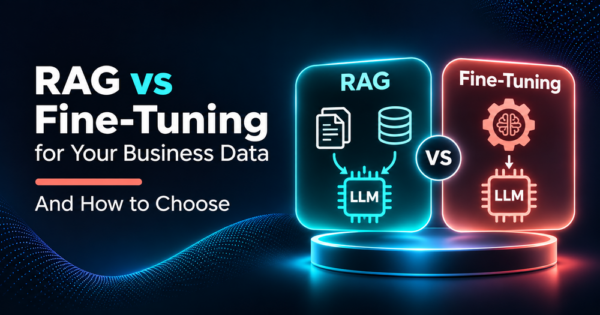
RAG, short for retrieval-augmented generation, looks up relevant passages from your own content at the moment a question is asked and hands them to the language model along with the question. Fine-tuning does something different: it continues training a model on example inputs and outputs so that its behavior changes, such as how it formats an answer or which tone it uses. In plain terms, RAG changes what the model can see, and fine-tuning changes how the model behaves.
That split matters because the two fix different failures. OpenAI’s guide Optimizing LLM Accuracy (read November 20, 2026; the page shows no date) describes RAG as the lever for a model that lacks knowledge, has outdated knowledge or needs proprietary information. It describes fine-tuning as the lever for inconsistent formatting, the wrong tone or unreliable reasoning, which it treats as problems of behavior, not of missing facts.
Most articles on this topic stop at that definition and a pros-and-cons list. The two popular guides we read for this post, from SoluteLabs and App Academy, gave no cost figures of their own, and neither covered evaluation or what to do when neither approach is needed. The rest of this guide covers those gaps.
How do you decide between RAG and fine-tuning?
Choosing fine-tuning vs RAG for your business data comes down to seven questions about your own use case, answered in order. Each answer points toward one approach, and a mix of answers usually means you should start with RAG, measure, and add fine-tuning only for a failure that retrieval cannot fix.
| Question | If yes, lean toward |
|---|---|
| Do the facts the answer depends on change weekly or monthly? | RAG |
| Must each answer show which document it came from? | RAG |
| Is the problem the format, tone or style of answers, not their facts? | Fine-tuning |
| Do you have at least a few dozen high-quality example answers? | Fine-tuning becomes possible |
| Is your whole knowledge base small enough to fit in one prompt? | Neither, use the prompt |
| Will you ask the same kind of question at very high volume? | Check the cost arithmetic below |
| Does your team lack a data scientist? | RAG, or a partner for fine-tuning |
The first two questions are the strongest signals. Facts that change are a poor fit for fine-tuning because every change means another training run, and a need for citations is a poor fit for fine-tuning because a tuned model does not show where an answer came from. The remaining sections explain each side of the test, then cover the cases where you combine them or use neither.
When does RAG fit better?
RAG fits better when the answer depends on information that is private, large or changing, and when you need to show your source. A support assistant that answers from your policy documents, a sales tool that quotes your current price list and an internal assistant that searches contracts all fit this description.
AWS’s Prescriptive Guidance page Comparing Retrieval Augmented Generation and fine-tuning (read November 20, 2026; no date shown) lists the advantages. It says RAG lets you build question answering over custom documents without fine-tuning, can incorporate the latest documents in a few minutes, provides a reference to the source in its response and carries a reduced risk of hallucination because the answer is grounded in retrieved context. AWS also says managed RAG services mean no data scientist or specialized machine learning knowledge is required. Its recommendation is direct: if you need a question-answering solution that references your custom documents, start from a RAG-based approach.
RAG has its own weak spots, and they are worth knowing before you commit. AWS notes that RAG does not work well when summarizing information from entire documents. OpenAI adds that failures can come from retrieving the wrong material or too much noise, so retrieval itself needs tuning. In practice, a RAG project is mostly a content and search project: cleaning documents, splitting them sensibly, testing what a vector or keyword search returns and keeping the index current. Our guide to a private ChatGPT-style system on your own data walks through that architecture, and the AI infrastructure guide covers the data and hosting layer behind it.
When does fine-tuning fit better?
Fine-tuning fits better when the model has the knowledge it needs but behaves wrongly, and you can show it what right looks like with examples. Typical cases are a fixed output format that prompts cannot hold steady, a brand voice, a classification task with your own labels, or a style of reasoning your team wants applied the same way every time.
OpenAI’s guide recommends starting with a small, high-quality set of around 50 or more examples and making sure the training examples match what the model will see in production. AWS lists the other side of the ledger: fine-tuning can take a few hours to days depending on model size, so it is a poor solution if your documents change frequently, and it may need an understanding of techniques such as LoRA and parameter-efficient fine-tuning, which can mean a data scientist. AWS also says fine-tuned models do not provide a reference to the source in their responses, that fine-tuning might not be available for all models, and that there can be an increased risk of hallucination when a fine-tuned model answers questions.
The practical reading is that fine-tuning is the right tool for a narrower set of problems than most teams assume. It teaches a model how to answer. It is the weaker tool for teaching it what is true today. If your team is weighing a tuned model, our machine learning development services cover the data preparation and evaluation that make a tuning run worth paying for.
Can you combine RAG and fine-tuning?
Yes, you can combine them, and some projects should, but the combination should come after you have measured each part on its own. AWS says the two can be used in a single model: the RAG architecture stays the same, and the model that writes the answer is also fine-tuned. It points to the RAFT research from the University of California, Berkeley, on adapting a model to domain-specific RAG, and says the combination might be an optimum solution for your use case.
OpenAI is more cautious, and its caution is a useful brake. It describes the two approaches as additive, but in its Icelandic correction case study, adding RAG to a fine-tuned GPT-4 model lowered the BLEU score from 87 to 83. The author concluded that the extra context added noise because the task was fundamentally a behavior problem. The lesson for a business is to add retrieval only when your failures show missing knowledge, and to add tuning only when they show wrong behavior. Diagnose first, then choose.
When do you need neither?
You need neither when a better prompt, a small knowledge base or a direct data connection solves the problem for less. OpenAI’s guide says to start with prompt engineering to get a baseline and an evaluation set, and that for many tasks, such as summarization or translation, it may be enough on its own.
The second case is a small knowledge base. In its article Introducing Contextual Retrieval (published September 19, 2024), Anthropic says that if your knowledge base is smaller than 200,000 tokens, about 500 pages of material, you can include the whole thing in the prompt with no need for RAG. It adds that prompt caching, which reuses frequently used prompts between calls, can cut latency by more than 2x and costs by up to 90%. A handbook, a product catalog of modest size or a single contract set can often fit.
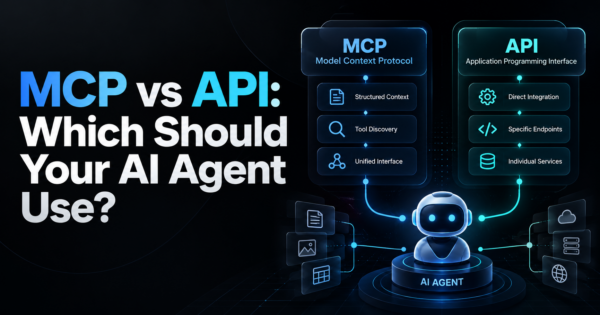
The third case is live data. If the answer lives in a system that changes by the second, such as stock levels, order status or a customer record, retrieval from a document index is the wrong shape. The model should call your system directly, which is the territory of tools and connectors. Our comparison of MCP and direct API calls for AI agents explains when each connection fits, and our guide to building an AI agent for your business shows where that connection sits in a full build.
How does cost compare between RAG and fine-tuning?
Cost depends on two numbers: how many questions you ask each month and how often your facts change. RAG sends extra retrieved text with every question, so its usage cost grows with volume. Fine-tuning shortens each question but adds a training cost every time you retrain. Neither approach is cheaper in general, and the figures below show why.
The arithmetic below is invented to show the method. The prices are placeholders, not any vendor’s rates, so replace them with your provider’s current pricing before you plan on them. Assume $3 per million input tokens, $15 per million output tokens, $70 a month for the retrieval index, and $2,000 for each training run. Each question uses 300 tokens of its own, RAG adds 2,000 tokens of retrieved context, and each answer is 300 tokens. The fine-tuned model is assumed to cost the same per token, which is a simplification.
Scenario A: 5,000 questions a month, facts change monthly.
- RAG input: 5,000 × 2,300 = 11.5 million tokens, which is $34.50. Output: 5,000 × 300 = 1.5 million tokens, which is $22.50. Add $70 for the index. Total: $127 a month, or $1,524 a year.
- Fine-tuned input: 5,000 × 300 = 1.5 million tokens, which is $4.50. Output is the same $22.50. Total: $27 a month, or $324 a year, plus 12 retraining runs at $2,000 each, which is $24,000. Total: $24,324 a year.
Here RAG wins by a wide margin, because monthly retraining dominates the fine-tuned cost.
Scenario B: 200,000 questions a month, facts change quarterly.
- RAG input: 200,000 × 2,300 = 460 million tokens, which is $1,380. Output: 200,000 × 300 = 60 million tokens, which is $900. Add $70. Total: $2,350 a month, or $28,200 a year.
- Fine-tuned input: 200,000 × 300 = 60 million tokens, which is $180. Output is the same $900. Total: $1,080 a month, or $12,960 a year, plus 4 retraining runs at $2,000, which is $8,000. Total: $20,960 a year.
At this volume the fine-tuned option costs $7,240 less per year on usage and training alone. This is a cost comparison only. It says nothing about accuracy, and OpenAI frames fine-tuning as the fix for behavior, so a model tuned to save money on a knowledge problem can be cheaper and wrong. For project-level pricing beyond usage, including data preparation, integration and upkeep, see our AI development cost guide.
How do you test RAG and fine-tuning before you commit?
You test them by writing an evaluation set first and running every candidate against it. Collect 30 to 50 real questions from support tickets, sales emails or staff, which is our own practical suggestion and not a sourced threshold. For each question, write the correct answer and note which document it should come from. Include a few questions that have no answer in your content, because a good system should say it does not know.
Then run the same set through three setups: the plain model with a good prompt, the model with RAG, and, only if the first two fail on behavior, a fine-tuned model. Score each answer as correct, partly correct or wrong, and for RAG also check whether the right source was retrieved. Read the failures one by one. A wrong answer with the right source retrieved points to a generation or prompt problem. A wrong answer with the wrong source retrieved points to a retrieval problem. A correct answer in the wrong format points to fine-tuning. This is the diagnosis OpenAI describes, and it keeps you from paying for a technique that does not address the failure.
Repeat the test after any change to the documents, the model or the prompt, because results move when any of them move. A small automated run of the evaluation set is one of the cheapest forms of insurance in an AI project.
What about privacy and data control?
Privacy depends on where your data goes in each approach, and you should check your provider’s terms before you send anything sensitive. With RAG, your documents stay in an index you control, but the retrieved passages are sent to the model inside each prompt. With fine-tuning, your training examples are sent to the provider to train a model, and what the model learned lives in that tuned model. Neither is automatically safe or unsafe.
Ask each provider in writing whether your prompts and training data are used to train other models, how long they are kept, who can access them and where they are stored. Limit what you retrieve by user permission, so an assistant cannot surface a document the person asking could not open themselves. If you handle health, legal or financial records, get your own counsel to confirm which rules apply. This section is general information, not legal advice.
What skills and team does each option need?
RAG needs people who can clean content, build and test search, and connect the assistant to your systems. Fine-tuning needs people who can prepare labeled examples, run training, measure results and retrain. AWS says fine-tuning may require a data scientist and that managed RAG options do not require specialized machine learning knowledge. Either way, someone has to own the evaluation set and the document pipeline after launch, or quality will drift.
If you lack that team, the sensible split is to keep ownership of the content and the evaluation questions, which only you can write, and use a partner for the build. Our AI development services and generative AI development services cover both approaches, and our AI integration services connect the result to the CRM, ERP or support system your staff already use.
Frequently Asked Questions
Why is RAG used instead of fine-tuning?
RAG is used instead of fine-tuning when the answer depends on facts that change or must be cited. AWS says RAG can take in the latest documents in a few minutes, provides a reference to its source and reduces the risk of hallucination. Fine-tuning takes hours to days and does not point to a source, so it suits stable behavior better than changing facts.
Is fine-tuning debunked?
No, fine-tuning is not debunked, but it is the right tool for a narrower job than many teams assume. OpenAI frames it as the fix for inconsistent formatting, the wrong tone or unreliable reasoning. It is a weak way to keep a model current on facts, which is why RAG handles that job.
Is RAG cheaper than fine-tuning?
It depends on volume and how often your facts change. In our invented example, RAG cost $1,524 a year against $24,324 for monthly retraining at 5,000 questions a month. At 200,000 questions a month with quarterly retraining, fine-tuning cost $7,240 less per year. Use your own volumes and your provider’s current prices.
Can you use RAG and fine-tuning together?
Yes, you can use both together. AWS says the RAG design stays the same while the model that writes the answer is also fine-tuned. OpenAI warns that extra context can hurt a task that is mainly about behavior, so measure each approach on its own before you combine them.
How much data do you need to fine-tune a model?
OpenAI recommends starting with a small, high-quality set of around 50 or more examples. The examples should look like the inputs the model will see in production. More data helps only if it is accurate and representative, so quality matters more than volume at the start.
Does fine-tuning teach a model your company facts?
It is the weaker tool for that job. OpenAI describes fine-tuning as a fix for behavior, and AWS notes that a fine-tuned model does not cite sources and can carry an increased risk of hallucination. For facts that change or need a source, retrieval is the safer choice.
Do you need RAG if your knowledge base is small?
Not always. Anthropic says a knowledge base smaller than 200,000 tokens, about 500 pages, can go entirely in the prompt, and that prompt caching can make this faster and cheaper. Test the prompt-only version first, because it is the simplest thing that could work.
Which is better for a customer support chatbot?
RAG is usually the better starting point for a support chatbot because answers depend on your current policies and should cite them. AWS recommends starting from a RAG-based approach for question answering over your own documents. Add fine-tuning later only if answers have the wrong tone or format after retrieval works.
How long does each approach take to set up?
RAG can be live faster, because new documents can be added in minutes once the pipeline exists, according to AWS. Fine-tuning needs prepared examples and a training run that AWS says can take hours to days. Both need time for evaluation, which is often the longest part.
Bottom Line
Choose by diagnosing the failure. If the model lacks or has stale knowledge, use RAG. If it behaves wrongly with the right facts, use fine-tuning. If a better prompt or a small knowledge base fixes it, use neither. Write the evaluation set first, run the plain model before you spend on either, and let the failures decide. If you want a team to run that test on your own content, talk to us about AI development services.