Table of Content

Where does AI in marketing save hours?
AI in marketing saves the most time on research, first drafts, repurposing, reporting and lead sorting, and wastes time on brand voice, factual claims and thin pages that need rework. Use it where a person can check output in minutes, keep a named reviewer on anything public, and judge it by net hours saved and pipeline.
TL;DR
- Hand a task to AI when the output can be checked in minutes, a mistake is cheap to fix and the task repeats often. Those three tests sort most marketing work.
- The reliable time savers are research, first drafts, repurposing, reporting, segmentation, ad variants and lead sorting. The time wasters are brand voice, unchecked facts, pages produced in bulk and anything that reaches customers without review.
- Google says generative AI can be useful for researching a topic and adding structure to original content, and also that creators should fact-check it, including titles, meta descriptions and structured data. It warns that producing many pages without adding value can break its spam policy.
- Email and ad rules still apply to AI-written messages. The FTC says the CAN-SPAM Act carries penalties of up to $53,088 per violating email and that hiring another company to send does not move the responsibility.
- Measure net hours saved after review time, then pipeline, not output. The worked examples below are invented illustrations, with the arithmetic shown.
- Start with a 30-day pilot on two tasks and one named reviewer. For the agent and platform side of this topic, see our AI marketing agents guide.
What counts as AI in marketing?
AI in marketing means using machine learning or generative models to do or speed up a marketing task, such as researching a market, drafting copy, sorting leads or reporting results. People also search for it as AI marketing, and for the buyer side as AI for marketing: which jobs to give a model and which to keep. In this guide the three phrases mean the same thing, and the real question is not whether to use it but which tasks to hand over.
Several neighboring topics have their own homes on this site, so it helps to know which one you need. Our AI marketing agents guide covers software agents and platforms that run campaigns. AI lead generation covers finding and qualifying new buyers, and AI in sales covers what happens once a lead is a live opportunity. Our guide to answer engine optimization covers being quoted inside AI answers. This post owns the broader adoption question that sits above all of them: across the whole marketing function, where does AI save hours, where does it waste them, and how do you find out for your team.
How do you decide which marketing tasks to hand to AI?
Hand a task to AI when the output can be checked in minutes, a mistake is cheap to fix and the task repeats often enough for the savings to add up. Run every candidate task through three tests before you buy anything.
- Can a person check it fast? Sorting 200 form fills into three groups is easy to spot-check. A 2,000-word article full of numbers is not, because each claim needs its own source.
- Is a mistake cheap? A weak internal draft costs a few minutes. A wrong price in a live ad, or a claim that breaks advertising rules, costs far more than the time you saved.
- Does it repeat? A task you do weekly pays back a setup effort. A one-off rarely does.
If a task fails the first test, AI will probably cost you time, because the review takes as long as doing the work yourself. That is the whole difference between marketing work AI helps with and work it wastes hours on.
Where does AI in marketing save hours?
It saves the most hours on work that starts from material you already have: research, first drafts, repurposing, reporting, segmentation, ad variants and lead sorting. The benefits of AI in marketing show up as hours returned to people who then spend them on strategy and customers, not as a bigger content count. The table maps each task to what the model does, what a person still checks and our verdict. The verdicts are our judgment, built from the three tests above, not measurements.
| Task | What AI does well | What a person still checks | Verdict |
|---|---|---|---|
| Research and summaries | Condenses long reports, calls and competitor pages into a brief | Every number and quote against the source | Saves time |
| First drafts | Produces a rough outline or draft from your notes and examples | Facts, claims, voice and anything legal | Saves time only with strong edits |
| Repurposing | Turns one approved piece into emails, posts and snippets | Tone per channel, accuracy of cut-down versions | Saves time |
| Reporting | Pulls data into a draft summary and flags changes | That the numbers match the source dashboards | Saves time |
| Segmentation | Groups contacts or customers by behavior | That the groups make business sense and are lawful to use | Saves time with review |
| Ad and email variants | Writes many headline and subject options to test | Claims, offers and platform rules before launch | Saves time |
| Lead sorting | Ranks inbound leads and drafts first replies | Edge cases, and any reply sent without a person | Saves time with a hand-off rule |
Two outside sources give a sense of the upside, and both come with limits. Google’s guidance on generative AI content, which shows no publication date on the page we read on November 20, 2026, says generative AI can be particularly useful when researching a topic and to add structure to original content. Invoca’s guide, dated September 26, 2025, cites a Salesforce and YouGov survey in which marketers estimate saving about five hours a week, but the page gives no survey date and Invoca sells a marketing platform, so treat that figure as an estimate and measure your own.
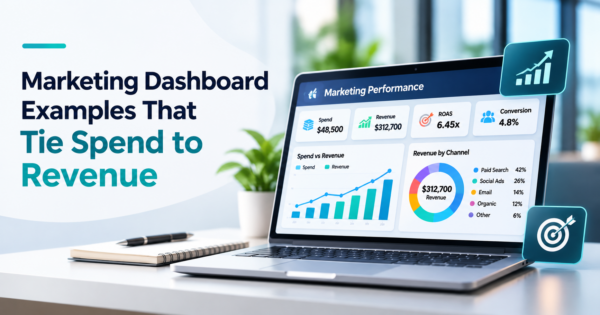
The same pattern shows up in the specific jobs we cover elsewhere. Our guide to content repurposing shows how one approved asset becomes many, AI email assistants covers drafting and sorting for the inbox, and marketing dashboard examples shows the reports worth automating first.
Where does AI in marketing waste time or cause damage?
It wastes time when review takes as long as writing, and it causes damage when output reaches customers unchecked. Five problems account for most of it.
Brand voice and trust
A model writes in an average voice unless you give it a strong one, and readers notice. Vanderbilt Business Review, a publication that says it is not operated by Vanderbilt University, described in an article dated October 26, 2025 several brand campaigns that drew backlash for poor execution or a lack of human warmth, including Coca-Cola’s AI-made holiday ad. Its advice is to treat AI as a partner, review output for bias and brand fit, and be transparent with consumers. The article gives no method for measuring trust, so build your own check: have a reviewer score each public piece on voice and accuracy before it ships.
Facts the model made up
Google says generative models do not retrieve facts and can produce inaccuracies, and that creators should manually fact-check and review all AI-generated content before publishing, including title elements, meta descriptions, structured data and image alt text. The practical rule is simple. Every number, quote, price and product claim in a draft needs a named source before it goes live, and a draft with no source for a claim loses the claim.
Pages produced in bulk
Google says using generative AI to produce many pages without adding value for users may violate its spam policy on scaled content abuse. It also notes that its guidance on low-effort content points to the Search Quality Rater Guidelines, which it says do not directly influence rankings. A site that publishes fifty thin AI pages to cover keywords is taking exactly the risk Google describes. A smaller number of pages with real data, examples and a reviewer’s name is the safer way to use the time AI saves.
Email, ads and endorsements
Rules attach to the message, not to who wrote it. The FTC’s CAN-SPAM compliance guide, which we read on November 20, 2026 and which is dated August 2023 and edited in January 2024, requires accurate header information and non-deceptive subject lines, a clear statement that the message is an ad, a valid postal address, a working opt-out that you honor within 10 business days, and says each violating email can carry penalties of up to $53,088. It adds that hiring another company to send your email does not transfer your legal responsibility. The FTC’s endorsement guide page says an endorsement must reflect the honest opinion of the endorser and that fake likes are clearly deceptive. That page does not address AI-generated reviews or endorsements, so ask counsel before you generate testimonials or review-style content.
Images and product data
Google says ecommerce sites that follow Google Merchant Center policies must add IPTC DigitalSourceType metadata, set to TrainedAlgorithmicMedia, to AI-generated images, and that AI-generated product titles and descriptions must be specified separately and labeled as AI-generated. If you run a store, add that check to your launch list.
Does AI in marketing work differently for B2B and ecommerce teams?
Yes, because B2B teams win on fewer, larger accounts and ecommerce teams win on volume and catalog data. A B2B team gets the most from account research, lead qualification and sales preparation, where one good hour of saved effort lands on a deal worth thousands. AI lead generation walks through that workflow, and AI in sales covers the sales side.
An ecommerce team gets the most from product copy, segmentation, email and personalization, where the catalog gives the model plenty to work from and volume makes small savings add up. That is also where review rules matter most, since mistakes repeat across thousands of pages. Our ecommerce personalization strategies guide covers the personalization side in detail, and the label and metadata rules above apply to your product pages.
How do you measure whether AI in marketing is paying off?
Measure net hours saved after review time first, then pipeline or revenue, and compare against a baseline you recorded before you started. Use this method for each task you test.
- Record a four-week baseline: hours spent on the task, output count and the result you care about, such as leads, replies or conversions.
- Run the task with AI for four weeks, with the same person logging time, including the time spent reviewing and fixing.
- Have a second person score a sample of outputs on accuracy and voice, using a simple five-point scale you define in advance.
- Compare net hours, quality scores and the business result against the baseline. Keep the task only if net hours fall and quality holds.
Here are two worked examples. The hours and the $60 hourly cost are invented placeholders, and the arithmetic is computed from them, so replace them with your own numbers.
A task that saves time. A team spends 40 hours a month assembling a performance report. With AI drafting the summary, the work takes 18 hours, and a reviewer needs 6 hours to check numbers against the dashboards. Net hours saved are 40 – 18 – 6 = 16. At $60 an hour that is $960 a month. If the tool costs $300 a month, the net gain is $960 – $300 = $660.
A task that wastes time. A team publishes 10 articles a month. AI saves 1.5 hours of drafting per article, so 10 x 1.5 = 15 hours. Editing for voice and fact-checking adds 2 hours per article, so 10 x 2 = 20 hours. Net hours are 15 – 20 = -5, which means the team lost 5 hours a month. The fix is not to drop AI. It is to use it for outlines and research, and keep drafting with the writer.
Pair the hours with a business result. If you are building the reporting side, our marketing dashboard examples guide shows how to tie spend to revenue so the result is visible.
What does a 30-day pilot of AI for marketing look like?
A good pilot tests two tasks, with one named reviewer, over 30 days, and ends with a keep-or-drop decision. This plan fits a small team.
- Week 1: pick two tasks that pass the three tests, record the baseline and write the quality scale. Write down what the model must never do, such as quote prices or invent customer names.
- Week 2: run both tasks with AI and log time, including review. Keep every output so you can sample it.
- Week 3: have the second person score a sample, fix the prompts and the review checklist, and rerun.
- Week 4: compare net hours, quality and the business result against the baseline. Keep the tasks that saved net time at the same quality, drop the rest and write down why.
Do you need an AI marketing agency or a custom build?
Most teams do not need one to start, but an AI marketing agency or a custom build earns its fee when the work crosses systems or needs steady oversight. If your tasks are drafting and research, a subscription tool and a good reviewer are enough. If the work has to pull from your CRM, ad accounts and analytics, run on a schedule and carry guardrails, it becomes a small engineering and operations project.
That is where our AI marketing services fit, and where AI development services build custom workflows when an off-the-shelf tool does not connect to your data. If your goal is visibility inside AI answers and search results, our AI SEO services and our guide to answer engine optimization cover that separately. Ask any provider what it will automate, what a person will review, and how it will report net hours and pipeline, using the same method as the pilot above.
Frequently Asked Questions
What is AI in marketing?
AI in marketing is the use of machine learning or generative models to do or speed up marketing tasks, such as research, drafting, segmentation, reporting and lead sorting. It also appears as AI marketing. It supports people on repeatable work and does not set strategy or take responsibility for what is published.
How is AI used in marketing?
AI is used in marketing mainly to research, draft, repurpose, report, segment audiences, test ad and email variants and sort leads. The strongest uses start from material you already have and end with a person checking the result. Public-facing output, such as ads and emails, needs review before it ships.
Does AI in marketing save time?
It can, but only after review time is counted. Invoca cites a Salesforce and YouGov survey in which marketers estimate saving about five hours a week, though the page gives no survey date. Test your own tasks: record a baseline, log net hours with AI including review, and keep only the tasks where net hours fall.
Is AI-generated content allowed by Google?
Yes, with conditions. Google says generative AI can be useful for research and adding structure, and that content must still meet its spam policies. Producing many pages without adding value for users may violate its scaled content abuse policy, and Google says creators should fact-check AI output before publishing.
Do the same email rules apply to AI-written emails?
Yes, because the rules attach to the message. The FTC’s CAN-SPAM guide requires accurate headers, non-deceptive subject lines, a clear ad disclosure, a postal address and an opt-out honored within 10 business days. It states penalties of up to $53,088 per violating email. The guide does not discuss AI, so ask counsel about edge cases.
Do I have to disclose that I used AI in marketing?
There is no single rule we can cite that covers all AI use. Google says to consider telling readers how content was created, and its Merchant Center rules require labeling AI-generated product titles and descriptions and adding metadata to AI-generated images. Ask counsel about advertising and endorsement disclosures for your situation.
What is the best AI for marketing?
There is no single best tool, because the right one depends on the task and the systems it must connect to. Choose by the task first, then test two tools on that task against a written baseline. Our AI marketing agents guide compares agent and platform options in detail.
How do I measure the return on AI in marketing?
Measure net hours saved after review, quality scores from a second reviewer and a business result such as leads or conversions, all against a baseline you recorded before the pilot. In the invented example above, a reporting task saved 16 hours a month while a drafting task lost 5, which is why each task is judged on its own.
Can AI replace a marketing team or agency?
Not for the work that depends on judgment, brand voice and accountability. AI handles repeatable steps, and a person still sets strategy, checks claims and owns what goes public. Hire an agency when you need steady oversight or systems integration, and use the pilot method to check what it actually delivers.
Bottom Line
AI in marketing pays off on repeatable work a person can check quickly, and it costs you where review takes as long as the writing or where unchecked output goes public. Run every task through the three tests, pilot two tasks for 30 days, and keep only what saves net hours at the same quality. If you want a team to build and run that workflow, talk to us about our AI marketing services.