Table of Content

What is vertical AI?
Vertical AI is artificial intelligence built for one industry or job, such as insurance claims, legal review or construction submittals. It uses that field’s data, rules and workflows, so it is usually more accurate and easier to trust inside that field than a general assistant, and less flexible outside it.
TL;DR
- Horizontal AI, such as ChatGPT Enterprise or Microsoft Copilot, works across industries. Vertical AI is built for one, and competes on data access, workflow depth and compliance.
- Vertical AI is not the same as vertical SaaS. Vertical SaaS is industry software you log into. Vertical AI adds a model that reads, drafts and decides inside the work.
- A narrow model tends to win when errors are costly, the data is specialized and the work follows a repeatable workflow. A general assistant tends to win when the task is broad and a person checks every answer.
- Judge any vendor on your own documents, not its demo. Ask who owns the data, how it handles exceptions and what happens when you leave.
- Build custom when the workflow is your competitive edge and your data is not available to vendors. Buy when a vendor already covers your case.
What is vertical AI, and how is it different from horizontal AI?
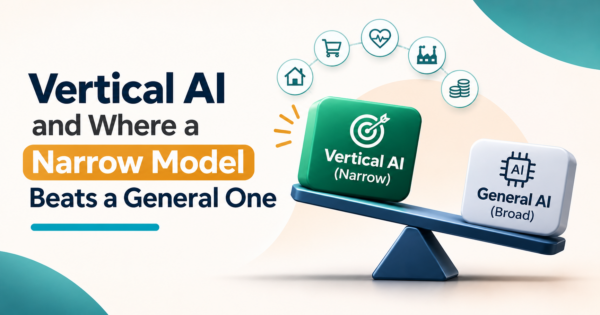
Vertical AI is AI designed for a single industry, function or profession, as opposed to horizontal AI, which is built to work across many of them. A vertical AI product for insurance understands policies, claims and underwriting rules out of the box. A horizontal product such as a general chat assistant understands language and can be pointed at almost anything, but needs you to supply the context each time.
CRV, a venture firm, defines vertical AI in a guide published on July 16, 2026 as AI that embeds domain knowledge, regulatory compliance and workflow integration that general-purpose models lack. It lists ChatGPT Enterprise, Claude for Work and Microsoft Copilot as horizontal products, and describes the vertical kind as trained or customized on domain data instead of relying on prompts alone. CRV says horizontal companies compete on distribution, brand and compute, while vertical companies compete on data access, workflow integration and regulatory position. CRV has investments in several of the companies it names, so read its claims as an investor’s view.
The same split shows up in vendor pages. Glean, a vendor of a horizontal platform, says in a page last updated on October 30, 2025 that vertical AI suits specialized sectors that need domain accuracy and compliance, while horizontal AI suits organizations that want one system across many departments. Its advice for most companies is a hybrid: a horizontal base, plus vertical tools for high-demand specialized tasks. Because Glean sells the horizontal option, weigh that framing accordingly.
Two comparisons people search for, horizontal vs vertical AI and vertical AI vs horizontal AI, come down to the same trade. You give up breadth to get depth. Whether that trade pays depends on your work, which the rest of this guide helps you test.
How is vertical AI different from vertical SaaS?
Vertical SaaS is subscription software built for one industry, such as a platform for dental offices or for construction accounting. Vertical AI uses the same industry focus but adds a model that can read documents, draft output and take steps inside the workflow. CRV makes the same point: vertical SaaS delivered industry-tailored cloud software, and vertical AI adds capabilities earlier software could not offer, especially for language-heavy and multimodal work.
In practice the line blurs. Many vertical SaaS vendors are adding AI features to the product you already use. The difference to look for is who does the work. In classic vertical SaaS, your staff operate the software. In vertical AI, the software does a step of the job and your staff review it.
| Type | Built for | Who does the work | Main risk |
|---|---|---|---|
| Horizontal AI | Many industries and tasks | You prompt it, a person checks it | Shallow on specialist rules |
| Vertical SaaS | One industry’s processes | Your staff operate the software | Limited help with unstructured work |
| Vertical AI | One industry’s data and workflow | The software does a step, staff review | Vendor lock-in and unproven accuracy on your cases |
A “wrapper” is a different thing again. A wrapper is a thin product that sends your input to a general model with a fixed prompt and a nicer interface. It can be useful, but it has little protection from the next feature the model maker ships. Real vertical AI earns its place through the data it can reach, the integrations it has with the systems of record, and the rules it encodes. When a vendor pitches vertical AI, ask what it has that a prompt and a template do not.
When does a narrow model beat a general one?
A narrow, industry-specific model beats a general assistant when three conditions hold: the data is specialized, errors are expensive and the work follows a repeatable workflow. Each condition has a reason behind it.
Specialized data. General models learn from broad public text. CRV argues that vertical products win because they reach industry data that horizontal products cannot, and improve as users correct them. William Blair, an investment firm, makes a similar case in a March 25, 2026 research note: general models can be inaccurate on technical tasks, while vertical vendors use proprietary domain data and feedback loops. Both are investor perspectives, so treat the direction as plausible and test the accuracy yourself.
Expensive errors. In regulated work a wrong answer has a cost beyond annoyance. CRV cites two studies in its guide, a Nature paper and a medRxiv preprint, reporting that general language models hallucinated at high rates in clinical tests, and it cites a comparison in which vertical clinical documentation tools caught 97% of confabulations against 82% for GPT-4o. CRV does not show dates for those studies, and the comparison is reported through an investor, so we treat the numbers as an illustration of the argument, not a benchmark you can rely on.
A repeatable workflow. The value of vertical AI grows when it can carry a task end to end instead of drafting text. William Blair gives a construction example: a general model might draft an email about a change, while a vertical system can manage the full process, from identifying the issue through budget revisions and approvals. We cover that process in our guide to construction change orders, and it shows why depth matters: the email is the easy part, and the budget and approval trail is the work.
There is also a market signal. CRV cites a Gartner forecast, in a press release dated July 10, 2025, that by 2027 more than half of the generative AI models enterprises use will be domain-specific, up from a small share in the early 2020s. Treat it as CRV’s summary of a forecast, not a measurement.
When is a general assistant the better choice?
A general assistant is the better choice when the task is broad, the stakes are low or a person reads every output anyway. Drafting an internal memo, summarizing a meeting, brainstorming names or reformatting a spreadsheet does not need an industry model. A general tool is also cheaper to start with, has no integration project and can be replaced easily.
It also wins when your workflow is unusual. A vertical product is built around the common way an industry works. If your process is a variation, the product may fight you, and you will spend your time configuring around its assumptions. Glean’s page makes a related point from the other side: vertical tools often need per-department setup, customization and domain data, while horizontal platforms reduce overhead.
A sensible rule is to start with a general assistant for anything a person will review, and move to a narrow tool when you can name a recurring task where errors, compliance or volume make the general tool too slow or too risky. Our guide to AI agent examples shows what that second step looks like across business functions.
Which vertical AI companies are worth knowing?
The vertical AI companies people mention most are in healthcare, legal, insurance and construction, where specialized data and heavy regulation create room for a focused product. CRV’s July 2026 guide names Abridge for clinical documentation, Joyful Health for claims and denials at healthcare providers, Fulcrum for insurance agents at brokerages, Harvey for legal work, AlphaSense for market intelligence and Trunk Tools for construction. It also names 7AI for security alert investigation and CodeRabbit for code review. CRV discloses no performance data for these companies in the passages we read, and as an investor it has a stake in several of them, so this list is a map of the field, not a recommendation.
A search for vertical AI companies returns many lists like this, and most are written by investors or vendors. Use them to learn what categories exist, then judge each product on your own cases using the vendor checklist below.
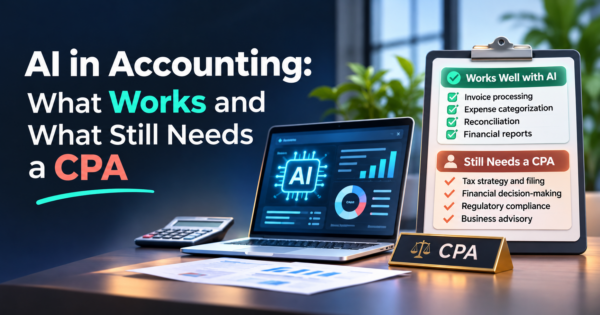
If your industry is not on those lists, that does not mean vertical AI does not apply. It often means no product fits your workflow yet. Our own industry guides show where a narrow approach works on top of data a company already holds: AI in construction on ERP and job cost data, AI in logistics for shippers and carriers, AI in retail for merchandising and inventory, and AI in accounting for the work that still needs a CPA. Each guide owns its own industry. This guide owns the choice between narrow and general.
One of our own projects shows the pattern on a small scale. Our CMES case study describes a Georgia heavy civil contractor with data spread across eight sources, including Trimble Construction One (Vista), HCSS HeavyJob, HeavyBid and BambooHR. The case study says we built an operations portal and three AI assistants grounded in company records such as contracts, bid data and HR policies, on top of the systems CMES already used. The page lists reported outcomes of 3,000+ hours saved and 70% faster operational reporting, which are the client-reported figures from that page.
How do you judge a vertical AI vendor?
Judge a vertical AI vendor on your own cases, not its demo. A vendor can pick the examples it handles well. You can only learn how the product behaves on your work by testing it on your documents and exceptions. Ask these questions before you sign anything.
- What data was it built on, and what data can it use from us? Ask what industry data the model draws on, whether your data trains anyone’s model and who owns outputs and corrections.
- How does it do on our documents? Run a blind test on a few hundred of your real files and compare the results with what a general assistant produces on the same set.
- What happens on exceptions? Ask for the last three cases it got wrong and how the product flags uncertainty instead of guessing.
- Where does it plug in? Name the systems it must read and write, such as your ERP, CRM or document store, and ask for a customer who runs the same stack.
- What compliance does it carry? Ask for the specific agreements and certifications your industry expects, in writing.
- What is the exit? Ask how you export your data, prompts, rules and history, and what you lose if you leave.
- What does the price scale with? Seats, documents, outcomes or usage behave very differently at ten times the volume.
Here is a worked illustration with invented numbers. Suppose you run both options on the same 200 of your real documents and a reviewer scores each answer. The general assistant gets 150 right and the vertical tool gets 178. That is 75% against 89%, a gap of 14 points. The general assistant leaves 50 errors for a person to catch and the vertical tool leaves 22. If each error costs 6 minutes to find and fix, the gap is 28 fewer errors, or 168 minutes, about 2.8 hours per 200 documents. At 2,000 documents a month, that is 10 batches and about 28 hours a month. Those figures are made up to show the method. Your own test replaces them, and the answer might be that the general assistant is good enough.
When should you build a custom vertical AI instead of buying?
Build a custom vertical AI when your workflow is a competitive advantage, your data is not available to vendors, or no product fits your process. Buy when a vendor already covers your case and your edge lies elsewhere. A useful test is to ask four questions.
- Is the workflow part of how you win, or is it overhead every competitor shares?
- Do you hold data, such as years of job cost records or claims history, that a vendor cannot get?
- Would the product need heavy customization to fit your process anyway?
- Can you name a measurable result, such as hours saved, error rate or cycle time, that would justify the spend?
Two or more “yes” answers to the first three, plus a clear answer to the fourth, point toward building. If the answers lean the other way, buy a product, run the vendor test and revisit later.
Custom does not mean training a model from scratch. Most custom vertical AI sits on a foundation model and adds your data, your rules and your integrations. Several sources we read describe vertical products as layers on top of general models, which is why the two categories are complementary more often than competing. The work is in the layer: retrieval over your documents, evaluation against your cases, and connections to your systems. Our guide to building custom AI models walks through that process, and our AI development cost guide explains what drives the price.
One way to structure a first build is in four stretches over about 90 days. In the first two weeks you pick one workflow, define what a correct result looks like and collect the documents you will test on. In weeks three to six you prepare the data and build an evaluation set. In weeks seven to ten you build a pilot, with a person reviewing every output. In the last three weeks you measure against your baseline and decide whether to expand. That plan is a suggestion, not a promise, and the timeline changes with your data and your systems.
If you want help, our AI development services team scopes this kind of project, and the work typically draws on LLM development services for the model layer and agentic AI development services when the system has to take actions across tools. For founders testing a narrow product idea before committing, an MVP development engagement keeps the first build small.
Frequently asked questions
What does vertical AI company mean?
A vertical AI company builds AI products for one industry or profession instead of for every business. Examples named in CRV’s guide include companies focused on clinical documentation, legal work, insurance and construction. Such companies compete on access to industry data, depth of workflow integration and regulatory position.
Is ChatGPT horizontal or vertical AI?
ChatGPT is horizontal AI. It is a general-purpose tool that works across industries and tasks. CRV lists ChatGPT Enterprise, along with Claude for Work and Microsoft Copilot, as horizontal products. A vertical product may use a general model underneath, but adds industry data, rules and integrations on top.
What is the difference between vertical AI and horizontal AI?
Horizontal AI works across many industries and tasks, while vertical AI is built for one. The trade is breadth for depth. Horizontal tools are faster to start with, and vertical tools are usually more accurate and better integrated inside their field.
What is the difference between vertical AI and vertical SaaS?
Vertical SaaS is industry-specific software your staff operate, while vertical AI adds a model that does a step of the work, such as reading a document or drafting a decision, with your staff reviewing it. Many vertical SaaS products are now adding AI features, so the line is blurring.
Is vertical AI better than general AI?
Vertical AI is better when errors are costly, the data is specialized and the workflow repeats. General AI is better for broad, low-stakes tasks that a person reviews. Test both on a few hundred of your own documents before you decide, because vendor claims and investor studies are not a substitute for your own results.
What are examples of vertical AI?
Examples include clinical documentation tools, legal research and drafting platforms, insurance underwriting and claims tools, and construction submittal and document review products. CRV names Abridge, Harvey, Fulcrum and Trunk Tools among others. Treat any list from an investor or vendor as a map of the field, not a ranking.
Can I build vertical AI on top of a general model?
Yes. Most vertical AI products and custom builds sit on a general foundation model and add domain data, retrieval, rules and integrations. The layer you build is where the value is, which is why your evaluation set and your connections to your own systems matter more than the choice of model.
How do I evaluate a vertical AI vendor?
Run a blind test on a few hundred of your real documents, compare it with a general assistant, and ask about data ownership, exception handling, integrations, compliance and exit terms. Ask for a reference customer on the same systems you use. Get the answers in writing, not from a sales call.
Bottom line
Vertical AI is worth choosing when the work is specialized, the cost of a mistake is real and the workflow repeats. Start by testing a general assistant, move to a narrow tool when you can name the task where it falls short, and build custom only when your data or process is your edge. If you want to scope a narrow AI build for your own industry, talk to our AI development services team.