Table of Content

What are the best Wix alternatives for an online store?
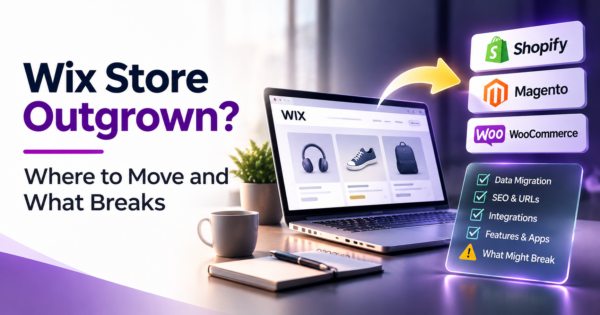
Of the Wix alternatives worth testing, Shopify fits most stores that have outgrown Wix. Choose WooCommerce if you want to own the stack on WordPress, BigCommerce if multi-currency and customer-group pricing matter most, and a custom build when your rules do not fit any platform. Plan the redirects before you choose.
TL;DR
- You have outgrown Wix when a limit blocks revenue or operations, not when the design feels dated. The signals are catalog and variant limits, missing B2B and pricing rules, integrations that need an ERP, and weak team controls.
- The best Wix alternatives for a store are Shopify, WooCommerce, BigCommerce and a custom or headless build. The right one depends on which limit you hit, so start from the problem, not from a ranked list.
- Wix’s own ecommerce page lists up to 1,000 variants per product. A product with 10 sizes, 10 colors and 12 materials has 1,200 combinations, which is how a real catalog crosses that line.
- A move from Wix is a URL project first and a design project second. Every old product, collection, page and post needs a mapped destination, and Shopify’s help center states a cap of 100,000 redirects.
- Products and customers usually move. Reviews, app data, order history, saved payment details and customer passwords often do not, so check each against your destination platform before you commit.
- The two top review sites we read, Tooltester and EXPERTE, rank website builders but have no section on migrating an existing Wix store. This guide covers that gap.
- This post owns the decision to leave Wix. If you are weighing a move away from Shopify instead, read our guide to Shopify alternatives for growing stores.
How do you know your store has outgrown Wix?
You have outgrown Wix when a limit in the platform costs you sales, slows your team or forces manual work that you can quantify. A builder that felt generous at 40 products can feel tight at 4,000, and the signs show up in a handful of places. Searches for the best Wix alternatives spike for the same reason: people hit a wall and look for a way around it.
Catalog and variants. Wix’s ecommerce page, which we read on November 20, 2026, describes physical catalogs with up to 1,000 variants per product. That is plenty for a shirt in five sizes and four colors, and not enough for configurable goods. Here is an invented illustration to show how the arithmetic works. A product with 10 sizes, 10 colors and 12 materials has 10 x 10 x 12 = 1,200 combinations. That product cannot be sold as one product with that many variants on Wix, and the workaround, splitting it into several products, makes search, reporting and inventory harder to manage.
B2B and pricing rules. The Wix ecommerce page does not mention B2B selling. If wholesale customers need their own prices, minimums or catalogs, check what you are doing by hand today. Tooltester, in its Wix alternatives review (updated May 11, 2026), says sellers who want to sell at a large scale might struggle with Wix’s ecommerce limitations, and points to Shopify or WooCommerce for bigger stores. It does not give specific numbers, so measure your own pain instead of relying on a general warning.
Integrations. A store that must exchange inventory, orders and customers with an ERP, a warehouse system or an accounting tool needs a platform with a mature API and app ecosystem. If staff re-key orders from the store into another system every day, that is the cost of the limit, and it grows with order volume. Our guide to ecommerce ERP integration shows what a clean connection looks like.
Search control and speed. If you cannot control URL structure, templates or technical SEO at the level your growth plan needs, or if page speed is a recurring complaint, a platform change can help. Treat that as a hypothesis to test, not a certainty, because a slow store is often slow because of its apps and images, not the platform.
Team and operations. More staff, more locations, more roles and more channels each add pressure. If your plan needs several staff accounts with different permissions, compare what each platform allows on the plan you would actually buy.
A quick test: write down the three things you cannot do on Wix that you need in the next twelve months. If you cannot name three, the cheaper move is usually to stay and fix the store you have. If you can name them, the next section matches each one to a platform.
Which Wix alternatives fit which problem?
Shopify fits most growing stores, WooCommerce fits teams that want control through WordPress, BigCommerce fits stores with multi-currency and customer-group needs, and a custom or headless build fits rules no platform handles. The table summarizes the choice. It is our view, based on how these platforms are positioned and on the vendor pages we read, not a test of each product.
| Your main problem | Look first at | Watch for |
|---|---|---|
| A larger catalog, more apps, a growing team | Shopify | Plan limits on B2B catalogs and staff accounts |
| Full control, content-led selling, your own hosting | WooCommerce | You own hosting, security and updates |
| Several currencies and customer-group pricing | BigCommerce | Which features sit on which plan |
| Rules, workflows or pricing no platform supports | Custom or headless build | Higher build cost and ongoing maintenance |
| Mostly a design or brochure site with a few products | Staying on a builder | Another builder rarely fixes builder limits |
If price is the deciding factor, our comparison of ecommerce platforms for small businesses owns the cost-first view. If search visibility drives the decision, our best ecommerce platforms for SEO guide owns that. This post owns what happens after you decide to leave.
Is Shopify the best Wix alternative for a growing store?
For most growing stores, yes, because it is built only for selling and has a large app ecosystem (EXPERTE lists more than 10,000 apps for it, read November 20, 2026). Shopify is the platform we would test first for a store that has outgrown Wix, and it is a common destination in a Wix to Shopify migration. In a Wix vs Shopify comparison, the deciding factors for a growing store are usually catalog size, integrations and team controls, not design.
The facts that matter come from Shopify’s own pages, read on November 20, 2026. Its pricing page lists B2B catalogs, up to three on the Basic, Grow and Advanced plans and unlimited on Plus, and shows additional staff accounts of 5 on Grow and 15 on Advanced. When we read the page it displayed prices in rupees, so we quote no prices here. Check the current price in your own currency before you plan a budget. Shopify’s product import help page says the only required column for a new product CSV is Title, that a product can have up to three options and that you can add up to 250 images to a product.
Shopify is not automatically the answer. A store with heavy custom pricing may hit its plan limits, and a content-led brand may prefer WordPress. If Shopify is your shortlist, talk to our Shopify development services team about migrating from Wix.
When does WooCommerce beat Wix for ecommerce?
WooCommerce beats Wix when you want control over code, hosting and content, and you have someone to maintain it. WooCommerce describes itself as open source and says merchants can avoid monthly platform fees, and it advertises more than 1,000 extensions in its marketplace (WooCommerce, read November 20, 2026). That flexibility has a price in responsibility: you arrange hosting, security, updates and backups yourself, or pay a partner to do it.
WooCommerce suits stores where content and commerce are tied together, where the team already uses WordPress, or where you need custom behavior that a hosted platform does not allow. It is a poor fit if nobody on your team wants to own a server. Our WooCommerce development services cover migrations from builders, along with the hosting and maintenance that come with them.
Is BigCommerce a good alternative to Wix for ecommerce?
BigCommerce is a good alternative when you sell in several currencies or need customer-group pricing, because those features are in its plan structure. Its pricing page, read on November 20, 2026, shows four plans named Core, Growth, Scale and Performance, quoted in US dollars excluding tax. Multi-currency, with payments in more than 100 currencies, is listed on all four plans. Customer groups and segmentation appear from the Growth plan, and price lists for SKU-level custom pricing appear only on Performance.
Two cautions. The page lists no B2B plan by name, so match your wholesale needs to the features, not to a label. And the page shows annual prices in its plan cards that differ from the annual prices in its fee table, so confirm the real price with BigCommerce before you budget. For help matching plan features to your needs, see our BigCommerce development services.
What about Squarespace, Webflow and other website builders?
Other website builders solve design and content problems more often than ecommerce limits. Squarespace, Webflow, Hostinger and similar tools appear in nearly every list of the best Wix alternatives, and for a portfolio, a brochure site or a small shop they are reasonable choices. We did not test them for this guide and cite no figures for them.
Our view is simple. If you are leaving Wix because it is a builder, moving to another builder tends to bring you back to the same wall a year later, because the limits come from the model, not the brand. If you are leaving because you dislike its design tools or its price, another builder may be right.
When should you choose a custom or headless build instead?
Choose a custom or headless build when your pricing, fulfillment or customer experience cannot be expressed in a platform without painful workarounds. Headless means the storefront customers see runs separately from the commerce engine that holds products, carts and orders, so each can change without rebuilding the other.
It costs more to build and to maintain, so it is the right call only when the business case is clear: complex configuration, several storefronts from one catalog, deep ERP integration or a need for performance that a hosted theme cannot reach. Our comparison of custom ecommerce development vs SaaS platforms sets out the trade-offs, and our custom web development services page describes what we build.
How do you migrate from Wix without losing SEO?
You migrate from Wix without losing search traffic by mapping every old URL to a new destination, redirecting each one permanently on launch day, and checking what Google can reach afterward. The sequence below works for a move to any platform, and it is the same order we follow on ecommerce migration services projects.
- Inventory every URL. Crawl the live Wix site and list each product, collection, page and blog post with its title, meta description and traffic. Export the list to a spreadsheet. This is your map, and it is also your checklist for later.
- Decide the new URL structure. Keep slugs where the new platform allows it, because a URL that does not change needs no redirect. Where it must change, write the new address next to the old one.
- Export your data. Export products, customers and orders from Wix. We could not read Wix’s current export documentation while preparing this guide, so confirm what its CSV export includes, especially for variants, images and order history, before you plan the import.
- Build and test on a staging store. Import a sample first, then the full catalog. Check variants, images, prices, tax rules, shipping rules and checkout on a real device with real test orders.
- Prepare the redirects. Shopify’s help center says you can import redirects from a CSV file and create up to 100,000 of them (20,000,000 on Plus). It also says redirects can only start from URLs that return errors and cannot start from restricted prefixes, so test your list on staging, not on launch day.
- Plan the cutover. Choose a quiet trading period, lower your DNS time-to-live in advance, pause order edits for the switch window and tell customers about any downtime. Move the domain only when the staging store has passed every test.
- Verify after launch. Resubmit the sitemap in Google Search Console, crawl the new site and compare it to your old URL list, and check for 404 errors and redirect chains. Watch rankings and revenue for several weeks, and expect some fluctuation.
Here is an invented illustration of the size of the job. A store with 1,200 products, 40 collections, 60 pages and 80 blog posts has 1,200 + 40 + 60 + 80 = 1,380 URLs to map. Even a store 20 times larger, with 27,600 URLs, would sit well under Shopify’s stated cap of 100,000 redirects. The cap is rarely the problem. Accuracy is: one wrong mapping sends a product with good rankings to the home page or a 404.
For a longer checklist, see our guides to ecommerce migration SEO and to migrating to Shopify without losing SEO.
What breaks when you leave Wix?
Products and customer lists usually move, while behavior built on top of Wix usually does not. Make a list of everything your store does that is not a product page, and check each item against the destination before you commit. These are the items we see missed most often, and each needs confirming with the platform you choose.
- Apps and automations. Wix apps and automations do not carry over. Rebuild or replace each one, and write down what it does today.
- Reviews and loyalty data. Check whether your review and loyalty tools export their data and whether the new platform can import it.
- Customer passwords. Platforms typically cannot move password hashes between systems, so plan for customers to reset passwords or use a new sign-in.
- Saved payment details and subscriptions. Ask your payment processor whether stored cards can be transferred, and plan how recurring billing continues.
- Order history. Decide whether to import past orders or keep an archive, and tell customer support which system holds what.
- Email, forms and analytics. Reconnect tracking, marketing tools and forms, and test that conversions are counted from day one.
Where does a development partner help in a move off Wix?
A development partner helps most with the parts that go wrong quietly: URL mapping and redirects, data import checks, integrations with your ERP or accounting system, and the cutover itself. A small catalog with no integrations can often be moved in-house with a platform’s own import tools. A store with thousands of URLs, several integrations or wholesale rules is where an experienced team pays for itself.
CommercePundit builds and migrates stores on Shopify, WooCommerce, BigCommerce and custom stacks. If you are weighing a move, start with a short scoping call: bring your URL list, your product count and the three limits that are costing you today, and we will tell you whether a platform change or a fix on your current store is the better route.
Frequently Asked Questions
What is the best alternative to Wix for ecommerce?
For most growing stores the best alternative is Shopify, with WooCommerce and BigCommerce as strong options for specific needs. WooCommerce suits teams that want control through WordPress, and BigCommerce suits stores that need multi-currency and customer-group pricing. Choose by the limit you hit on Wix, not by a ranked list.
Is there anything better than Wix?
Yes, for the right job. Wix is a builder that works well for small sites and simple stores, and a dedicated ecommerce platform is better when your catalog, B2B rules, integrations or team have outgrown it. If your site is a portfolio or a few-product shop, another builder or staying on Wix can be the better choice.
What is the downside of Wix for an online store?
The main downside is limits at scale. Wix’s ecommerce page lists up to 1,000 variants per product and does not mention B2B selling, and a review by Tooltester says large-scale sellers might struggle with its ecommerce limitations. Whether these matter depends on your catalog and your wholesale needs.
Can you migrate from Wix to Shopify and keep your SEO?
Yes, if you map every old URL to a new one and redirect it permanently at launch. Shopify’s help center says you can import redirects from a CSV file and create up to 100,000 of them. Crawl the old site first, test the redirects on a staging store and check Google Search Console after launch.
How long does a Wix to Shopify migration take?
There is no honest fixed number, because the time depends on the count of products and URLs, the number of integrations and how clean your data is. A small catalog with no integrations can move in days to a few weeks, while a larger store with an ERP connection takes longer. Ask any partner for a timeline tied to a URL count and an integration list.
Is Shopify better than Wix?
For selling at scale, Shopify is usually the stronger choice because it is built only for commerce and has a large app ecosystem. Wix can be the better fit for a small store where design control and simplicity matter more than growth features. Compare plans against your own catalog and staff needs.
Is WooCommerce cheaper than Wix?
WooCommerce itself is open source and says merchants can avoid monthly platform fees, but you pay for hosting, extensions, security and maintenance. Wix’s ecommerce page showed plans from $29 to $159 a month (pricing current as of November 2025, and the same page also gives $27). Compare total yearly cost, including labor, not the platform price alone.
What happens to my Wix store when I migrate?
Your Wix store stays live until you move the domain, so you can build and test the new store first. Cancel the Wix plan only after the new store has passed testing, the redirects work and you have saved your exports. Keep the exports as a backup for as long as you need order records.
What can’t be moved from Wix to another platform?
Apps, automations and customer passwords typically do not move, and saved payment details and review data need checking case by case. Products and customer lists usually export, but confirm what Wix’s export includes for variants, images and orders. Plan to rebuild the behavior around the data, not only the data.
Are there cheaper Wix alternatives?
Yes. WooCommerce has no monthly platform fee, though hosting and extensions cost money, and several builders price below Wix at the low end. BigCommerce’s pricing page showed a Core plan at $39 a month billed monthly (read November 20, 2026). The cheapest option on paper is not always the cheapest once you add apps and labor.
Bottom Line
Leave Wix when a limit costs you money, and choose the Wix alternative that removes that limit: Shopify for most stores, WooCommerce for control, BigCommerce for multi-currency and customer-group pricing, and a custom build when your rules are unusual. Then treat the move as a URL project. Map every address, redirect it, test on staging and verify after launch. If you want a second opinion before you commit, our ecommerce migration services team can review your URL list and tell you what the move will involve.