Table of Content

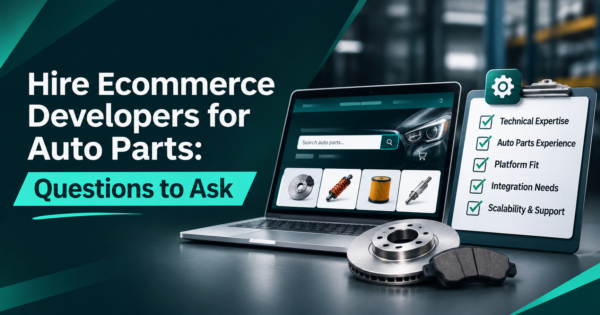
What should you ask when you hire ecommerce developers for an auto parts store?
Ask whether they have built a catalog with vehicle fitment before, how they load and validate supplier feeds, how search and fitment lookup perform at your catalog size, how stock and orders sync with your ERP and marketplaces, which platform they recommend and why, who owns the code and data after launch, and how they test fitment before it goes live. Specific answers to those seven questions tell you more than a portfolio of generic stores.
TL;DR
- An auto parts store is not a generic ecommerce build. Fitment, supplier feeds and catalog size are where parts projects fail, so test a developer on those, not on theme design or hourly rate.
- Search results for “hire ecommerce developers” are mostly freelancer marketplaces, staffing pages and agency landing pages (checked November 24, 2026). None of the top-ten titles or snippets mentions fitment or parts catalogs, so the questions that matter most for a parts seller are ones those pages do not raise.
- The seven questions below each come with what a good answer includes and what should make you walk away.
- Published hourly rates disagree widely. One vendor guide’s search snippet says $15 to $25 an hour, another says $30 to $180 for a freelancer. Neither is about parts catalogs, so compare fixed-scope quotes written against the same brief instead of comparing rates.
- Ask for proof at your scale. Our Sugar Auto Parts case study reports 6M+ products, 400+ sellers onboarded and a 90% drop in catalog upload errors after import automation. Those figures are the case study’s own, so read them as one reported project, not a benchmark.
- Whatever the developer builds, fitment rows and any compatibility claim a buyer relies on need human review before launch.
- Choose the engagement model (freelancer, agency or dedicated team) after the scope is written, not before.
Why is hiring for an auto parts store different from hiring for any other ecommerce build?
A generic store sells products that each have a name, a price and a photo. A parts store sells products that only make sense next to a vehicle. The same brake pad fits one trim and not the next, the same filter has three part numbers across brands, and the catalog behind it arrives as supplier files in formats you do not control. A developer who has only built fashion or home goods stores can ship a beautiful storefront and still miss every one of those problems.
If you plan to hire ecommerce developers for a parts business, the real risk is not that the site looks wrong. It is that the wrong part ships. Wrong-part orders become returns, and returns eat the margin on the sale. That is why the interview should spend more time on data and fitment than on design.
| Area | A generic ecommerce build assumes | An auto parts store needs |
|---|---|---|
| Catalog | A manageable number of products, edited by hand in the admin | Bulk imports from several supplier feeds, with validation before anything reaches the store |
| Product match | Search by name, category and filters | Year, make, model and engine lookup, plus search by part, OEM and interchange number |
| Data standards | Free-form attributes | A field map for fitment and product information, often based on ACES and PIES |
| Stock and orders | One store, one inventory count | Stock, price and orders kept in sync across the store, the ERP, the warehouse and marketplaces |
| Returns | Mostly taste and size | Wrong-part returns that trace back to catalog and fitment data |
The Auto Care Association describes the Aftermarket Catalog Exchange Standard (ACES) as the standard for fitment data and the Product Information Exchange Standard (PIES) as the standard for product information (association standards page, read November 23, 2026). Using them involves a paid subscription to the reference databases, so confirm current terms with the association. A developer who has worked in this industry will already know both names. One who has not will need your time to learn them, and you will pay for that learning.
What questions should you ask before you hire an ecommerce developer for auto parts?
These are the seven questions we would ask if we were buying, in the order that tends to expose the gaps fastest. For each one, listen for a specific example from a real project. A confident general answer without a case behind it is the red flag.
1. Have you built a catalog with vehicle fitment before, and can you show how it is stored?
What a good answer includes: A good answer names the structure: how vehicles are modeled, how a part links to many vehicles, how position or trim notes are kept, and how the year, make, model and engine selector queries it. They can describe at least one project and what went wrong on it. Ask whether they have worked with ACES and PIES files or mapped supplier spreadsheets to an internal format.
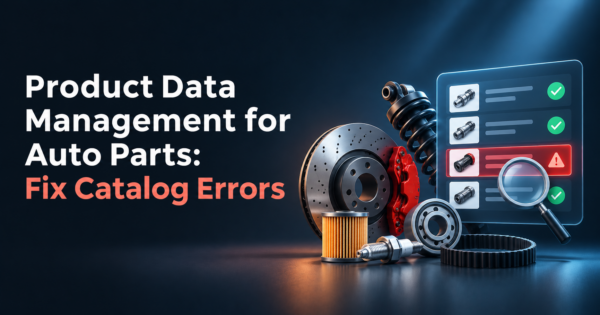
Red flag: They describe fitment as a plugin or a filter. Fitment is a data model with its own rules, and treating it as a filter is how a part ends up tied to a whole model range when it fits only some trims. Our guide to auto parts product data management shows the error patterns to test them against.
2. How will you load supplier feeds and stop bad rows from reaching the store?
What a good answer includes: A good answer describes an import gate: a staging area, required fields per category, normalized brand and part-number keys, duplicate detection, and a review queue for rejected rows. They should be able to say what happens when a feed changes format without warning. If you are also moving from another system, ask how they approach the move itself, and compare it with the tooling covered in our guide to data migration tools for ecommerce, ERP and CRM moves.
Red flag: The plan is a one-time import script. Supplier files arrive every week, so a script that runs once is a plan to repeat the cleanup forever.
3. How will search and fitment lookup perform at our catalog size?
What a good answer includes: A good answer starts with your number of products and fitment rows, and talks about indexing, caching and the search engine they would use. Ask for a reference project with a catalog in the same range and ask what they measured. Our Sugar Auto Parts case study, for example, reports that a React frontend and backend API work cut page load times by 40% on a marketplace listing millions of products.
Red flag: They test with a few hundred sample products. Slow search and slow fitment lookup only show up at full catalog size, which is exactly when it is expensive to fix.
4. How will stock, price and orders stay in sync with our ERP, warehouse and marketplaces?
What a good answer includes: A good answer names the systems on your side and how each connection works: scheduled sync or real-time events, which system is the source of truth for stock, and what happens when two channels sell the last unit at once. If you sell on eBay or ad channels as well, ask how the same product record feeds each one. Our guides on ecommerce inventory management and our AI integration services page cover the stock side and the connections.
Red flag: They treat the ERP as out of scope. Overselling and stale stock are integration problems, and a store that cannot see warehouse stock will sell parts you cannot ship.
5. Which platform would you recommend for our catalog, and what would change your answer?
What a good answer includes: A good answer gives a recommendation with reasons tied to your size, your budget and your team, and says what would change it. Shopify, Adobe Commerce (Magento), BigCommerce, WooCommerce and a custom build handle large catalogs and bulk imports differently. Read our ecommerce platform comparison before the call so you can judge the answer. A Magento development partner will usually favor Magento and a Shopify specialist will favor Shopify, so ask each one what the platform cannot do for you.
Red flag: They name one platform before asking about your catalog size, supplier formats or channels.
6. Who owns the code, the data and the documentation, and what happens after launch?
What a good answer includes: A good answer is in writing: you own the repository, the database and the configuration, the developer documents the import and sync logic, and there is a defined support period with response times. Ask who gets paged when a feed fails at night and how a new developer would take over.
Red flag: The code lives in the developer’s own account, or the sync logic is described as proprietary. If you cannot hand the project to someone else, you are renting your store.
7. How will you test fitment before launch, and what happens when a wrong part ships?
What a good answer includes: A good answer includes a hand-checked sample of fitment records per brand against a source you trust, automated checks for required fields and impossible combinations, and a way to trace each return back to the catalog row that caused it. They should tell you plainly that no script replaces the hand sample, and that a person should approve fitment records before they go live.
Red flag: They promise accurate fitment without describing how it is checked. No one can promise that without a method, and any accuracy figure should come from a sample of your own data.
Should you hire a freelancer, an agency or a dedicated team?
The engagement model matters less than the answers above, but it changes how much risk you carry. A freelancer is the cheapest to start and the hardest to replace. An agency brings a team and process but costs more per hour. A dedicated team gives you continuity on a long roadmap. For a parts store with a large catalog and several integrations, most of the real work is data and integration, which favors a team over one person.
| Model | Fits when | Watch for |
|---|---|---|
| Freelance developer | A defined, bounded task such as a feed import, a theme fix or one integration | Single point of failure, limited coverage if they are unavailable, and no second pair of eyes on fitment logic |
| Agency | A full build or replatform with design, development, data migration and integrations in one scope | Scope changes priced per request, junior staff on a senior quote, and handoff terms |
| Dedicated team or staff augmentation | A long roadmap, ongoing catalog and integration work, and your own product owner | You carry management, and the team needs a clear backlog to stay productive |
If a dedicated team looks right, our guide to hiring dedicated developers lists the checks to run before you sign. If your store runs on Shopify, our guide to the signs you need a Shopify developer covers that decision on its own platform. Published hourly rates are a poor guide here: one vendor guide’s search snippet quotes $15 to $25 an hour for ecommerce developers and another quotes $30 to $180 an hour for freelancers (snippets read November 24, 2026), and neither is about parts catalogs.
How do you compare quotes from different developers?
You compare quotes by giving every candidate the same written brief, so the numbers describe the same work. A brief that is one page long is enough to start, and it filters out candidates who quote without reading it.
- Catalog size and growth. The number of products and fitment rows today and the number you expect in a year.
- Suppliers and formats. How many supplier feeds you receive, in what formats, and how often they change.
- Channels. Your store, marketplaces and ad feeds, and which record feeds each one.
- Systems to connect. The ERP, warehouse, accounting and shipping systems that hold stock, price and orders.
- Fitment source. Where your vehicle and fitment data comes from today and who approves it.
- Success measures. Wrong-part return rate, catalog upload error rate, search speed and sync delay, each with a number you track now.
- Ownership and support. Repository and data ownership, documentation, support hours and response times.
Ask each candidate to price the import gate, the fitment model and the integrations as separate lines. A quote that bundles them into one figure hides the part that usually overruns. If the same candidate cannot say what is in each line, treat that as an answer to question one.
What does proof at your scale look like?
Ask candidates for one project at your scale and ask what changed after launch. As an example of the kind of answer to expect, on Sugar Auto Parts, a multi-seller automotive marketplace we built, the case study page reports 6M+ products and 400+ sellers onboarded in the first year. It credits import automation on AWS Lambda with reducing catalog upload errors by 90%, a Year-Make-Model (YMM) integration with reducing returns and improving buyer trust, a React frontend and API work with cutting page load times by 40%, and a web application firewall with Sucuri with reducing automated threats by 50%.
Those results come from the project team and have not been independently audited, so use them to judge what a candidate should be able to describe, not as numbers to expect on your store. Read the full Sugar Auto Parts case study to see how the import, fitment and frontend work fit together. If you want a team to scope a parts build against this list, our ecommerce development services page describes how we approach large-catalog projects.
Frequently Asked Questions
How can I hire an ecommerce web developer?
Start with a one-page written brief covering catalog size, supplier feeds, channels, systems to connect and success measures. Send it to a short list of candidates, ask each the same questions and compare answers and fixed-scope quotes. For an auto parts store, add questions about fitment, supplier feed validation and ERP sync, because generic ecommerce experience does not cover them.
What are best practices to hire a web developer?
Define the work before you contact anyone, ask for a reference project at your scale, test the candidate on your hardest problem rather than a generic one, agree who owns the code and data in writing and start with a small paid scope before a large commitment. Check references on what broke after launch, not only on what shipped.
How much does it cost to hire an ecommerce developer?
Published rates vary widely. One vendor guide’s search snippet gives $15 to $25 an hour and another gives $30 to $180 an hour for freelancers and $100 to $400 for agencies (snippets read November 24, 2026). Rates depend on location, experience and platform, and none of these figures is specific to parts catalogs. Get fixed-scope quotes against the same brief and compare what each line includes.
Should I hire a freelancer or an agency for an auto parts store?
A freelancer suits a bounded task such as one feed import or one integration. An agency or dedicated team suits a full build or an ongoing roadmap, because parts stores combine catalog data, fitment, search and several integrations that one person is unlikely to cover. Choose after the scope is written, and check that any freelancer can be replaced without rebuilding the project.
Where can I hire the best developers to build an ecommerce website?
Candidates come from freelancer marketplaces, staffing and staff augmentation firms, ecommerce agencies and referrals from other sellers in your category. The source matters less than the vetting: ask for a reference project at your scale, interview on fitment and data handling for a parts store and confirm ownership terms before you sign.
Which ecommerce platform is best for a large auto parts catalog?
No single platform wins for every parts seller. The choice depends on catalog size, how much custom fitment logic you need, your budget and your team. Ask each developer for a recommendation tied to your numbers and what would change it, then compare it with an independent platform comparison before you decide.
What should an auto parts ecommerce developer know about ACES and PIES?
They should know that the Auto Care Association describes ACES as the aftermarket standard for fitment data and PIES as the standard for product information, and that both are machine-readable XML formats. They should be able to map supplier files to an internal format whether or not your suppliers send ACES and PIES, and to flag that the reference databases carry a paid subscription.
How do I check that a developer has built an auto parts store before?
Ask for a reference project with a parts catalog and fitment, ask how fitment is stored and tested, and ask what they changed after launch. A developer with real experience will describe specific problems such as duplicate SKUs, trim-level fitment and stale supplier data. Generic answers about responsive design or checkout speed do not show parts experience.
Bottom Line
The developer you hire for an auto parts store has to be good at catalog data, fitment and integrations first, and at storefront design second. Put the seven questions to every candidate, give each one the same written brief, and compare answers and fixed-scope quotes, not hourly rates. Ask for proof at your scale and keep fitment under human review, whoever builds it. If you want a second opinion on a brief or a quote you already have, our team can review it with you.