Table of Content

Which software development methodology should you use?
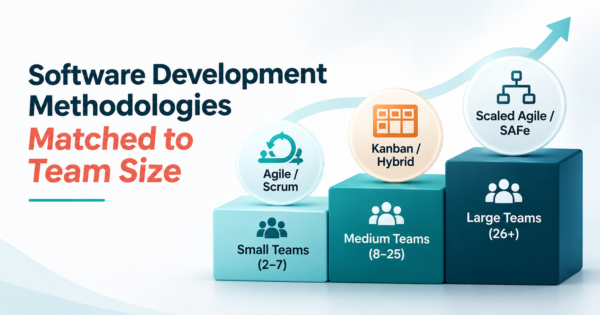
Pick the methodology that matches how stable your requirements are, how large your team is and how much regulation or contract rigidity you face. Stable requirements and strict sign-off point to Waterfall or the V-model. Changing requirements and a small team point to Scrum or Kanban. A large organization with many teams usually needs Agile at team level and a coordination layer above it. Most real projects use a mix, so choose the practices that fit, not the label.
TL;DR
- A methodology is a set of rules for how work is planned, built, tested and released. Waterfall runs in phases. Agile methods such as Scrum, Kanban and Extreme Programming work in short cycles.
- The decision depends on three things: how stable the requirements are, how big the team is and how much formal sign-off the project needs.
- A worked scoring example below shows the same five methods ranking differently for a five-person startup, a 40-person team on a regulated product and a team on a maintenance backlog.
- A second example shows why late changes hurt Waterfall more: with an assumed rework multiplier, the same change costs 3 times as much when found at week 12 as at week 2.
- Hybrid approaches are common and often right: fixed scope and budget for contract reasons, with iterative delivery inside the phases.
- The numbers in the worked examples are illustrations built for this guide, not industry statistics. Score your own project with your own inputs.
- CommercePundit builds software with iterative delivery. See the last section.
What are the main software development methodologies?
| Methodology | How it works | Best when | Watch out for |
|---|---|---|---|
| Waterfall | Fixed phases in order: requirements, design, build, test, release | Requirements are stable and well understood; strict sign-off | Late discovery of errors; slow to adapt |
| V-model | Waterfall with a test phase planned against each design phase | Safety or compliance work with formal verification | Same rigidity as Waterfall |
| Scrum | Fixed-length sprints (one month or less) with planning, review and retrospective | Changing requirements; a team of up to about ten | Skipping the retrospective; unclear product owner |
| Kanban | Continuous flow with limits on work in progress | Support, maintenance and unpredictable request streams | No time boxes can mean no sense of progress |
| Extreme Programming (XP) | Short iterations plus engineering practices such as pair programming and test-first | Teams that want high code quality and fast feedback | Needs team discipline; practices can feel heavy |
| Lean | Remove waste, deliver fast, learn early | Startups and cost-sensitive teams | A philosophy, so it needs concrete practices added |
| Spiral | Repeated cycles of planning, risk analysis, build and review | Large, high-risk projects | Heavy process for small projects |
| Rapid Application Development | Prototypes and user feedback over detailed up-front planning | Interface-heavy apps with a clear user group | Weak for large or complex back ends |
| DevOps | Joins development and operations with automation of build, test and release | Teams that release often | Not a replacement for planning; see DevOps tools |
Agile is an umbrella of values and practices, not a single method. Scrum, Kanban and XP are all ways to be agile. Our MVP development guide shows how a small product team applies iterative delivery in practice.
How do you choose a methodology?
| Question | If the answer is | Lean toward |
|---|---|---|
| How stable are the requirements? | Fixed and signed off | Waterfall or V-model |
| Likely to change as you learn | Scrum, Kanban or XP | |
| How big is the team? | Under about ten | Scrum or Kanban |
| Dozens of people in several teams | Agile per team with a coordination layer | |
| Is there regulation or a fixed-price contract? | Yes, with formal evidence needed | V-model or hybrid with documented phases |
| What is the work like? | A steady stream of small requests | Kanban |
| A new product with unknown demand | Scrum or Lean, starting with an MVP | |
| How often can you release? | Rarely | Waterfall or phase-gated hybrid |
| Whenever a change is ready | DevOps practices with Kanban or Scrum |
Worked example: the same methods rank differently for different teams
Score each method from 1 to 5 against five criteria, then weight the criteria by what the team needs. The method scores below are judgments made for this guide, not measurements, and the weights are different for each team. The weighted totals show why one method does not win everywhere.
| Criterion | Waterfall | Scrum | Kanban | XP | Hybrid |
|---|---|---|---|---|---|
| Handles changing requirements | 1 | 5 | 4 | 5 | 4 |
| Fits formal sign-off | 5 | 2 | 2 | 1 | 4 |
| Works for a large team | 3 | 3 | 3 | 2 | 4 |
| Fits a steady request stream | 1 | 2 | 5 | 2 | 3 |
| Quality practices built in | 2 | 3 | 2 | 5 | 3 |
Weights per criterion, in the order above: startup 5, 1, 1, 1, 3; regulated team 2, 5, 5, 1, 4; maintenance team 2, 1, 2, 5, 2.
| Team profile | Waterfall | Scrum | Kanban | XP | Hybrid | Highest score |
|---|---|---|---|---|---|---|
| Five-person startup, new product | 20 | 41 | 36 | 45 | 40 | XP |
| 40 people, regulated product | 51 | 49 | 46 | 47 | 63 | Hybrid |
| Maintenance and support backlog | 22 | 34 | 45 | 35 | 41 | Kanban |
The startup leans on methods that handle change, the regulated team ends up with a hybrid because sign-off and size carry weight, and the support team lands on Kanban. If your own scoring comes out close, pick the method your team already knows. A familiar method run well beats a better one run badly.
Worked example: why late changes cost more in phased projects
Assume a requirement change would take 10 hours to handle if it is found in week 2. In a phase-gated project, the same change found in later phases needs rework of design, code and tests. The multipliers below are assumptions to illustrate the shape, not statistics.
| When the change is found | Assumed rework multiplier | Hours |
|---|---|---|
| Week 2 (requirements) | 1.0x | 10 |
| Week 6 (build) | 1.5x | 15 |
| Week 12 (test and acceptance) | 3.0x | 30 |
Iterative methods do not remove change. They shorten the time between building something and learning it was wrong, so the multiplier stays near 1. Our guides to regression testing and user acceptance testing software cover how that feedback is gathered.
When does a hybrid methodology make sense?
| Constraint | Hybrid approach |
|---|---|
| Fixed price and fixed scope contract | Fix the scope and milestones, deliver each milestone in sprints and agree a change process |
| Regulated documentation | Keep required documents as outputs of each phase, built incrementally |
| Hardware dependency | Plan the hardware in phases and develop the software in sprints |
| Executive reporting by phase | Report by phase gates while the team works in iterations |
| Multiple vendors | Agree an interface contract first, then let each team iterate |
The usual mistake is calling something Agile because there are daily meetings while requirements, scope and release dates are all fixed. That is Waterfall with stand-ups, and it brings the disadvantages of both.
What does each methodology need from the team?
| Methodology | Roles and artifacts | Meeting cadence | Release rhythm |
|---|---|---|---|
| Waterfall | Project manager, analyst, developers, testers; requirements and design documents | Phase reviews | One release after testing |
| Scrum | Product owner, scrum master, developers; product backlog and sprint backlog | Planning, daily stand-up, review, retrospective | At least each sprint, often more |
| Kanban | Flexible roles; a board with limits on work in progress | Light, often a weekly review | Continuous |
| XP | Customer representative, developers; stories and automated tests | Planning game, frequent integration | Frequent small releases |
What mistakes derail a methodology?
| Mistake | What happens | Fix |
|---|---|---|
| Picking a method by fashion | The process does not match the work | Score the criteria for your project |
| Agile in name only | Fixed scope and date with daily meetings | Agree what flexes: scope, date or budget |
| No clear owner for priorities | The backlog is a wish list | Name one product owner with authority |
| Skipping retrospectives | The same problems return | Hold one every cycle and act on one item |
| Too many work items in progress | Everything is started and nothing finishes | Limit work in progress |
| Ignoring testing until the end | Defects pile up | Test within each iteration |
If you need extra hands to run the chosen method, see how staff augmentation and dedicated developers fit in, and compare custom software development companies. Our project management dashboard guide shows what to track once work is running.
Frequently Asked Questions
What are the main software development methodologies?
The best known are Waterfall, the V-model, Scrum, Kanban, Extreme Programming, Lean, Spiral, Rapid Application Development and DevOps practices. Agile is the umbrella for the iterative methods.
What is the difference between Waterfall and Agile?
Waterfall completes each phase in order before moving to the next. Agile works in short cycles, building and reviewing a small part at a time, so changes are cheaper to absorb.
When should you use Waterfall?
Use it when requirements are stable and well understood, sign-off is formal, or regulation requires documented phases. It suits projects where change is unlikely or costly to manage after the fact.
What is the difference between Scrum and Kanban?
Scrum works in fixed-length sprints with defined roles and ceremonies. Kanban is a continuous flow with limits on work in progress and no required time boxes, which suits support and maintenance work.
Which methodology is best for a startup?
Most startups benefit from an iterative method such as Scrum or Kanban with a Lean mindset, because requirements change as they learn. Start with a small first release and adjust.
Can you combine methodologies?
Yes. Hybrid approaches are common, such as fixed milestones for a contract with sprints inside each milestone. Choose practices that fit your constraints rather than adopting a label.
What is the best methodology for a large enterprise?
Large organizations often use Agile within teams and a coordination layer across teams, with phase-gated governance where regulation requires it. The right mix depends on your constraints.
How long should a sprint be?
Scrum sprints are one month or shorter. Many teams use one or two weeks, which gives faster feedback while leaving enough time to finish meaningful work.
Is DevOps a methodology?
DevOps is a set of practices and a culture that joins development and operations, with automation for build, test and release. It complements methods such as Scrum and Kanban.
Bottom Line
Choose the methodology by the constraints you actually have: how stable the requirements are, how big the team is and how formal the sign-off must be. Score the options, prefer the method your team can run well and mix practices when contract or compliance demands it. If you want a team that delivers in short cycles, see our MVP development services and custom web development services.