Table of Content

How much does mobile app development cost?
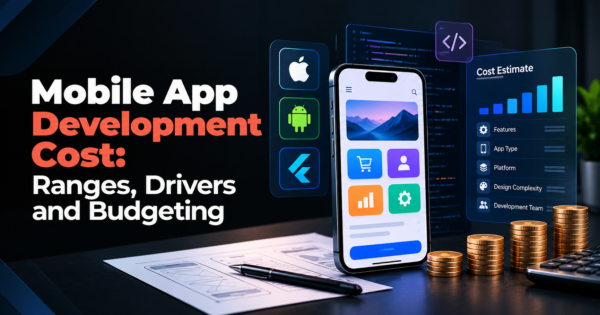
Mobile app development cost depends mainly on complexity. One agency guide puts simple apps at $5,000 to $30,000, medium apps at $30,000 to $100,000 and complex apps at $100,000 or more, plus maintenance of about 15% to 25% of the build cost each year. These are published estimates from companies that sell development, so use them to frame a budget and then get written quotes for your own scope.
- Complexity sets the price. A published agency guide (Serdao, May 9, 2026) lists simple apps at $5,000 to $30,000, medium at $30,000 to $100,000 and complex at $100,000 or more.
- App type matters too. The same guide lists e-commerce apps at $30,000 to $150,000 or more, on-demand apps at $50,000 to $250,000 or more and fintech apps at $100,000 to $400,000 or more.
- Budget for life after launch. Both guides put yearly maintenance at roughly 15% to 25% of the original build cost, and Blaze lists Apple at $99 a year and Google Play at a one-time $25 for store accounts.
- Development is not the whole bill. Serdao allocates 40% to 60% of a budget to development, 15% to 25% to UI and UX design, and the rest to planning, testing and release.
- The cheapest way to learn what you need is a minimum viable product, not a full build. Define the smallest version that proves demand.
- CommercePundit builds MVPs, web apps and cross-platform apps for startups and enterprises.
How much does mobile app development cost?
Anyone who quotes you a price before asking what the app must do is guessing. The same word, “app,” covers a calculator and a ride-hailing platform, and the cost gap between them is enormous. The ranges below come from two published guides, both written by companies that sell development: Serdao, dated May 9, 2026, which says plainly that its figures “are still estimates,” and Blaze, updated April 2, 2026, which sells a no-code platform. Neither cites a survey for most of its numbers, so read them as framing, not as benchmarks.
How much does an app cost by complexity?
| Complexity | Serdao estimate | Typical examples (Serdao) |
|---|---|---|
| Simple | $5,000 to $30,000 | Calculators, basic business or information apps |
| Medium | $30,000 to $100,000 | E-commerce, fitness tracking, booking apps |
| Complex | $100,000 or more | Social platforms, ride-hailing, fintech |
Blaze gives a different cut. It lists native mobile apps at $20,000 to $250,000 for a typical build, hybrid apps at $50,000 to $100,000 for typical and $100,000 to $200,000 or more for highly complex, and notes a Forbes figure of about $80,000 for a WhatsApp-style app. Most of those ranges have no named source. The overlap between the two guides is a useful signal: expect tens of thousands for a focused app and six figures for anything with real-time features, payments or heavy integrations.
How much does an app cost by type?
| App type | Serdao estimate |
|---|---|
| E-commerce | $30,000 to $150,000 or more |
| On-demand | $50,000 to $250,000 or more |
| SaaS | $60,000 to $200,000 or more |
| Social media | $80,000 to $300,000 or more |
| Fintech | $100,000 to $400,000 or more |
The types that cost more share features: payments, user-to-user interaction, location, real-time updates, regulated data and large integrations. If your idea is a software product with accounts and subscriptions, our guide to SaaS examples shows what that scope looks like in practice.
What drives mobile app development cost?
| Driver | How it moves the price |
|---|---|
| Features and screens | Every screen and rule needs design, build and testing |
| Platform choice | iOS only, Android only, both native, cross-platform or a web app |
| UI and UX design | Custom design and animation cost more than standard components |
| Backend and data | Accounts, databases, admin tools and APIs are often half the work |
| Third-party integrations | Payments, maps, messaging, analytics, ERP and CRM links |
| Security and compliance | Regulated data raises testing and documentation effort |
| Team location and model | Rates differ by region; freelancers, agencies and in-house teams price differently |
| Maintenance and updates | OS releases, bug fixes and new features recur every year |
How should you split an app budget?
| Stage | Share of budget (Serdao) | Our example on an assumed $60,000 build |
|---|---|---|
| Planning and research | 10% to 15% | $6,000 to $9,000 |
| UI and UX design | 15% to 25% | $9,000 to $15,000 |
| Development | 40% to 60% | $24,000 to $36,000 |
| Testing and QA | 10% to 15% | $6,000 to $9,000 |
| Deployment | 5% to 10% | $3,000 to $6,000 |
| Post-launch maintenance | 15% to 25% a year | $9,000 to $15,000 a year |
The right-hand column is our arithmetic on a $60,000 assumption, not a quote, and the ranges overlap so they will not sum to the total. The point is the shape: development is about half the bill, and maintenance is a recurring cost to plan for from the start.
What does an app cost to run after launch?
- Maintenance: Blaze gives a rule of thumb of 15% to 20% of the original development cost per year, and Serdao says 15% to 25%.
- Store fees: Blaze lists Apple at $99 a year and Google Play at a one-time $25.
- Hosting and services: servers, databases, push notifications, email and SMS, maps and analytics, usually billed by usage.
- Updates: Blaze lists minor updates at $1,000 to $5,000 and major updates at $10,000 to $50,000 or more.
- Support and monitoring: crash reporting, user support and security patches.
Native, cross-platform or web app: which is cheapest?
| Approach | Cost pattern | Trade-off |
|---|---|---|
| Native iOS and Android | Two codebases, so cost rises with each platform | Best performance and device access |
| Cross-platform | One codebase can reduce cost and time | May underperform native for demanding features |
| Progressive or responsive web app | Generally cheaper than native for many business tools | No store presence and fewer device features |
| No-code or low-code | Lowest upfront cost for simple apps (Blaze lists plans from $400 a month) | Limits on customization and portability; Blaze sells this, so treat its comparison as promotional |
Choose the approach from the user need, not from the price list. A booking app for local customers may be fine as a web app; a camera, offline or payments-heavy app may need native features. Our React development and full-stack teams build cross-platform and web apps with shared code.
How can you reduce the cost without cutting quality?
- Start with an MVP. Build the smallest version that proves demand. See our MVP development guide for founders and MVP development services.
- Phase features. Launch with the core flow and add secondary features after real usage.
- Reuse components. Standard UI kits, authentication and payments services save weeks.
- Pick one platform first if your users are concentrated.
- Write requirements before quotes. Vague scope is the main cause of change orders.
- Plan for AI features carefully. They add API, data and testing cost; see AI agent development cost and our AI development services.
A simple way to estimate your own app budget
The cost to build an app and the total cost of app development are not the same number: the second includes everything after launch. Estimate both before you commit.
Illustration with assumed numbers: if a team estimates 800 hours of design, development and testing for a focused app and bills at $75 an hour, the build costs $60,000. Blaze lists freelancer rates of $25 to $150 an hour, so the same hours could run from $20,000 to $120,000 depending on who does the work. Add 15% to 25% a year for maintenance, which on $60,000 is $9,000 to $15,000. The estimate tells you what to ask each vendor: how many hours, at what rate, covering which features, and what is excluded.
How do you compare app development quotes?
| Check | Why it matters |
|---|---|
| Scope in writing | Feature list, platforms, integrations and what is out of scope |
| Hours and rates | Shows how the total is built and lets you compare fairly |
| Team and seniority | Who will actually design, build and test |
| Milestones and acceptance criteria | Payment tied to delivered work |
| Ownership | You should own the code, designs and accounts |
| Post-launch terms | Warranty period, bug-fix policy and maintenance price |
| Change process | How new requests are estimated and approved |
If you are choosing a partner, our list of custom software development companies explains how to compare firms, and our guide to hiring dedicated developers covers the team-based option.
What mistakes inflate app budgets?
- Building everything at once instead of validating a core flow.
- Ignoring maintenance, then running out of budget in year two.
- Choosing the lowest bid without checking scope and seniority.
- Changing requirements midstream without a change process.
- Underestimating the backend and admin tools.
- Skipping testing on real devices.
Frequently Asked Questions
How much does mobile app development cost?
Published estimates run from about $5,000 to $30,000 for a simple app, $30,000 to $100,000 for a medium app and $100,000 or more for a complex one, according to one agency guide. Your cost depends on features, platforms, integrations and who builds it.
How much does it cost to make an app?
The same ranges apply. A focused app with a few screens may cost tens of thousands of dollars, while apps with payments, real-time features or heavy integrations commonly run into six figures. Get a written estimate based on your feature list.
How much does it cost to build my own app?
If you build it yourself with a no-code tool, the tool can cost a few hundred dollars a month. Blaze lists a no-code plan from $400 a month. With developers, expect the hourly rates and hours that match your scope.
How much does app maintenance cost?
Two published guides put yearly maintenance at roughly 15% to 25% of the original build cost. Add store fees, hosting, third-party services and any new features.
How much do mobile app developers charge per hour?
Blaze lists freelancer rates of $25 to $150 an hour depending on experience and location. Agency rates vary by region and seniority; see our guide to staff augmentation for published benchmarks.
Is it cheaper to build an app for iOS or Android?
Costs are similar per platform. Building native apps for both roughly adds a second build. A cross-platform framework can reduce the total, with some trade-offs in performance for demanding features.
What features make an app expensive?
Payments, user-to-user messaging, live location, real-time updates, video, AI features, regulated data and large integrations with existing systems.
How long does it take to build a mobile app?
Simple apps can take a few weeks, according to Serdao, while complex apps need extensive planning, development and testing. Timelines depend on scope and team size, so ask each vendor for a milestone plan.
Can AI tools build an app for me?
AI tools can generate code and prototypes quickly, and they can lower the cost of early drafts. A production app still needs design decisions, testing, security review, hosting and ongoing maintenance, so budget for those.
Should I build an MVP first?
In most cases yes. An MVP proves demand with the smallest set of features, so you spend on a full build only after you have evidence that users want it.
Bottom Line
Mobile app development cost is a function of scope, platform and team. Use published ranges to frame the conversation, write requirements before you collect quotes, plan maintenance from the start, and begin with an MVP so you learn before you spend. To scope your app with us, see our MVP development services or full-stack development services.