Table of Content

What is answer engine optimization?
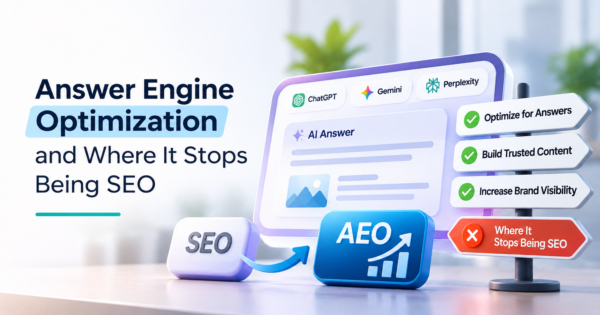
Answer engine optimization (AEO) is the practice of writing and structuring pages so AI answer tools and Google’s AI features can pull a passage from them and name your brand as the source. It sits on top of SEO. A page that is not crawled, indexed and trusted has nothing for an answer engine to quote.
TL;DR
- AEO, GEO, LLM optimization and AI search optimization are different names for one job: getting quoted and named inside generated answers.
- Google’s own documentation says there are no extra requirements and no special files or markup for its AI features. The work is SEO fundamentals plus answer-ready writing.
- The change is in the unit you optimize. SEO wins a page in a list. AEO wins a passage inside an answer.
- Clicks fall when an AI summary appears. Pew Research measured 8% of visits clicking a traditional result with a summary versus 15% without one, so visibility without a click needs its own scorecard.
- In our own Search Console export, queries of ten or more words earn about 15% of impressions and about 2% of clicks. Long, prompt-style questions are showing up, and they do not click.
- Measure by sampling a fixed prompt set on a schedule. No tool gives a complete picture, and answers change between runs.
- For the full technical checklist, use our guide to optimizing for AI Overviews and LLM answers. This guide is the decision layer above it.
What answer engine optimization means
An answer engine is any product that responds to a question with a written answer instead of a list of links. Google’s AI Overviews and AI Mode, ChatGPT search, Perplexity, Gemini and Microsoft Copilot all behave this way. When one of them answers “how do I choose a Shopify agency,” it assembles the reply from a handful of pages and sometimes names them. Answer engine optimization is the work of becoming one of those pages.
You will see the same idea sold under several labels. Generative engine optimization (GEO), LLM optimization and AI search optimization all describe optimizing for generated answers. The labels come from different vendors and have no formal standard behind them. For a buyer the practical point is simple: if a proposal promises “AEO” and another promises “GEO,” ask each what they would change on your pages and how they would measure it. The answers matter more than the acronym.
There is also a narrower older meaning. Before AI summaries, AEO often meant winning featured snippets and voice answers. That work still counts, because a snippet-ready paragraph is also an answer-ready paragraph. What changed is the number of places that quote you and how few of them send a visit back.
What Google says you need to do
Start with the owner of the largest answer surface. Google’s page on AI features and your website says a page must be indexed and eligible to be shown in Search with a snippet. It adds that there are no additional technical requirements, and no special optimizations are necessary to appear in AI Overviews or AI Mode. It also says you do not need to create new machine-readable files, AI text files or markup to appear in these features.
The best practices Google lists are the ordinary ones: let crawlers reach the page, make content findable through internal links, give readers a good page experience, keep important content available as text, and keep structured data consistent with what is visible on the page. Google also says traffic from these features is included in overall search traffic and reported in the Performance report under the Web search type.
That has two consequences. First, any promise of a secret technique for Google’s AI features deserves suspicion, because Google states there is none. Second, the real gap on most sites is basic: pages that are slow, thin, hard to crawl or never linked to. Fix those first. Our search engine optimization work starts there for the same reason.
AEO vs SEO in practice
The two are not rivals. SEO earns the crawl, the index entry and the authority. AEO decides whether a specific paragraph on that page is clear enough to be lifted. The table lays out where the daily work differs.
| Question | SEO | AEO |
|---|---|---|
| What are you trying to win? | A position for a page in a results list | A quoted passage and a named source inside an answer |
| What does the content look like? | Complete coverage of a topic, built to satisfy a search | The same coverage, with a short self-contained answer under each question heading |
| What does it depend on? | Crawlability, links, relevance, page experience | All of that, plus clear facts, consistent naming and mentions on other sources |
| How do you measure it? | Rankings, clicks, conversions in Search Console and analytics | Sampled prompts: is the brand named, is the page cited, is the answer correct |
| What if you skip the other one? | You rank but may not be quoted | You write good answers on pages nobody can find |
If you are weighing the two as a budget line, the honest split is that AEO is a content and measurement layer added to an SEO program, not a replacement for it. A team with weak technical SEO should fund that first. A team that already ranks well and wants to be named in AI answers can start with the passage-level work below.
What the click data shows
The reason to care is not that answers are new. It is that they change who gets the visit. Pew Research Center studied the browsing of 900 U.S. adults in March 2025 and published the results on July 22, 2025. When a Google search showed an AI summary, users clicked a traditional result in 8% of visits. When it did not, they clicked in 15%. Clicks on links inside the summary itself were 1% of visits, and 26% of pages with a summary ended the browsing session, against 16% without one. Pew found that 18% of the searches in its sample produced a summary. Those are March 2025 numbers from one panel, so treat them as direction, not a forecast for your category.
Google’s documentation makes a different claim, that clicks coming from AI Overviews tend to be higher quality. Both can be true at once: fewer visits, and the ones that arrive are more engaged. Neither tells you what happens on your site, so measure it there.
Our own data points the same way. In the Search Console query export we pulled in November 2026 (68,005 query rows and about 1.95 million impressions), queries of ten or more words account for roughly 15% of impressions and about 2% of clicks. Queries of fifteen or more words account for about 4% of impressions and a single click. Many of the long ones read like prompts typed into an assistant, not like keyword searches. One example asks which SEO agency is best for AI-native answer engine optimization of blog posts, experiment pages and OKR pages, and it shows about 3,000 impressions and no clicks. This is query-level data, which Google anonymizes in part, so it is not a page total. It does show that the demand shape is moving toward full questions that get answered without a visit.
What to change on a page
Answer engines lift passages, so the unit of work is the passage. These are the changes that cost little and apply to any page.
Put the answer first under each question heading
Write the heading as the question a buyer would ask, then answer it in the first one or two sentences, then explain. Keep the answer complete without the paragraphs around it, because an engine may quote only that block. Here is an invented before-and-after to show the shape. The “before” opens with context: “Headless commerce has become a topic of growing interest as brands rethink how storefronts are built and managed over time.” The “after” opens with the answer: “Headless commerce separates the storefront your customers see from the commerce engine that holds products, carts and orders, so each can change without rebuilding the other.” The second version can be quoted as it stands.
Name things the same way every time
Pick one name for your company, products and services and use it consistently on your site, your profiles and your listings. A model that sees three spellings has to guess whether they are one entity. Use plain descriptions for services, with the specific platform names a buyer searches for.
Back claims with a source you can name
An unsourced figure is the first thing to cut from an answer. Where you state a number, say where it came from and when. Where you have your own data, such as costs from projects you delivered, state what it covers and what it does not.
Keep visible text and structured data in agreement
Google says structured data should match the visible page text. That rules out marking up an FAQ that readers cannot see. If you add FAQ markup, show the questions and answers on the page too. Structured data helps machines read a page, but it does not replace a clear paragraph, and Google says it does not require special schema to appear in its AI features.
Link the pages that belong together
Answer engines and crawlers both follow internal links to understand which page owns which topic. Link your explainer to the service page it supports and to the deeper guide on each sub-question. Our ecommerce SEO strategies guide shows the same pattern applied to a store.
Crawler access: separate the training bot from the search bot
Many sites block every AI crawler and later wonder why they are never named. OpenAI documents three agents with different jobs. OAI-SearchBot is for search and surfaces sites in ChatGPT’s search features, and OpenAI says sites opted out of it will not be shown in ChatGPT search answers. GPTBot gathers content that may be used to train its models, and disallowing it does not govern search visibility. ChatGPT-User handles actions a person starts inside ChatGPT, and because a user triggers those visits, robots.txt rules may not apply to it. OpenAI also notes that each robots.txt setting is independent and that changes can take about 24 hours to take effect. The details are on its crawler documentation page.
The decision for you is policy, not tactics. If you want to be named in ChatGPT answers, allow OAI-SearchBot. Whether to allow training crawlers is a separate business and legal choice. Check the current documentation of every vendor before you edit robots.txt, since these agents change.
How to measure AEO without fooling yourself
No dashboard shows every answer your brand appears in. Google reports AI feature traffic inside the Web search type of the Performance report, so do not expect a clean AI-only line there. Third-party trackers sample prompts and report visibility, and they differ from each other. We compare several in our guide to AI rank tracking tools.
A simple method you can run yourself:
- Write a fixed list of 20 prompts a buyer would ask, mixing brand, category and comparison questions.
- Run each prompt in each engine you care about, three times, on the same day each month. Answers change between runs, so one result proves little.
- Record whether your brand is named, whether a page of yours is cited, which page, and whether the statement about you is correct.
- Track the share of runs where you are named and the share where the claim is accurate. Watch the trend, not a single month.
- In analytics, watch visits from AI assistant referrers and branded search. Both are noisy, and both are worth watching next to the sampled prompts.
Two cautions. Sampling shows presence, not revenue, so tie it back to leads or sales you can count. And a competitor’s tool reporting “your visibility” is describing its own prompt set, which may not match your buyers.
What not to believe
Much of the advice in this area is unsupported, so hold these claims to a standard:
- “You need a special file or markup to be included.” For Google, its documentation says you do not. An optional file can still be harmless, but do not pay for it as a fix.
- “FAQ schema guarantees a citation.” Markup helps a machine read a page. It does not make the page the best answer.
- “The perfect answer is 40 words.” You will see exact length rules. We did not find evidence behind them. Write the shortest complete answer, which varies by question.
- “AEO replaces SEO.” The mechanics above say otherwise. If a page is not indexed, it cannot be quoted by a system that retrieves from the web.
- “Results in weeks.” Nobody can promise a timeline when answers shift between runs and the engines change.
An AEO strategy for a small team
If you have a services site and one person’s time, this sequence works without new tools.
- Week one, access. Confirm pages are indexed and crawlable, check robots.txt for the search bot decision, and fix any money page that is slow or thin.
- Week two, answers. Take your five highest-value pages, put a direct answer under each question heading and cut the introductions that delay it.
- Week three, proof. Add a source and date to each number, and add real project facts you can defend.
- Week four, baseline. Build the 20-prompt list, run the first sample and save the results. You now have a number to improve against.
Repeat monthly and expand to the next five pages. This is also the order we follow when we do AI SEO services work, because the measurement step is what keeps the other three honest.
AEO services: what to ask an agency
“AEO services” is a new category and the quality varies. A competent provider should be able to show you what it will change on your pages, how it will sample answers, and what it will report. Ask these questions before you sign:
- Which pages will you change first, and what will you write on them?
- How do you sample answers, with how many prompts, how often, and in which engines?
- What happens to the technical SEO problems you find? Who fixes them?
- How will you report visibility separately from visits and leads?
- What will you not promise?
Compare the answers with the way an experienced SEO would work, which our guides on how to hire an SEO expert and what SEO costs cover. If you want a comparison of providers, our list of AI SEO agencies is the place to start, and the AI search engines comparison shows the products you are trying to appear in. For tooling that supports the work, see our SEO tools roundup.
Frequently asked questions
What is AI search optimization?
AI search optimization is another name for answer engine optimization. It means preparing your pages and brand so AI products such as Google’s AI Overviews, ChatGPT search and Perplexity can use your content and name you as a source. It builds on regular SEO and adds passage-level writing and answer sampling.
What is the difference between AEO and SEO?
SEO aims to rank a page in a list of links. AEO aims to have a specific passage quoted, and your brand named, inside a generated answer. They share the same foundation of crawlable, trusted pages, so most teams run AEO as an added layer on their SEO work.
Does AEO replace SEO?
No. Google says its AI features use the same eligibility as normal Search, meaning a page must be indexed and eligible to show with a snippet. A page that is not indexed cannot be quoted. AEO adds work on top of SEO and does not remove it.
Is SEO still relevant if AI answers questions?
Yes, because traditional results still appear and AI features draw on indexed pages. Pew found people clicked traditional results less often when a summary appeared, 8% against 15% of visits, so the value of a visit rises and visibility without a visit needs measuring too.
Do I need an llms.txt file for AEO?
Google says you do not need new machine-readable files, AI text files or markup to appear in its AI features. An optional file does no harm, but it is not a requirement for Google, and it should not be where your budget goes first.
Should I block AI crawlers in robots.txt?
It depends on what you want. OpenAI says sites opted out of OAI-SearchBot will not be shown in ChatGPT search answers, while GPTBot relates to model training and does not govern search visibility. Decide search inclusion and training access separately, and read each vendor’s current documentation first.
How do I measure answer engine optimization?
Sample a fixed list of prompts in each engine on a schedule, run each more than once, and record whether your brand is named, whether a page is cited and whether the claim is accurate. Pair that with Search Console and analytics for visits and leads. No single tool gives a complete picture.
How long does AEO take to work?
Nobody can give an honest fixed timeline, because answers change between runs and engines change their behavior. Technical fixes and rewritten answers can be crawled within days or weeks, but visibility in generated answers varies. Track the monthly trend instead of waiting for a date.
Can ChatGPT do SEO for me?
It can draft outlines, rewrite answers and suggest questions, which speeds up the writing. It cannot confirm that your pages are indexed, verify your facts or measure your visibility. Use it as a drafting aid and keep a person responsible for accuracy and sources.
Bottom line
Answer engine optimization is SEO with a sharper focus on the passage and a new way of measuring. Make sure your pages can be crawled and trusted, write a direct answer under each question, keep names and sources consistent, decide your crawler policy on purpose, and sample a fixed prompt list every month. If you want a team to run that sequence for you, talk to us about AI SEO services.