Table of Content

What is an AI proof of concept?
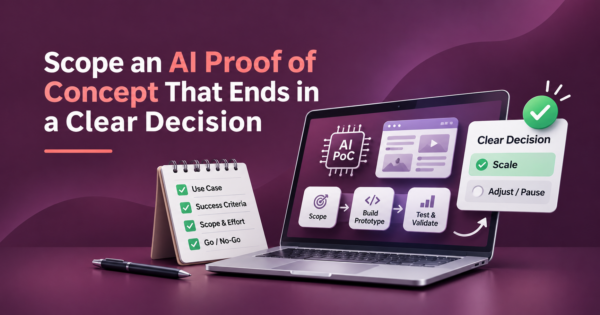
An AI proof of concept (AI PoC) is a small, time-boxed test that shows whether one AI idea works on your real data and is worth building. Most run two to eight weeks and end with a written decision: go, pivot or stop. It produces evidence, not a finished product.
TL;DR
- An AI proof of concept answers one question: can this work on our problem? It does not answer whether people will adopt it or whether it can run at scale. A pilot and a production build answer those.
- Scope it around one business decision, the smallest workflow that still matters, and the riskiest assumption, not the easiest feature to demo.
- Write the success numbers and the go, pivot and stop rules before any building starts. A proof of concept judged after the results arrive is a demo.
- Plan on two to six weeks for a narrow use case on usable data, and longer when the data needs cleanup first. Typical US cost is covered below.
- Most proofs of concept stall for the same reasons: a vague goal, sample data cleaner than the real thing, no owner and scope that keeps growing.
- For what an outside specialist charges, see our guide to what an AI consultant costs.
What is an AI proof of concept, and how is it different from a pilot or an MVP?
An AI proof of concept is an experiment, not a product. You take one narrow use case, run it against a representative sample of your own data, and measure the result against targets you set in advance. When it ends, you know whether the approach is feasible and whether the value is large enough to justify the next stage. Teams also call it an AI PoC, and the term is often used loosely, which is where trouble starts. A stakeholder who hears “proof of concept” and pictures a working tool will be disappointed by a feasibility test, and the project can be canceled for the wrong reason.
The four stages below are often used interchangeably, but each answers a different question and carries a different level of cost and risk.
| Stage | Question it answers | Data used | What you walk away with |
|---|---|---|---|
| Proof of concept | Can this work on our problem? | A representative sample of real data | Evidence and a go, pivot or stop decision |
| Prototype | What would using it look like? | Mock or limited data | A demo for stakeholder feedback |
| Pilot | Does it hold up with real users? | Live data and a small group of users | Measured results inside a real workflow |
| MVP or production build | Can we run it every day? | Live data with full integration | A system your team operates |
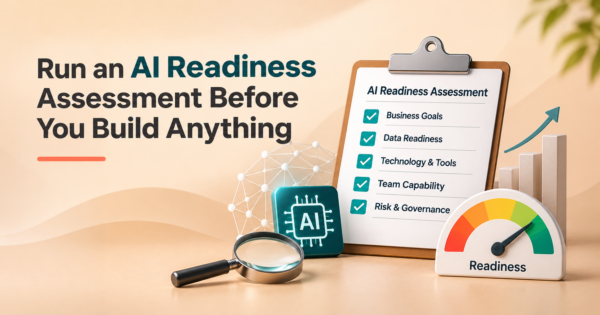
The gap between the first and last row is where many AI projects fail. A proof of concept can show that a model summarizes contracts well enough, and the next stage can reveal that running it on every contract costs more than the work it replaces. That is why the proof of concept should include a rough cost-per-task estimate, not only an accuracy score. If you are still deciding whether your data and systems can support AI at all, that question comes first, and a readiness review is the cheaper way to answer it.
How do you scope an AI proof of concept?
Scoping is where a proof of concept is won or lost. A well-scoped test is narrow enough to finish and pointed enough to settle a real decision. These steps keep it that way.
Start with one business decision
Write the decision the result will feed, in one sentence. “Should we automate first-pass review of supplier invoices?” is a decision. “Explore what AI can do for finance” is not. If you cannot name who makes the decision and when, the proof of concept has no destination, and it will drift into a demo.
Choose the smallest workflow that still matters
Pick one workflow, one data source and one type of user. Leave out edge cases, extra languages, a polished interface and every integration that is not needed to test the idea. A proof of concept that tries to solve scale, security and design at the same time ends up proving none of them. The workflow still has to matter, though. If the best possible result would not change a number the business cares about, choose a different one.
Test the riskiest assumption first
Every AI idea rests on a few assumptions: the data contains the signal, the model can read the documents, the answers are accurate enough for the task, the cost per task works. Find the one most likely to be false and test that, not the feature that is easiest to show. If it fails, you learn it in weeks instead of after a full build.
Measure the current process before you build
You cannot say an AI result is better without a baseline. Record how long the task takes today, how often it contains errors and what it costs. Even a rough baseline from two weeks of real work gives the proof of concept something to beat.
Set success criteria at three levels
Write each target as a number, and write them before the build starts.
- Business outcome. The result the sponsor cares about: hours saved per week, cost per ticket, error rate or turnaround time.
- Workflow fit. Whether the person using the output accepts it: the share of answers used as-is, the share edited and the share rejected.
- Technical performance. Accuracy against a reviewed answer set, response time and cost per task at the volume you expect.
A model can pass the third level and fail the first two. An answer that is accurate but slows down the person who must check it has not improved the workflow, so all three belong in the criteria.
Prepare a representative data sample and an evaluation set
Use real data, with the messiness production will have: duplicates, missing fields, odd formats and the exceptions people handle by hand. Confirm who owns the data, whether it contains personal or regulated information, and whether you are allowed to use it. Then build an evaluation set, a collection of real cases with answers reviewed by a subject-matter expert, so every result is scored the same way. If you cannot describe what clean data looks like for your use case, that assessment is the first task and the AI build is the second.
Build the minimum that tests the assumption
Use existing models, standard interfaces and lightweight pipelines instead of custom infrastructure. Skip user interface polish. Log every input, output and failure from day one, because the log is how you prove performance against your criteria and how you find out why the errors happen. The same rule applies to AI automation: prove the workflow on a thin slice before wiring it into everything.
Name one owner
Someone on your side must own the question, supply the data, review the answers and make the final call. A proof of concept run entirely by an outside team, with no internal owner, tends to produce a report nobody acts on.
What should the AI proof of concept decide? Go, pivot or stop
A proof of concept ends with a decision, and the decision rules should be written before the first test runs. Agreeing on them in advance protects you from two common failures: declaring success because the demo looked good, and abandoning a promising idea because the first run was imperfect.
- Go. The results meet the thresholds. Move to a pilot with real users and live data, and use the cost and failure findings to plan it.
- Pivot. The idea has value but the approach missed. Change the data, the workflow or the model, and run one more short round with the same criteria.
- Stop. The assumption failed, the cost does not work or the data cannot support it. Stopping here is a good outcome. You spent a small amount to avoid a large one.
Use a short checklist at the review meeting. Each row needs a written threshold from week one.
| Check | Go if | Pivot if | Stop if |
|---|---|---|---|
| Accuracy on the evaluation set | Meets the written threshold | Misses it, and the errors cluster in a fixable case | Misses it, and the errors are spread across every case |
| Workflow fit | Reviewers use most outputs as they are | They use it but edit heavily | Checking costs more time than the old way |
| Cost per task at expected volume | Fits the business case | Too high, but a cheaper model or smaller scope is plausible | Exceeds the value of the work |
| Data access in production | The same data is reachable, permitted and maintained | Access needs a defined fix | The data cannot be used or kept current |
| Risk and security | Privacy and security review is clear | Controls are missing but buildable | The risk cannot be reduced to an acceptable level |
How long does an AI proof of concept take and what does it cost?
Most scoped proofs of concept run two to six weeks when the use case is narrow and the data is usable. Plan for up to eight weeks or more when the data needs cleanup first or when the pipeline is custom. If a proof of concept keeps running past that, the scope has grown or the data was not ready when the build began, and the team is spending the schedule on data repair instead of the experiment.
Cost follows scope. A proof of concept should cost a small fraction of the build it is meant to justify. Typical US pricing for a proof of concept that tests feasibility without production integration runs about $50,000 to $150,000, the same range covered in our guide to what an AI consultant costs and delivers. If the price approaches the cost of a pilot, the scope has broken down. For the build that follows, our breakdown of AI agent development cost shows what the next stage adds. These figures are averages, so for an exact price for your project, contact us for a quotation.
Why do AI proofs of concept stall?
An AI PoC that impresses in a demo and never reaches production is a familiar pattern. The cause is rarely the model. It is usually the setup.
- A vague goal. The team built something impressive that is tied to no business metric or decision, so no result can count as success.
- Data that is cleaner than reality. The test used a tidy sample, and production data is scattered, permission-restricted or full of exceptions.
- Success defined afterward. The criteria were written after the results came in, so the test was a demo.
- Scope creep. Edge cases, scale and security were all added to the first test, and the timeline doubled.
- Ignored running costs. Nobody estimated response time, usage cost and maintenance at real volume, so the business case collapsed at the pilot stage.
- No owner. Nobody on the business side was accountable for the question, so the results had no audience.
- Integration left for later. The idea worked in isolation, but connecting it to the systems your team already uses was never tested.
What happens after the AI proof of concept?
A “go” moves you to a pilot: the same workflow, live data, a small group of real users and a measurement plan. Carry forward the evaluation set, the cost-per-task figure and the list of failures the proof of concept found, because they are the starting point for the pilot design. Our guide on how to integrate AI into your business covers the integration work that follows, and our overview of AI consulting services explains which parts of that work are advice and which are engineering.
If you want a team to run the test or build the stage after it, our AI integration services connect AI to the systems you already run, and our AI development services cover custom builds. Either can start from a scoped proof of concept so you decide with evidence.
Frequently Asked Questions
How long should an AI proof of concept take?
Most scoped AI proofs of concept take two to six weeks for a narrow use case on usable data. Work that needs data cleanup or a custom pipeline can run up to eight weeks or more. If yours is running longer, the scope has grown or the data was not ready, and it is worth pausing to re-scope.
What data do you need before starting an AI proof of concept?
You need a representative sample of the data the AI will act on, clear ownership of that data and a basic quality check. Include the messy cases, not only clean examples. If you cannot describe what clean data looks like for your use case, assessing the data is the first task, not building the AI.
How is an AI proof of concept different from a pilot or an MVP?
A proof of concept tests whether the approach can work, using a sample of data. A pilot runs the workflow with real users and live data to see whether it holds up. An MVP or production build is a system your team operates every day. Each stage answers a different question and costs more than the one before it.
How is a proof of concept different from hiring a team to build an AI tool?
A build produces working software. A proof of concept produces evidence and a decision, and it stops before the full build. Treating the two as the same leads to mismatched expectations, such as a team expecting a finished product from what is only a feasibility test.
How much does an AI proof of concept cost?
Typical US pricing for a proof of concept without production integration runs about $50,000 to $150,000, and the cost rises with data cleanup, custom pipelines and integrations. These are averages, so for an exact price, contact us for a quotation.
How do you know an AI proof of concept succeeded?
You define success before the test starts and judge the results against it. Good criteria cover three levels: a business outcome such as hours saved, workflow fit such as the share of answers used as they are, and technical performance such as accuracy against reviewed answers, response time and cost per task. Criteria written after the results arrive turn the test into a demo.
Should a proof of concept use an open-source model or a hosted one?
For most proofs of concept, a hosted model is the fastest route to a working result because it needs little infrastructure. An open-source model is worth testing when privacy rules keep data from leaving your environment, or when adapting a model to your own data is central to the use case and long-term running cost matters. Either way, test the same evaluation set so the comparison is fair.
What kind of AI proof of concept should a business run first?
Run one with a clear owner, usable data and a repeatable, high-volume task, such as sorting incoming requests, reading documents or answering internal questions from a defined set of documents. Avoid a first project that depends on messy data in several systems, because the data work will use up the time meant for the experiment.
Bottom Line
An AI proof of concept is worth running when it is built to end in a decision. Scope one workflow, test the riskiest assumption, write the success numbers and the go, pivot and stop rules in week one, and keep the owner on your side. Done that way, even a “stop” is a good result, because it costs a fraction of the build it prevents. If you want help scoping the test or building what comes after it, talk to our team about AI integration or custom AI development.