Table of Content

What is an AI readiness assessment?
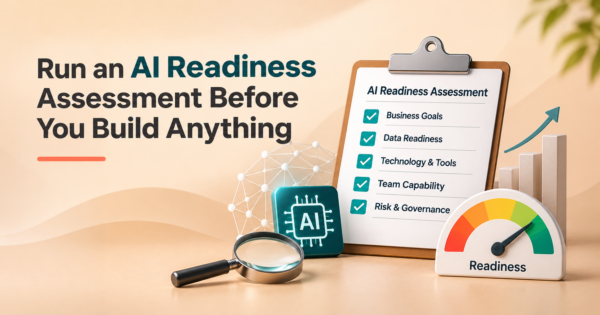
An AI readiness assessment checks whether your business can support an AI project before you spend on one. It scores seven areas: use case, data, systems access, ownership, budget, people and process, and risk. The result tells you whether to fix gaps first, run a small proof of concept, or plan a full build.
TL;DR
- Score seven areas from 0 to 2, for a total out of 14. The scorecard below doubles as an AI readiness assessment template you can copy into a spreadsheet.
- Three areas can stop a project on their own: the use case, the data and the risk controls. A zero in any of them means fix it before you build, whatever the total says.
- Six checks, run by your own staff in about a week, replace the guesswork: a data spot check, an export test, an access map, a baseline measurement, an owner sign-off and a tool-use survey.
- A score of 0 to 6 means fix gaps first, 7 to 10 means you are ready for a narrow proof of concept, and 11 to 14 means you are ready to plan a pilot.
- This guide helps you judge readiness yourself. If you would rather pay someone else to do it, see our guide to what an AI consultant costs.
- If your score says you are ready to prove an idea, our AI integration team can scope it with you.
What does an AI readiness assessment decide?
An AI readiness assessment decides one thing: whether the next dollar should go into building something or into fixing what an AI project would sit on. It looks at your data, your systems, your people and your risk controls, then turns what it finds into a score and a next step.
An AI project can stall for reasons that have nothing to do with the model: nobody owns the outcome, the data lives in three places, or the tool touches customer records nobody has approved. An assessment surfaces those problems while they are still cheap to fix, which is why it comes before any build.
You can run one yourself. It takes a spreadsheet, a few people who know your systems, and about a week. If your answers show you cannot run it alone, that is useful information too, and the section on when to bring in outside help covers it.
What does AI readiness cover? The seven areas of an AI readiness framework
Published AI readiness frameworks group the same concerns under different names: strategy, data, technology, governance, people. For a mid-size business making a first decision, seven areas keep the assessment short enough to finish and specific enough to act on:
- Use case. One named problem, the people affected, and a number that should move if the project works.
- Data. The information the AI needs exists, is mostly accurate, and can be exported.
- Systems access. Software can read from, and where needed write to, the systems involved.
- Ownership. A named person on the business side owns the result and has the time and authority to act on it.
- Budget and timeline. Money exists for a test and for running the result, not only for building it.
- People and process. The process is written down, and the team who will use the result has been involved.
- Risk and security. There are rules for what data may enter AI tools, which tools are approved, and where a human reviews the output.
The use case sets everything else. If your use case is a repeatable process such as intake, scheduling, reporting or follow-up, our AI automation services page shows what that kind of project looks like, and our guide to AI automation for small businesses lists common starting points.
AI readiness assessment template: the one-page scorecard
Score each area 0, 1 or 2 using the descriptions in the table. Be strict. Give a 2 only when you could show the evidence to someone outside the team.
| Area | 0 points | 1 point | 2 points |
|---|---|---|---|
| Use case | “We want to use AI” with no specific problem | A named problem, but no measure of success | A named problem, the team affected and a baseline number to beat |
| Data | Scattered across spreadsheets and inboxes, or does not exist | Lives in one or two systems with known gaps or duplicates | Exists, passed a spot check and can be exported |
| Systems access | No integration or admin access to the systems involved | Manual exports only, or access limited to one system | Documented integration points and approved admin access |
| Ownership | Nobody owns the outcome | IT or an outside vendor owns it, the business does not | A named business owner with time and authority |
| Budget and timeline | No budget set aside | Money for a test, none for running it afterward | Money for the test and for the first year of running it |
| People and process | Process undocumented, team unaware of the plan | Process known to a few people, team partly informed | Process written down and the team involved in the design |
| Risk and security | No rules on what data may enter AI tools | A policy exists but is not enforced or checked | Approved tools, defined data classes and human review of risky output |
Copy the table into a spreadsheet, add a column for the evidence behind each score, and add the totals. The evidence column is what keeps the exercise honest. A score with no evidence is an opinion.
How to score your AI readiness and what the result means
Add the seven scores for a total out of 14. Your AI readiness score points to a next step, using these cut-offs as a guide:
| Total | Where you stand | Next step |
|---|---|---|
| 0 to 6 | Not ready | Fix the lowest-scoring areas first. Do not start a build. |
| 7 to 10 | Ready to test | Run a narrow proof of concept on one use case while you close the remaining gaps. |
| 11 to 14 | Ready to plan | Plan a pilot with real data and real users, and set the success measure first. |
Apply the hard gates before you read the total. A 0 on use case means you do not yet know what you are building. A 0 on data means there is nothing for the AI to work from. A 0 on risk means the first rollout could expose customer or company data. Any one of those blocks a build even if the other six areas score a 2.
Read the pattern, not just the sum. A business scoring 2 on use case, ownership and budget but 0 on data does not need a bigger budget. It needs a data cleanup, and that cleanup is the project.
Six checks you can run in a week
This is the AI readiness checklist behind the scores. Each check produces evidence for the table, so you are scoring what you found and not what you hope is true.
- Spot-check the data. Pull 100 recent records from the system the AI would read. Count how many have missing fields, duplicates or conflicting values. If nobody can say which records are wrong, that is your answer for the data score.
- Run an export test. Ask the person who administers the system to export the data you need without help from the vendor. Note how long it takes and what they could not get.
- Map access. List every system the use case touches. Mark which have an integration or API, which allow only manual exports, and who holds the admin login.
- Take a baseline. Measure the current process for a week: how long it takes, how often it goes wrong and what it costs in staff time. Without a baseline you cannot tell later whether AI helped.
- Get the owner on paper. Put the owner, the budget and the success measure on one page and have the owner sign it. If nobody will sign, ownership scores a 0.
- Survey tool use. Ask five employees which AI tools they already use for work and what they paste into them. The answers show the real state of your risk controls, which can differ from the written policy.
How systems access and data readiness decide what you can build
Data and systems access sit together because they fail together. An AI assistant that answers questions about orders is only as good as the order data it can read, and only as safe as the permissions it is given. If your data lives in a system that offers only manual exports, the project has to start with an integration, not a model.
Access is also a design decision. Software that connects an AI to your systems should read first and write later, and it should act with the narrowest permissions that do the job. Our guide to MCP servers for business explains how that connection layer works and which permission questions to settle before anything goes live.
Score access a 2 only when someone has confirmed the integration point exists and the administrator has approved its use. “The vendor probably has an API” is a 1 at best.
Risk and security readiness before any AI tool touches company data
Risk readiness is easy to score too high, because a policy document exists and nobody has checked whether anyone follows it. Three questions give you an honest score. Which AI tools are approved? Which categories of data may never be entered into them? Where does a person review the output before it reaches a customer, a contract or a financial record?
For a structured way to think about AI risk, the NIST AI Risk Management Framework organizes the work into four functions: govern, map, measure and manage. A mid-size business does not need the whole framework to start. It needs an approved-tools list, a short list of data that stays out of AI tools, and a named person who reviews high-stakes output.
What to do with your result
Your score points to one of three next steps.
- Not ready: fix first. Take the two lowest-scoring areas and assign each to a person with a date. Rescore in a month. Ownership, a written process and an approved-tools list are typically quick to fix. Data cleanup is typically the slowest, so size it early.
- Ready to test: prove one idea. Choose the use case with the clearest baseline and run a small, time-boxed test against a success measure you set in advance. Keep the scope to one process. Our guide on how to integrate AI into your business lays out the wider roadmap this test fits into.
- Ready to plan: scope a pilot. Write the success measure, the data sources, the people involved and the review points, then price the build. Our guide to AI agent development cost shows what each part of a build typically costs, and our AI development services page shows how we build.
When an outside AI readiness assessment is worth paying for
Do it yourself when your systems are few, your data is yours, and someone on the team can answer the data and access questions. Bring in outside help when you cannot answer them, when regulated data is involved, or when the use case crosses several systems and nobody understands all of them.
An outside readiness assessment in the United States typically costs $10,000 to $25,000 over one to three weeks. That is an average, not a quote. For an exact price for your project, contact us for a quotation. Our guide to AI consulting services explains what each service in an engagement includes, and what an assessment should hand you at the end: a scored current state, a ranked list of use cases and a list of gaps with owners.
Frequently Asked Questions
What is an AI readiness assessment?
An AI readiness assessment is a structured check of whether your business can support an AI project. It reviews your use case, data, systems access, ownership, budget, people and process, and risk controls, then scores them. The score tells you whether to fix gaps, run a small proof of concept or plan a pilot before you spend on a build.
How do I assess AI readiness in my business?
Score seven areas from 0 to 2 using the scorecard in this guide, and back each score with evidence. Run six checks first: a 100-record data spot check, an export test, an access map, a baseline measurement, an owner sign-off and a short survey of the AI tools your staff already use. Then add the scores and apply the hard gates.
Is my business ready for AI?
Your business is ready for a first AI project if you can name one problem, point to usable data, get software access to the systems involved, assign a business owner and set rules for AI tool use. If any of those is missing, you are not blocked for good, but that gap is where the work should start before you build.
What does an AI readiness checklist include?
A practical AI readiness checklist includes a one-sentence use case with a success measure, a data sample you have checked for errors, a list of systems with their integration options, a named business owner, a budget for testing and running, a written process, and an approved-tools list with data rules. The six checks in this guide produce that evidence.
Is there an AI readiness assessment template?
Yes. The scorecard in this guide is a one-page AI readiness assessment template. Copy the seven areas into a spreadsheet, add a column for evidence, and score each area 0, 1 or 2. Interactive AI readiness assessment tools exist, but a spreadsheet you control works for a first decision and keeps your answers inside your own team.
What is a good AI readiness score?
No universal standard exists, so a good score is one that matches your next step. On this scorecard, 0 to 6 means fix gaps first, 7 to 10 means ready for a narrow proof of concept, and 11 to 14 means ready to plan a pilot. A zero on use case, data or risk blocks a build regardless of the total.
How long does an AI readiness assessment take?
A self-assessment takes about a week, most of it spent on the six checks rather than the scoring. An outside readiness assessment typically takes one to three weeks. The time depends on how many systems are involved and how quickly your team can answer questions about data, access and ownership.
How much does an AI readiness assessment cost?
A self-assessment costs staff time. An outside readiness assessment in the United States typically costs $10,000 to $25,000, which is an average and not a quote. The price depends on how many systems and teams the assessment covers. For an exact price for your project, contact us for a quotation.
What should you do after an AI readiness assessment?
Act on the lowest scores first. If you scored 0 to 6, assign owners and dates to the weakest two areas and rescore in a month. If you scored 7 to 10, run a time-boxed proof of concept on one use case. If you scored 11 to 14, scope a pilot with a success measure written in advance.
Should a small business run an AI readiness assessment?
Yes, and a small business can finish it faster because it has fewer systems and fewer decision makers. The scorecard works at any size. The areas that matter most for a small team are usually ownership, because one person often holds several roles, and risk, because staff may already paste customer data into AI tools.
Bottom Line
An AI readiness assessment is cheap insurance against an expensive mistake. Score the seven areas, back each score with evidence, honor the hard gates, and let the total pick your next step: fix, test or plan. The first two checks often reveal something useful, and sometimes they show that the best first AI project is a data cleanup.
If your score says you are ready to test an idea, or you want a second opinion on the score itself, our AI integration team can help you scope the next step.