Table of Content

What is the difference between a forward deployed engineer and a solutions engineer?
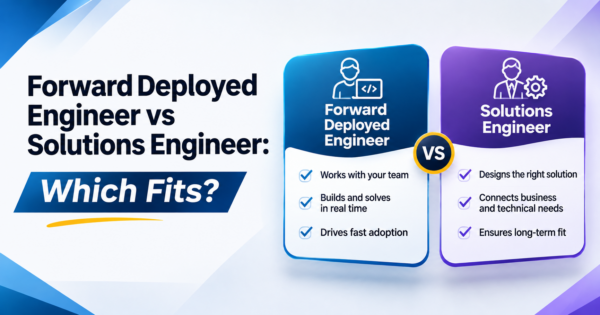
A solutions engineer supports the sale: demos, proofs of concept and technical answers before the contract is signed. A forward deployed engineer builds and runs the solution after the sale, writing production code inside the customer’s environment and staying through rollout. A consultant advises and an agency delivers a scoped project. For an AI project, pick by the stage you are stuck at: evaluating, deciding or deploying.
TL;DR
- The dividing line is what happens after the demo works. A solutions engineer hands off. A forward deployed engineer stays and owns the result in production.
- A consultant gives you a recommendation and a roadmap. An agency gives you a finished, scoped build. Neither is embedded the way a forward deployed engineer is.
- Hiring the wrong one is the expensive mistake. A solutions engineer cannot be expected to run a deployment, and a forward deployed engineer is wasted on pre-sale demos.
- Median posted pay for remote forward deployed engineer jobs is $184,500 a year across 122 postings (Working Nomads, read November 23, 2026). We found no sourced solutions engineer figure to compare, so check current postings for both.
- Postings for the forward deployed role rose more than 1,000% between January and August 2026 compared with a year earlier (Lightcast data reported by Fortune, September 3, 2026), so hiring one competes with the AI labs.
- This post owns the role comparison. For the definition, read our guide to the forward deployed engineer role. For the hiring decision, read how to hire, contract or use a partner for forward deployed work.
Forward deployed engineer vs solutions engineer: what is the difference?
In the forward deployed engineer vs solutions engineer question, both roles sit between a technical product and a customer, which is why the titles get mixed up. The difference is where each one stops. A solutions engineer works on the commercial side of the deal: technical discovery, demos, answers to security and integration questions, and a proof of concept that shows the product can fit. A forward deployed engineer works after that point, or in parallel with it, building the integration, workflow or agent inside the customer’s real systems and staying accountable for it running.
That changes what you can expect from each. A solutions engineer proves a solution is possible, often with sample data. A forward deployed engineer proves it works with your data, permissions and edge cases, and fixes it when it breaks. Our guide to the forward deployed engineer role covers where the job came from. The table below compares the two on the points that matter when you are choosing between them.
| Factor | Solutions engineer | Forward deployed engineer |
|---|---|---|
| Main job | Win the technical evaluation | Build, deploy and run the solution |
| Stage of the project | Before the contract is signed | After the sale, through rollout and beyond |
| Code written | Prototypes, demos and proofs of concept, often on sample data | Production code on the customer’s systems and real data |
| After launch | Usually hands off to delivery or support | Stays embedded and stays accountable |
| Who they answer to | Sales or the pre-sales team | Engineering, the customer or both |
| Feeds the product | Sometimes, through feature requests | Usually, through what the field work shows |
| Best hired when | You need to win technical evaluations | Signed work is stuck at pilot or integration |
Where do the consultant and the agency fit?
If you are scoping an AI project, you are rarely choosing between only two options. Two more show up on every shortlist, and each does a different job from the first two.
A consultant helps you decide what to build. The output is a recommendation, an assessment or a roadmap, and the engagement usually ends when it is delivered. That is the right fit when the question is still “should we, and where first?” It is the wrong fit when the question is “get this running in our systems.” An agency or development partner delivers a scoped build with a team that can cover several skills at once: design, integration, data and testing. It is usually the fastest to start and the best fit for a one-time project, with a defined handoff at the end.
| Role | What you get | Writes production code? | Stays after launch? | Typically engaged for |
|---|---|---|---|---|
| Solutions engineer | A demo, a proof of concept and technical answers | Rarely; prototypes | Usually no | Pre-sale evaluation |
| Consultant | A recommendation, assessment or roadmap | Rarely | No, the project ends at delivery | Deciding what to build |
| Agency or partner | A scoped build delivered by a team | Yes | For support, if contracted | One-time builds and series of projects |
| Forward deployed engineer | A working solution inside your environment, kept running | Yes | Yes, embedded | Ongoing work tied to a product or workflow |
An agency can also act as the embedded role. Several firms, including ours, put an engineer inside a customer’s team for the length of a project. The practical test is the one in our guide to hiring a forward deployed engineer: ask who writes the code, who is still around after launch and whose name the code, documents and accounts end up in.
Which one does your AI project need?
Start from the situation you are in, not the job title that sounds most current. Forward deployed engineer is the fashionable title right now, but it is the right answer to a narrow problem.
| Your situation | Best fit | Why |
|---|---|---|
| You sell a technical product and lose deals at the evaluation stage | Solutions engineer | The gap is proof and technical credibility before signature |
| You are not sure which AI use case to start with | Consultant | You need a decision and a ranked roadmap, not code yet |
| You have one defined project and no internal team to build it | Agency or partner | A team with several skills can start within weeks and hand off cleanly |
| Signed customers are stuck because integrations and workflows are not built | Forward deployed engineer | The gap is production work inside the customer’s environment |
| You need the capability for years, tied to a product | Forward deployed engineer, hired | Knowledge stays with you and feeds the product |
| You need it for a bounded project and have an internal owner to take it over | Contracted engineer or partner | Cheaper than a permanent hire if the need ends |
Two combinations work well in practice. A solutions engineer plus a forward deployed engineer covers a product company end to end: one wins the evaluation, the other makes the customer successful. A consultant followed by a partner covers a company with no technical team: the consultant picks the use case and the partner builds it. If you already know the use case, skip the consultant. Paying for a roadmap when you need a build is wasted money.
What about solutions architects and sales engineers?
Job titles vary by employer, and the duties in the posting matter more than the label. In general, a sales engineer and a solutions engineer are close to the same pre-sale job under different names. A solutions architect designs the system and often hands the build to someone else, while a forward deployed engineer builds it and stays embedded. If a posting says “forward deployed” but every duty ends at the demo, it is a solutions engineer role. If a posting says “solutions engineer” but the duties include shipping and supporting production code, it is a forward deployed role.
What should you ask before you hire or buy either one?
The same four questions separate the roles in an interview or a vendor call. Each has a short honest answer if the person or firm really does the work.
- “Show me something you carried to production.” A forward deployed engineer or a partner can name a system, what broke after launch and how it was fixed. A candidate who can show only demos is a solutions engineer.
- “What happens after the demo works?” Listen for who owns data permissions, testing and support. If the answer is “the customer’s team takes it from there,” you are hearing a handoff role.
- “Who owns the code, documents and accounts at the end?” It should be you, in writing, whichever route you choose.
- “What does a good first month look like?” A strong answer names one workflow, a measurable target and a human approval step. A weak answer is a slide deck.
If you are weighing a hire against a partner for forward deployed work, the decision table in our hire, contract or partner guide goes through duration, time to start and who keeps the knowledge. For a broader hiring view, our guide to hiring AI developers covers the in-house and outsourced options.
How do the costs compare?
Costs come in three different shapes, which makes a direct comparison misleading. A hired engineer is a salary plus recruiting, benefits and ramp time. A contracted engineer is an hourly or monthly rate with no long-term commitment. An agency or partner is a project fee or a team rate. Posted pay for forward deployed roles is high: Working Nomads listed a median of $184,500 a year across 122 remote postings when we read it on November 23, 2026, and that is base pay in postings, not total cost. We did not find a sourced pay figure for solutions engineers that we trust, so we are not quoting one. Pull current postings for both roles in your market before you set a budget.
The cheaper title is not the cheaper outcome. A solutions engineer hired to run a deployment will stall at the point the job description never covered, and the project cost shows up as delay. Match the role to the work first, then compare prices inside that role. If your project is an agent or an integration, our AI agent development cost guide shows what a partner build includes.
What does this look like in our own work?
We do forward deployed style work for contractors, ecommerce brands and operations teams: sit with the people who run a process, connect the systems they already use and build the automation on top. In the CMES project we connected ERP, field and HR data and added assistants that read it without changing it, described in the CMES case study. In the ArchetypeDG project we built a custom commerce platform with agents working under written specs, which you can read in the ArchetypeDG case study.
If you want an embedded team for an AI or integration project rather than a single hire, our agentic AI development services and AI integration services are the closest match, and our AI development services team can help you scope which role fits first. If you are still choosing between agencies, our guide to AI automation agencies lists what to ask.
Frequently Asked Questions
Is a forward deployed engineer the same as a solutions engineer?
No. A solutions engineer supports the sale with demos, proofs of concept and technical answers, and usually steps back once the customer signs. A forward deployed engineer writes production code inside the customer’s environment and stays accountable for it running. Titles vary by company, so judge the role by its duties, not its name.
What is a forward-deployed solutions engineer?
It is a title some employers use for a hybrid: a solutions engineer who also builds and deploys in the customer’s environment. Read the duties in the posting. If the job includes shipping code to production and supporting it after launch, it is a forward deployed engineer role. If it ends at the demo or proof of concept, it is a solutions engineer role.
Does a forward deployed engineer require coding?
Yes. The role exists to build and run working software inside a customer’s systems, so candidates are expected to have carried code to production. A solutions engineer also writes code, but usually prototypes and demos rather than systems that must run unattended.
Is a forward deployed engineer a high-paying job?
Posted pay is high. Working Nomads listed a median of $184,500 a year across 122 remote postings when we read it on November 23, 2026. That is base pay in postings, not total compensation, and we did not find a sourced figure for solutions engineers to compare it with, so check current postings for both roles before you set a budget.
Is a forward deployed engineer entry-level?
Usually not. The job is built around carrying a deployment to production in a live customer environment, so employers tend to look for engineers with shipped work. A solutions engineer role is a more common way in, and it is a frequent step toward forward deployed work. Check each posting, because requirements differ.
What is the difference between a forward deployed engineer and a consultant?
A consultant gives recommendations for a defined project and usually leaves once the report or roadmap is delivered. A forward deployed engineer builds the solution, stays through rollout and is accountable for it working in production. If you need code running in your systems, a consultant alone will not deliver it.
What is the difference between a forward deployed engineer and an agency?
An agency delivers a scoped project with a team and a defined handoff, and the team can cover several skills at once. A forward deployed engineer is one embedded person who keeps working with your team over time. An agency is usually faster to start and better for one-time builds. An embedded engineer fits ongoing work tied to a product.
Should I hire a solutions engineer or a forward deployed engineer first?
Hire a solutions engineer first if your problem is winning technical evaluations before the contract is signed. Hire a forward deployed engineer first if signed customers are stuck because nobody is building their integrations and workflows. If neither fits and you have one bounded AI project, a partner is often the faster route.
Do forward deployed engineers travel?
It depends on the employer and the customer. Because the role places the engineer inside the customer’s environment, some on-site time is possible. Ask for the expected travel in writing before you accept or staff the role.
Can a solutions engineer become a forward deployed engineer?
Yes, and it is a common path. Customer communication and technical discovery transfer directly. The gap is production ownership: tested, maintainable code that keeps running in a customer’s live environment, with accountability after launch.
Bottom Line
In the forward deployed engineer vs solutions engineer choice, the solutions engineer helps you win the evaluation, a consultant helps you decide, an agency builds a scoped project and a forward deployed engineer builds and runs the solution inside your environment. Choose by the stage you are stuck at, ask each candidate to show work that reached production, and make sure the code, documents and accounts end up in your name. If you want a second opinion on which role fits your project, talk to our AI development team.