

Storefront
Fast, searchable, accessible
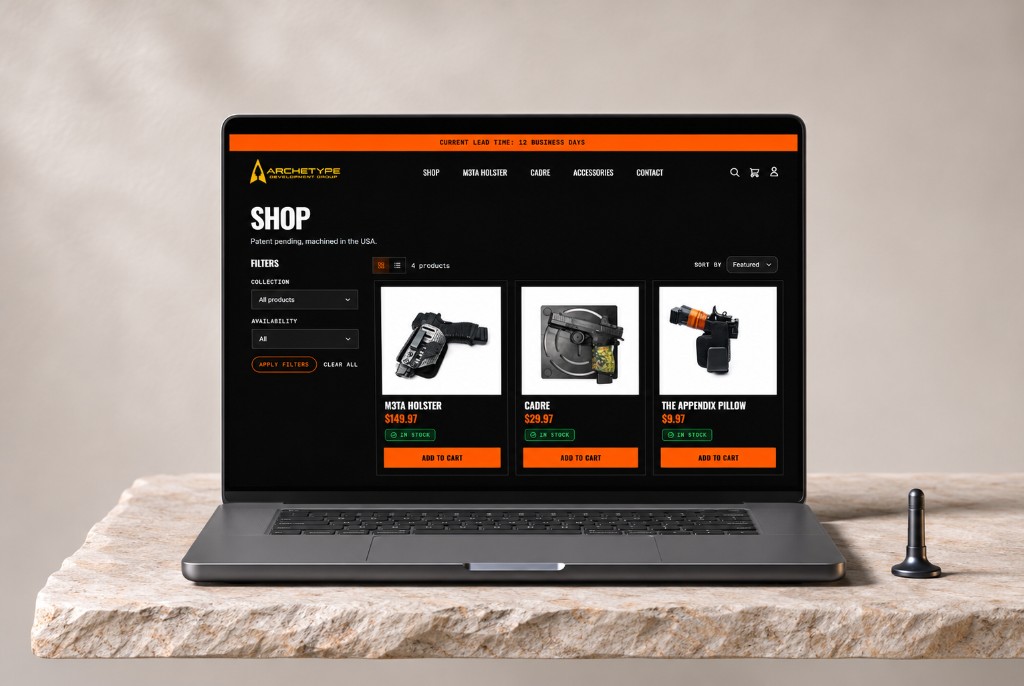
- Product pages with gallery, variants and live stock
- Collections, search and CMS-managed pages
- Moderated reviews with photos
- Sitemap, structured data and llms.txt
Delivered: 19 storefront modules
Case Study · ArchetypeDG · Custom ecommerce development · Ecommerce automation
ArchetypeDG needed a storefront, an operations console and a partner programme that a small team could run without manual busywork. Commerce Pundit delivered custom ecommerce development for all three on one secure platform, using AI-assisted development under a spec-first process and ecommerce automation for the repeatable operations behind every order.
At a glance
Reported outcomes
01 — The challenge
A two-product launch had to grow into hundreds without a rebuild. Every order creates work: payment, tax, a label, a packing slip, emails, returns and partner commissions. Doing that by hand does not scale, so ecommerce automation had to sit at the core of the build. Money, accounts and customer data also leave no room for guesswork.
Payment, tax, fulfilment, tracking and customer emails all had to happen reliably and in order.
Capture, cancel, refund and return rules needed strict guardrails against double charges and mismatches.
Influencers, ads and search all had to be tracked in a way that respects customer privacy and consent.
A short timeline still demanded tests, security and documentation a client can inherit.
The solution
Payments, tax, shipping, email and analytics sit behind swappable integration ports. Changing a vendor means adding one provider and a setting, never rewriting checkout.
01 — Inputs
02 — One platform
ArchetypeDG Commerce Platform
web + worker + database
03 — Outputs
What we built
Separate customer, staff and partner logins, with role-based permissions checked on every request.
Storefront
Delivered: 19 storefront modules
Checkout
Delivered: amount-mismatch and duplicate-charge guards
Fulfilment
Delivered: daily carrier reconciliation fallback
Returns
Delivered: SLA badges and email at every stage
Ops console
Delivered: 22 admin modules, 53 screens
Partners and growth
Delivered: isolated partner login realm
Three services, one delivery
A storefront and console built around the business
No theme limits and no plugin stack to maintain. The front end and the back end evolve separately.
Operations that run on events and schedules
Each workflow fires on an event or a schedule and retries on failure, so work does not depend on someone remembering it.
AI where it helps, and rules where it must not
AI agents helped build the platform under written specs and guardrails. The store runs on deterministic automation and is ready for AI features.
03 — AI and automation
The storefront does not hide a chatbot. The AI is in the engineering process, and the automation is in every order. The architecture is ready for AI-powered features when the business wants them.
In practice
Engineering processSpec, plan, tasks, code and tests, automated hardening scan, pipeline
In practice
AutomationOrder delivered, review-request sequence starts, stops the moment a review is submitted
In practice
ExtensibilitySwap the rule-based insight provider for a language model by adding one provider file
04 — Automation at work
Each one fires on an event or a schedule and writes its side effects through the outbox, so a failure retries instead of vanishing.
Live path from checkout to aftercare — every handoff is handled by a workflow.
Fully automated
Payment authorised, stock checked
Live tax quote, duplicate-charge and mismatch checks
Shipping label and packing slip generated
Tracking recorded, shipment email sent
Review request sequence starts
Returns, refunds and partner commissions follow set rules
| Workflow | Trigger | What happens automatically |
|---|---|---|
| Order and payment | Order placed | Payment authorised, stock checked, guards block amount mismatches and duplicate charges, confirmation email queued. |
| Sales tax | Checkout, refund | Live tax quote at checkout. Orders and refunds are reported to the tax provider in the background. |
| Fulfilment and labels | Order moves to packing | Label and packing slip generated, tracking recorded, shipment email sent. A daily job reconciles carriers for missed webhooks. |
| Abandoned-cart recovery | Cart left behind | Multi-step email sequence on admin-set delays. Stops when an order is placed and respects marketing consent. |
| Review requests | Order delivered | Reminder sequence invites a review and stops once one is submitted. |
| Review intelligence | Review approved | Moderation queue, topic counts and FAQ-gap flags for editors. |
| Returns (RMA) | Customer starts a return | 60-day window from delivery, prepaid label, staff workflow with SLA badges and emails at each stage. |
| Inventory | Stock changes | Reservations and stock moves recorded, low-stock alerts to staff, back-in-stock alerts to shoppers. |
| Affiliates | Referred visit or order | Consent-aware attribution feeds a commission ledger and partner earnings exports. |
| Privacy | Scheduled | Consent Mode v2 and Global Privacy Control honoured, with scheduled privacy sweeps. |
| Email delivery | Every send | Editable templates. Bounce and complaint events update a suppression list. |
| Release pipeline | Code pushed | Images build in parallel and are type-checked, staging deploys automatically, production waits for manual approval. |
05 — Security by design
Payments and data
Access and identity
Platform
06 — Results
Measurement framework
AI-assisted commits are those carrying a Cursor or Claude co-author credit. AI agents co-author; engineers set the specs and rules.
AI-assisted commits ÷ All commits
Equals 75% AI-assisted delivery for this build, measured from co-author credits in the repository history.
07 — How we delivered
Architecture plan, decision records, design tokens and an engineering rulebook agreed before code.
Storefront, console and integrations built with AI agents against specs, with tests in every change.
Worker, outbox, email sequences, labels, returns and reconciliation added module by module.
Security controls, accessibility and performance checks, runbooks and a gated production pipeline.
08 — Built on
A cohesive digital ecosystem for storefront, ops console, partners and automated fulfilment on AWS.
Frequently asked questions
Answers about how AI was used to build the platform, and how the store runs day to day.
Mainly to build it. The store itself runs on deterministic ecommerce automation, not a chatbot. It is also AI-ready: llms.txt, structured data and a review-insight service behind a provider port mean a language model can be added without a rewrite.
Specs, plans and tasks come before code. A written rulebook forbids agents from inventing APIs, schema fields or cloud settings. Tests ship with every change, payments, auth, inventory and returns carry a 95% coverage target, and automated hardening scans run in the pipeline.
Card entry uses the payment provider’s hosted fields, so card numbers never touch the site’s pages or servers (a PCI SAQ-A style design). Amounts are stored as integer minor units, and payments and refunds use idempotency keys.
Yes. Payments, shipping, tax, email, analytics and search sit behind integration ports. Changing a vendor means adding one provider file and a setting, not rewriting checkout.
External side effects go through a transactional outbox with retries. Mutations are idempotent, a daily job reconciles carrier data in case a webhook was missed, and bounces and complaints feed a suppression list.
The project rules restrict dependencies to permissive licences (MIT, Apache-2.0, BSD, ISC) and a licence scan checks them, so the client can own and reuse the platform.
This build went from first commit to a production-ready platform in about eight weeks. Timelines for custom ecommerce development depend on scope, integrations and how much of your operations you want automated.
Typical next steps are new automation workflows, LLM-powered review insights and customer assistance on the existing ports, performance and AI-search optimisation, and further phases such as wholesale or multi-carrier shipping.
Free for D2C and ecommerce teams
Get a free 30 minute Commerce Automation Audit. We review your order, shipping, returns, email and partner workflows and show you which three ecommerce automation opportunities to tackle first, with an effort estimate.