Table of Content

What is AI in finance?
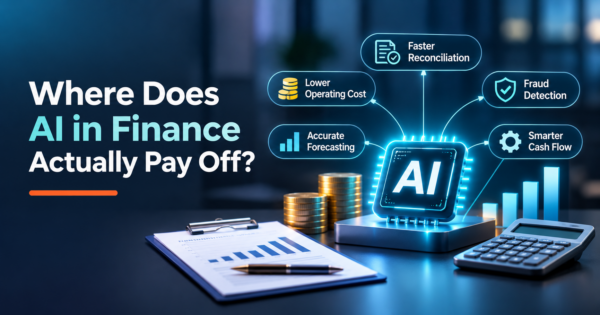
AI in finance means using machine learning and language models to speed up finance work such as invoice capture, reconciliation, forecasting, variance commentary and anomaly flagging. It pays off first where data is structured and volume is high, like accounts payable and reconciliation, and it needs a named person to review anything that reaches the books.
TL;DR
- Scope. This guide covers AI in finance for the finance team of a company: payables, receivables, reconciliation, forecasting, planning and analysis, fraud flags and audit support. Banks and lenders use related tools under heavier rules. Nothing here is investment, tax or legal advice.
- Where it pays first. High-volume, rule-heavy work with structured data: invoices, bank lines, ledger entries. Judgment-heavy work pays later and needs more review.
- Rank before you buy. The table below scores six functions on data needs, payoff speed and what a person keeps. The payoff ratings are our judgment, not a measured benchmark.
- Controls come first. Anything that can post to the books needs a named reviewer and an audit trail. NIST’s AI Risk Management Framework, released January 26, 2023, is a voluntary starting point.
- Test vendor claims. Several vendor guides we read report accuracy and time-savings figures with no independent source. Run your own invoices through any tool before you believe them.
- Start small. One workflow, a written baseline and a 30-day pilot beat a company-wide rollout.
- Where this fits. This post is the map across the finance function. Our guide to AI in accounting goes deeper on month-end close and accounting controls.
What does AI in finance mean for a company finance team?
For a company, AI in finance means software that learns patterns from your own financial data or reads documents in plain language, then does one step of a finance process for you. Three kinds of technology sit under the label. Machine learning finds patterns in numbers, such as which invoices usually go to which account or which payments look unusual. Language models read and write text, such as invoices, contracts and variance commentary. Robotic process automation (RPA) follows fixed rules to move data between systems, and it often sits next to the other two.
The search term “artificial intelligence in finance” covers a much wider field than a finance team needs. Guides from Osfin (June 20, 2025) and DesignRush (updated December 10, 2025) mix payables and reconciliation with credit decisioning, anti-money laundering, wealth advice and trading support, so a controller and a bank risk officer end up reading the same page. We read both on November 20, 2026. This guide stays with the controller’s side: the work that closes the books, pays suppliers, collects cash and plans the next quarter.
One boundary matters. We do not cover trading, investing or personal financial advice. If a tool suggests how to invest money, that is advice, and a general-purpose chatbot is not a licensed advisor.
Where does AI in finance pay off first?
AI in finance pays off first in work that is high in volume, follows clear rules and starts from structured or semi-structured data. That points to invoice handling, bank reconciliation and cash forecasting before it points to anything that needs professional judgment. The table ranks six functions. The payoff speed is our judgment from how these workflows run, so treat it as a way to order your list, not as a measured result.
| Function | What AI does | Data it needs | Payoff speed (our judgment) | What a person keeps |
|---|---|---|---|---|
| Payables, receivables, invoice capture | Reads documents, suggests coding, matches to orders and receipts | Past coded invoices, vendor list, purchase orders | Fast | Approval and payment release |
| Reconciliation and close | Matches bank and ledger lines, flags breaks, drafts journal suggestions | Bank feeds, ledger detail, matching history | Fast | Posting journals, signing off the close |
| Cash flow forecasting | Projects inflows and outflows from payment history and open items | Clean receivables and payables history, pipeline signals | Medium | Assumptions and the decisions made from the forecast |
| Planning and analysis commentary | Drafts variance explanations from the numbers, answers questions about the data | Budget, actuals and a defined chart of accounts | Medium | The story told to leadership |
| Fraud and anomaly flags | Scores unusual payments, duplicate invoices and vendor changes | Transaction history, vendor master changes | Medium | Investigating and deciding on every flag |
| Audit and compliance support | Searches contracts and documents, assembles evidence | Contracts, policies, ledger detail | Slow | Conclusions and every control judgment |
Notice the last column. In every row, the person keeps the decision and the software removes the typing, matching and searching. That pattern is what separates AI use that survives an audit from AI use that creates a cleanup project.
Accounts payable and receivable
Invoice handling is the usual first stop because the volume is high and the rules are stable. AI reads the invoice, suggests the account and cost center from past coding, and matches it to a purchase order and receipt. On the receivables side it matches incoming payments to open invoices and drafts reminders. Our guides cover each step in detail: accounts payable automation explains the process, costs and ROI, invoice processing automation walks through capture and coding, and accounts receivable automation follows an invoice through to cash.
Reconciliation and the close
Reconciliation is matching two records that should agree, such as the bank statement and the ledger. AI helps by learning which differences are timing and which are real breaks, so people only look at the breaks. The payment reconciliation steps we outline show where the matching rules end and where a model helps. The month-end close itself, with its controls, is the subject of our AI in accounting guide.
Cash flow forecasting and AI in FP&A
A forecast is only as good as the history behind it. Models can project when customers will really pay and when bills will really go out, which beats assuming everyone pays on the due date. For planning and analysis, the most practical use of AI in FP&A today is drafting the first version of variance commentary from your actuals and budget, so analysts spend their time on the explanation and not the arithmetic. Our cash flow forecasting guide shows the 13-week template these tools should reproduce. If you want a custom model trained on your own history, that is the work behind our predictive analytics services.
Fraud detection and anomaly flags
AI fraud detection in a company finance team is mostly pattern spotting on your own data: a duplicate invoice, a supplier whose bank details changed last week, a payment just under an approval limit. The software scores and flags. People investigate. Expect false positives, and set the threshold with the person who will have to chase every flag, because a tool that cries wolf gets ignored.
Audit and compliance support
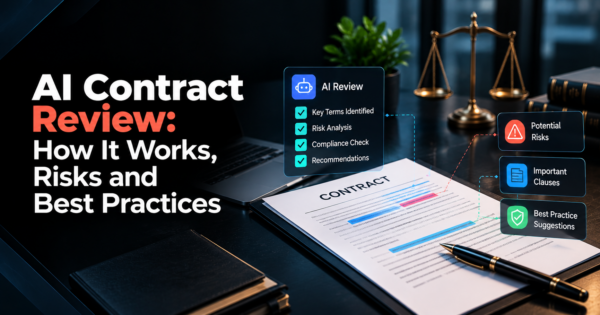
Language models can search a large set of contracts or policies and pull the relevant clauses, which saves hours of reading. They can also invent a clause that is not there, so every pulled passage needs a human check against the source. We cover the pattern in AI contract review.
How does AI in financial services and banking differ?
AI in banking and in wider financial services covers the same technologies applied to credit decisions, anti-money laundering, customer service and market activity, and it operates under tighter regulation than a company finance team does. The Osfin and DesignRush guides we read both list credit decisioning, anti-money laundering and virtual assistants among their use cases. A bank also has to explain model decisions to regulators and customers, so questions of model validation and explainability weigh much more.
If you work at a lender or a regulated institution, treat this guide as the finance-operations layer and add your regulator’s requirements on top. Ask your compliance team what applies, because the rules depend on your charter and jurisdiction, and we cannot give that advice here.
What controls does AI in finance need?
AI in finance needs the same basics as any change to a financial process: a named owner, a human who reviews what the tool produces, a record of what it did and a way to switch it off. The NIST AI Risk Management Framework is a voluntary place to start. NIST released version 1.0 on January 26, 2023, and its page (read November 20, 2026) says the framework is intended for voluntary use and is being revised as part of the White House AI Action Plan. A graphic on the page names four functions: Govern, Map, Measure and Manage.
In practice for a finance team, that becomes five rules:
- Name an owner for each AI-assisted workflow, with a backup.
- Separate suggest from post. The tool may propose an entry or a payment. A person with the right authority releases it.
- Keep an audit trail of inputs, the tool’s output and who approved it.
- Sample the output every month against the source documents, and track the error rate.
- Keep data inside your agreements. Know where invoices and bank data go and whether a vendor trains its models on them.
If your company is public, ask your auditors how AI tools that touch the financial statements should be documented, and ask your compliance team whether model risk guidance applies to you. We have not reproduced those rules here, because the details differ by company and this is not audit or legal advice.
How do you choose the first AI use case in finance?
Choose the first use case by volume, rule clarity and how easy it is to measure. A workflow that happens hundreds of times a month, follows rules you can write down and produces a number you already track is a good first pilot. A workflow with rare, one-off judgments is a bad one.
Here is a worked illustration with invented inputs, so you can replace them with your own. A team handles 2,000 supplier invoices a month. By hand, each takes about 8 minutes to open, code, match and route, which is 16,000 minutes, or about 267 hours. Suppose AI capture and coding passes 70% of invoices with a 1 minute check, and the other 30% become exceptions that still take 8 minutes.
- Passed invoices: 2,000 × 70% = 1,400 invoices at 1 minute = 1,400 minutes.
- Exception invoices: 2,000 × 30% = 600 invoices at 8 minutes = 4,800 minutes.
- New total: 1,400 + 4,800 = 6,200 minutes, or about 103 hours.
- Time saved: 16,000 − 6,200 = 9,800 minutes, or about 163 hours a month, which is 61% of the manual time.
The numbers are made up. The method is not: write down invoices per month, minutes per invoice and the share that needs a human, then test the tool until the share is real. If the pass rate on your own invoices is 40% and not 70%, the saving shrinks, and you want to know that before you sign a contract.
Should you buy, build or integrate AI for finance?
Buy when a packaged tool already does your workflow and connects to your accounting system. Integrate when the tool works but your systems do not talk to each other. Build when your process is unusual enough that no product fits. Most finance teams should start by buying or integrating, and build only after a pilot shows where the packaged options fall short.
Connecting a tool to your ERP or accounting software is often where AI finance automation projects stall, which is the work covered by our AI integration services. If you need something custom, such as a model trained on your own payment history or an agent that handles one specific workflow, see our AI development services. Price it from the parts, not from a headline number, using our breakdown of what drives AI development cost.
What does AI in finance not do well?
AI in finance does not do well with messy data, rare events and anything that needs accountability. A model that learns from badly coded history repeats the bad coding at speed. A language model can state a figure confidently that is not in your data. And no tool can take responsibility for a decision, which is why the person keeps the last step in every row of the table above.
Be careful with vendor numbers as well. Osfin’s guide states over 99% accuracy in most financial operations activities, with no source, date or method. Datarails’ glossary page lists time savings and customer results taken from its own success stories, with no dates. Both are vendor-written pages we read on November 20, 2026, and these are reasonable claims to test, not facts to plan around. Ask any vendor for a trial on your own documents and judge the pass rate yourself.
What does a 30-day AI pilot in finance look like?
A 30-day pilot picks one workflow, measures it before and after, and ends with a go or no-go decision. Here is a plan a small team can run:
- Week one: baseline. Pick one workflow. Record volume, minutes per item, error rate and who touches it today.
- Week two: connect and configure. Load a sample of real items, set the review rules and name the owner and the reviewer.
- Week three: run in parallel. Process the same items by hand and with the tool, and compare results item by item.
- Week four: decide. Compare pass rate, error rate and time saved against the baseline. If the pass rate is below the level you set at the start, stop or adjust. Do not widen the scope until it clears.
Repeat the cycle with the next workflow only after the first one has run for a full month-end without surprises.
Frequently asked questions
How is AI used in finance?
AI is used in finance to read and code invoices, match bank and ledger lines, forecast cash, draft variance commentary, flag unusual payments and search contracts. In banks it also supports credit decisions and anti-money laundering checks. In each case a person approves what the tool produces.
What is the difference between AI in finance and AI in banking?
AI in finance is the broad label for the technology across finance work, while AI in banking is its use inside banks for credit, fraud, compliance and customer service. Banks face tighter regulation and must explain model decisions. A company finance team uses similar tools for operations like payables and reconciliation.
How is AI being used in financial markets?
Institutions use AI in markets for research, signal analysis, risk monitoring and execution support. That area is investment territory, and this guide does not cover it or give investment advice. If you are a company finance team, the use cases that matter are in operations, forecasting and controls.
Which AI tool is best for finance?
No single tool is best, because the right one depends on your workflow, your accounting system and your volume. Shortlist two or three tools that connect to your system, run the same sample of real documents through each, and compare pass rate, error rate and review time. Choose on your own results, not on a vendor’s claims.
How much does it cost to implement AI in finance?
The cost depends on the workflow, how many systems it connects to and how clean your data is. A packaged tool is usually a subscription plus setup, while a custom build adds engineering and testing. Estimate hours by phase and add run costs, as we show in our guide to AI development cost, and ask each vendor for a first-year total.
Can I use ChatGPT as a financial advisor?
No, you should not treat a general-purpose chatbot as a financial advisor. It is not a licensed advisor, it can state wrong figures with confidence, and it does not know your full situation. In a company finance team it can help draft text or explain a concept, but a person must check every number against source records.
Will AI replace finance staff?
AI changes what finance staff spend time on more than it removes the need for them. The typing, matching and searching shrink, and review, judgment and explanation remain. Teams that adopt it well usually shift effort toward exceptions and analysis.
What controls does AI in finance need?
It needs a named owner, a human reviewer who releases anything that posts, an audit trail of inputs and outputs, monthly sampling against source documents and clear rules on where data goes. NIST’s voluntary AI Risk Management Framework, released January 26, 2023, is a useful reference for structuring this.
How long does a first AI finance pilot take?
A focused pilot on one workflow can run in about 30 days if you have a baseline, sample data and a named owner. Connecting to your accounting system is the part most likely to take longer, so check integration early.
Bottom line
AI in finance pays off where volume is high and the rules are clear, and it fails where data is messy or nobody owns the result. Rank your workflows, start with one, keep a person on every decision that reaches the books and test every vendor claim on your own documents. If you want help connecting a tool to your systems or building a custom model, talk to our team about AI development services.