

Table of Content

What is AI dropshipping?
AI dropshipping is dropshipping where AI tools handle parts of the work: finding products, writing listings, making images and ad creative, answering customers and routing orders to suppliers. You still own the store, the promises you make to customers and the relationship with the supplier. The AI changes how much effort each task takes. It does not change the margin on each order.
TL;DR
- AI makes dropshipping cheaper to run, not safer to run. The economics still decide whether a store makes money: product margin, ad cost per order and refunds.
- Our worked example shows the test that matters. With a $39.99 product and our assumptions, the store clears about $17.63 per order before ads and needs a return on ad spend of about 2.27 just to break even. AI tools do not move that number.
- Good uses of AI: product research drafts, listing copy and images, support triage, order routing and reporting. Keep a person on supplier vetting, product claims, refund rules and ad budgets.
- The risks that guides skip are real: slow shipping, supplier stock-outs, chargebacks, unsupported product claims, image and trademark rights, and ad platform policies. The risk table covers each and the control for it.
- “Build a store in minutes” tools produce a template and some generated text. They do not produce supplier relationships, a brand or policies that protect you.
- There is no reliable public data on how many AI dropshipping stores make a profit, so this guide does not quote any. Test with sample orders and a small budget before you scale.
- CommercePundit builds Shopify stores and the automations around them. See the last section.
Is AI dropshipping worth it?
It can be worth it if you treat AI as a way to reduce labor and run tests faster, and not as a source of profit. The structural problems of dropshipping are the same with or without AI: thin margins, long shipping times from suppliers, ad costs that rise as more sellers chase the same product, and little control over quality. Many sellers can now publish the same product with the same AI-written page, so the advantage of a better listing shrinks.
No one publishes a trustworthy profit rate for AI dropshipping stores, and most guides are written by tool vendors or course sellers. We are not going to invent one. What you can do instead is run the math on your own product before you spend on ads, as below.
What do the unit economics look like?
These are illustrative inputs, not market data. Replace them with your supplier quote, your payment processor rates and your own refund history. We assume the supplier cost and shipping are not recovered on a refunded order and the payment fee is not returned, which is conservative.
| Input or step | Value | How it is calculated |
|---|---|---|
| Selling price | $39.99 | Assumption |
| Product cost from supplier | $14.00 | Assumption |
| Supplier shipping per order | $4.50 | Assumption |
| Payment fee | $1.46 (2.9% + $0.30) | Assumed card rate; check your processor’s current rate |
| Refund rate | 6% of orders | Assumption |
| Expected revenue per order after refunds | $37.59 | Price x (1 – refund rate) |
| Contribution per order before ads | $17.63 | Revenue after refunds – product cost – shipping – payment fee |
| Break-even return on ad spend (ROAS) | 2.27 | Price / contribution per order |
Contribution is what each order leaves to pay for advertising and everything else. If you pay more than that to win an order, you lose money on every sale. Now put the ad cost in.
| Ad cost per order | Profit per order after ads | ROAS at this ad cost | Orders per month to cover $200.00 of fixed costs |
|---|---|---|---|
| $8.00 | $9.63 | 5.00 | 21 |
| $12.00 | $5.63 | 3.33 | 36 |
| $16.00 | $1.63 | 2.50 | 123 |
| $18.00 | -$0.37 | 2.22 | never |
| $20.00 | -$2.37 | 2.00 | never |
At an ad cost of $12 per order the store keeps $5.63 per order and needs about 36 orders a month to cover $200.00 of store plan, apps and AI tool fees (an assumption for the example). At $16 it keeps only $1.63 and needs about 123 orders. At $18 or more it loses money on every order, and no listing quality or automation fixes that. Run this table for your own numbers first; if the break-even ROAS is higher than the ad platforms are likely to deliver for your product, pick a different product.
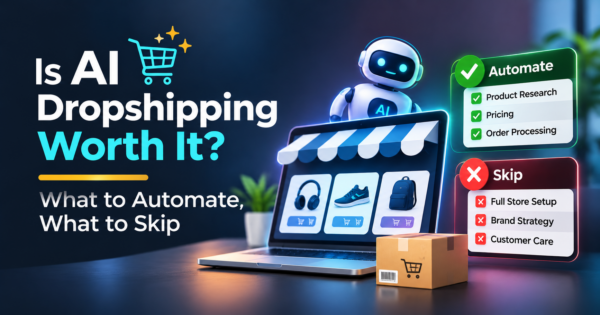
What can AI automate in a dropshipping store?
| Stage | What AI can do | What a person should keep | Risk if you skip the check |
|---|---|---|---|
| Product research | Summarize trends, group candidate products, estimate demand signals from search data | Final product choice, margin check, supplier sample order | You test products with no margin or no reliable supply |
| Supplier vetting | Draft questions, compare stated shipping times, summarize reviews | Decision to work with a supplier; a test order | Delays, poor quality and refunds you pay for |
| Listing copy | Draft titles, bullets and descriptions from the supplier spec | Fact check every claim against the product spec; remove unsupported claims | Misleading claims, returns and possible legal exposure |
| Images and video | Clean backgrounds, resize, draft lifestyle visuals | Confirm you have the right to use the images; make sure the product shown is the product shipped | Rights complaints and customers who feel misled |
| Pricing | Suggest price tests and flag margin drops | Floor price set by your break-even math | Selling below contribution without noticing |
| Ad creative | Draft angles, headlines and variations | Claims review and platform policy review; you set the budget | Ad rejections, account problems and runaway spend |
| Customer support | Answer order-status and policy questions, draft replies, tag tickets | Refunds, exceptions and anything involving a complaint or a safety issue | A wrong promise made on your behalf |
| Order routing and inventory sync | Send orders to the supplier, update stock, flag late tracking | Exception handling when a supplier cancels or substitutes | Selling items that are out of stock |
| Reporting | Summarize margin, ad cost and refund trends weekly | Decisions about what to cut or scale | Looking at revenue while contribution falls |
Order-routing and inventory apps such as DSers and AutoDS are common choices on Shopify, and the platform’s own assistant can help with listings. Names change and prices change, so check each vendor’s current page before you decide. Our guide to the best AI tools for Shopify and our list of AI automation ideas for ecommerce go deeper on the tool side.
What risks do most AI dropshipping guides skip?
| Risk | How it shows up | Control |
|---|---|---|
| Slow or unreliable shipping | Customers wait weeks, open disputes and leave bad reviews | Order a sample, record real delivery times, publish them honestly. In the US, sellers are subject to the FTC’s Mail, Internet, or Telephone Order Merchandise Rule on shipping times and delay notices; check the current rule with counsel |
| Supplier stock-outs and substitutions | You take the order, the supplier cannot fill it or ships something different | Inventory sync, a backup supplier for each product, and a rule for canceling and refunding quickly |
| Chargebacks and disputes | Refunds are forced by the card network and fees are added | Clear policies, tracking on every order, fast support replies and a log of every promise made |
| Unsupported product claims | AI-written copy invents a feature or a result | Fact check each claim against the supplier spec; delete health, safety and performance claims you cannot prove |
| Image and trademark rights | Supplier photos or branded items you are not allowed to sell | Get written permission for images; avoid branded goods without authorization |
| Ad platform policies | Account restrictions for misleading ads or restricted products | Read the current policy for each platform and review creative before launch |
| Taxes and registration | Collecting or paying the wrong amount | Ask an accountant about sales tax and business registration for your state; this guide is not tax or legal advice |
| Dependence on one product | One product dies and revenue disappears | Test a small range and track contribution per product |
How do you start dropshipping with AI step by step?
Do step 1 before anything else. Most failed stores skipped the sample order and the math.
Before you spend on ads, run this short checklist:
- You placed at least one real order with the supplier and measured the delivery time and the packaging.
- Your break-even ROAS is written down and your stop-loss budget is set.
- Shipping, returns and refund policies are published and match what the supplier actually does.
- Every claim on the product page is checked against the supplier specification.
- Order confirmation and tracking emails work, and a test refund has been processed end to end.
- You know who answers support messages, and how the AI hands off to a person.
If you want the store built and the automations connected properly, our Shopify development services and AI solutions for ecommerce cover setup, apps, integrations and support. Our Shopify store setup steps guide explains the basic build, and Shopify Payments versus PayPal helps with the payments decision.
What do “build a store in minutes” AI tools actually give you?
| Claim | What you usually get | What is still your job |
|---|---|---|
| A full store in minutes | A themed template with generated text and imported products | Supplier choice, policies, pricing, tax and payment setup |
| Winning products found by AI | A list based on trend and sales signals that other sellers also see | Margin math, supply test and a reason customers would buy from you |
| Automated profit | Automated tasks | Everything that determines profit: product, price, ad cost and refunds |
| Done-for-you ads | Auto-generated creative and campaign settings | Claims review, policy review and budget control |
These tools are useful for speed. Treat their output as a first draft and the marketing as marketing. If you are weighing several online business models rather than only this one, our post on AI business ideas compares them, and our guide to AI in ecommerce explains where AI helps established stores.
What mistakes sink AI dropshipping stores?
| Mistake | What happens | Fix |
|---|---|---|
| Skipping the math | You scale ads on a product with no margin | Calculate contribution and break-even ROAS first |
| Never ordering a sample | Surprise delays and quality problems reach customers | Order, measure and photograph the real product |
| Trusting AI copy | Invented claims and returns | Fact check each line against the spec |
| Automating support without a handoff | Customers get stuck with a bot | Define when a person takes over |
| Copying the same product as everyone | Ad costs rise and margins fall | Test a narrow niche or add a real differentiator |
| No stop-loss | A bad test eats the budget | Set a maximum loss per test before launching |
Frequently Asked Questions
What is AI dropshipping?
It is dropshipping where AI tools help with research, listings, images, ads, support and order routing. The seller still owns the store and the promises made to customers; the supplier ships the product.
How does dropshipping work?
You list products on your store, a customer orders and pays you, and you place the order with a supplier who ships directly to the customer. You keep the difference between your price and your costs, and you handle support and refunds.
Is AI dropshipping worth it?
It can be, if the product has enough margin to cover ads and refunds and you use AI to reduce labor. AI does not fix weak margins, slow shipping or high ad costs, so run the unit economics before you spend on ads.
Is AI dropshipping legit?
The business model is legal in the US, but sellers must follow consumer protection rules, tax rules and platform policies, including honest shipping times and truthful product claims. Be skeptical of courses that promise fast income, and check legal and tax details with a professional.
How much money do you need to start AI dropshipping?
It depends on your plan and tools, which change, so we do not quote a number. Budget for sample orders, the store plan, tools, a capped ad test and a reserve for refunds and chargebacks, and set a maximum loss before you begin.
How do you create an AI dropshipping store?
Test a product and its margin, order a sample, build the store with clear policies, use AI to draft listings that you fact check, automate order routing and stock sync, then run a small capped ad test and review contribution weekly.
Which parts of dropshipping should you not automate?
Do not automate supplier vetting, product claims, refund and dispute decisions or ad budget approval. AI can draft and flag, but a person should make those calls.
Can ChatGPT run a dropshipping store?
It can draft product pages, emails and support replies, but it cannot place supplier orders, check delivery times or take responsibility for what the store promises. Treat it as an assistant, not an operator.
Is dropshipping still profitable?
Some stores make money and many do not, and no reliable public profit rate exists. Profit depends on product margin, ad cost per order, refund rate and how well you manage suppliers, which is why the break-even math comes first.
Bottom Line
AI dropshipping is worth testing when the math works and you keep people in charge of suppliers, claims, refunds and budgets. Use AI to save time on research, listings, support and reporting, and use a small, capped test to find out whether customers will buy at a price that covers your costs. If you want a store and automations built properly, talk to us about our Shopify development services.


