Table of Content

What is an RFI in construction?
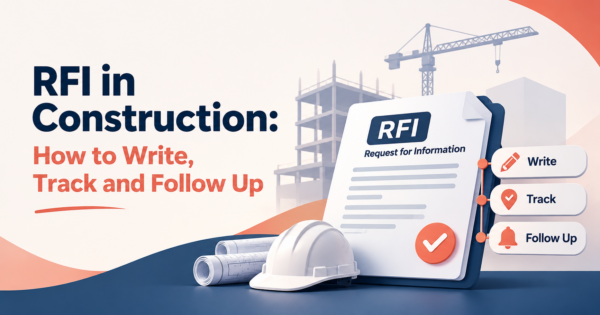
An RFI, or request for information, is a formal written question sent during construction to get a clarification from the design team or owner when the drawings, specifications or other contract documents are unclear, conflicting or silent. The answer is recorded so everyone works from the same information. A good RFI is specific, cites the drawing or spec section, proposes a solution and is sent early enough that the answer does not stall the work.
TL;DR
- An RFI asks for a clarification of the contract documents. It is not a change order, a submittal or a place to argue about price, though an answer can lead to a change.
- The RFI log is the heart of the process. Each row needs a number, a date, a question, a reference to the drawing or spec, who owes the next action (ball in court), a due date and a status.
- A good RFI states the problem, cites the document, attaches a photo or markup, proposes a solution and says when the answer is needed, with the work item it affects.
- A worked aging example below runs 12 sample RFIs against their due dates and shows how a simple report finds the overdue ones and who owes the next move.
- A second example prices a late answer: a crew standing by costs real money each day, and the cost of a nine-day answer against a seven-day clause is easy to compute.
- Automate the tracking, reminders and aging reports. Keep the technical answer with the design team and the decision to send with a person.
- The numbers in the worked examples are illustrations built for this guide, not industry data or client results. Your contract sets response times and procedures.
- CommercePundit builds tracking and reporting automation for contractors. See the last section.
What is the difference between an RFI, a submittal and a change order?
| Item | What it is | Who sends it | Typical outcome |
|---|---|---|---|
| RFI | A question about unclear, conflicting or missing information in the contract documents | Contractor or subcontractor, usually through the contractor | A written clarification |
| Submittal | Product data, shop drawings or samples sent for review before something is built or bought | Contractor or subcontractor | Approved, approved as noted or rejected |
| Change order | A formal contract change in price, time or scope | Owner or contractor, depending on origin | A signed modification to the contract |
| Supplemental instruction | A design team instruction that clarifies or adjusts the documents | Design team | An instruction; it may or may not change cost or time |
An RFI answer can lead to a change order if the clarification adds scope or delay, and your contract defines how that is claimed. That link is why RFI tracking should connect to cost tracking, not live in an email thread. Our guides to construction job costing and the construction WIP report show where a change shows up in the numbers.
When should you send an RFI?
| Situation | Send an RFI? | Why |
|---|---|---|
| Drawings and specs conflict with each other | Yes | The documents must be reconciled in writing |
| A detail is missing for something you must build | Yes | You need the design intent, not a guess |
| A dimension does not fit the field condition | Yes | Send with a photo and measurements |
| You want to substitute a product | Usually a submittal or a substitution request | Follow the contract procedure |
| You want more money for extra work | No, start the change process | An RFI is not a claim |
| Something is unsafe or an emergency | Call first; document after | Do not wait for the log |
| You could find the answer in the documents | No, read them again | Unnecessary RFIs slow the whole job |
How do you write a good construction RFI?
| Part | What to write | Example in plain words |
|---|---|---|
| Subject | What and where, in a few words | Level 2 slab edge conflicts with the curtain wall anchor at gridline C |
| Question | One question, specific | Which governs, the structural detail or the curtain wall detail? |
| Reference | Drawing numbers, spec sections, grid lines | Sheet S-201, detail 4; spec section 08 44 13 |
| Background | What you found and why it matters | The two details specify different edge dimensions |
| Attachments | Photo, markup or sketch | A marked-up detail and a field photo |
| Proposed solution | What you suggest | Use the structural dimension and shift the anchor 2 inches |
| Impact and date needed | What stops and when | Slab pour is scheduled in 10 days; answer needed in 5 |
| Cost or time flag | Say if you believe there is an impact | Possible cost impact; will submit a separate notice if so |
Proposing a solution speeds the answer because the designer can accept or correct it instead of starting from nothing. Keep each RFI to one question so each can be answered and closed on its own.
What does an RFI template look like?
A simple RFI template has the same parts as the table above, in a fixed order, so every construction RFI on the job reads the same way. Copy the structure below into your project software or a shared document.
RFI template
RFI number and date sent. Project and trade. Subject. Question. Drawing and spec references. Background and what you found in the field. Attachments. Proposed solution. Date answer is needed and the work it affects. Cost or time impact flag. Ball in court. Response, responder and date answered.
The template matters for RFI in construction because the log built from it can be sorted, filtered and reported on. Free text in an email cannot.
How does an RFI move from question to closed?
The log should show who owes the next action at every step. That is the idea of ball in court.
What belongs in an RFI log?
| Field | Why it matters |
|---|---|
| RFI number | One unique reference per question |
| Date sent and date due | Drives the aging report; the contract sets the response time |
| Subject and question | Searchable record |
| Drawing or spec reference | Lets the design team and trades find the issue |
| Ball in court | Who owes the next action: contractor, designer, owner |
| Status | Draft, sent, answered, closed, void |
| Date answered | Measures real response time |
| Cost impact flag | Connects the RFI to a possible change |
| Schedule impact flag | Flags answers that stop work |
| Linked change order or submittal | Keeps the chain traceable |
Worked example: an aging report for 12 open RFIs
These sample RFIs are invented. Each has a days-open count and a response time allowed by the contract. The report flags any RFI that has been open longer than its allowance and counts who owes the next move.
| RFI | Subject | Ball in court | Days open | Days allowed | Status |
|---|---|---|---|---|---|
| 101 | Slab edge vs anchor | Designer | 21 | 7 | Overdue by 14 |
| 102 | Rebar spacing at pier | Designer | 12 | 7 | Overdue by 5 |
| 103 | Door hardware conflict | Contractor | 9 | 5 | Overdue by 4 |
| 104 | Underground utility conflict | Designer | 26 | 10 | Overdue by 16 |
| 105 | Finish schedule gap | Designer | 8 | 7 | Overdue by 1 |
| 106 | Roof drain location | Owner | 15 | 7 | Overdue by 8 |
| 107 | Paint spec clarification | Designer | 4 | 7 | On time |
| 108 | Elevator pit depth | Designer | 19 | 10 | Overdue by 9 |
| 109 | Fire stopping detail | Designer | 3 | 7 | On time |
| 110 | Footing elevation | Designer | 11 | 7 | Overdue by 4 |
| 111 | Curb ramp slope | Owner | 6 | 7 | On time |
| 112 | Gate hardware | Contractor | 2 | 5 | On time |
Of the 12, 8 are overdue: 1 with the contractor, 6 with the designer, 1 with the owner. The average age of all 12 is 11.3 days. The report turns “we are waiting on the designer” into a list: 6 RFIs the design team owes an answer on, and a clear reason to escalate the oldest. Any construction team can build this report in a spreadsheet, and it becomes more valuable when it feeds a dashboard and a weekly meeting agenda. See our guides to construction reports worth automating and the project management dashboard.
Worked example: what does a late RFI answer cost?
Suppose an RFI answer is allowed 7 days by the contract and arrives in 9. A crew of 6 is held at $62 per hour loaded for 8 hours a day, and a piece of equipment is idle at $450 a day. All inputs are invented.
| Item | Calculation | Result |
|---|---|---|
| Crew cost per day | 6 x 8 x $62 | $2,976 |
| Idle equipment per day | Assumed | $450 |
| Daily cost of waiting | Crew + equipment | $3,426 |
| Days late | 9 – 7 | 2 |
| Cost of the delay | 2 x $3,426 | $6,852 |
That is $6,852 of waiting for one RFI, before schedule knock-on effects. It is also the number that supports a delay notice if the contract allows one. Without a log that records the date sent, the date due and the date answered, you cannot prove any of it. The same discipline of tying a question to a record is behind our AI contract review work, which finds clauses such as notice periods quickly.
What can you automate in the RFI process?
| Task | Automate? | How |
|---|---|---|
| Number and date the RFI at creation | Yes | The system assigns the next number and stamps the date |
| Route to reviewers and the design team | Yes | Rules by project and discipline |
| Reminders before the due date | Yes | Email or message at set intervals |
| Aging report and ball-in-court list | Yes | A scheduled report or dashboard |
| Link an answer to a cost or schedule flag | Yes, with review | A flag triggers a notice for a person to evaluate |
| Draft an RFI from a field note or photo | Yes, with review | AI drafts; a person edits and sends |
| Search the specs and drawings for related references | Yes, with review | Search tools find candidate references |
| Answer the technical question | No | The design professional answers |
| Decide whether to claim cost or time | No | A person with contract authority decides |
Most of the value is in tracking and reminders, which are plain workflow automation. Our construction automation guide covers the pattern of automating around your ERP, and our AI in construction guide covers where AI helps and where a person decides. If you want RFI data connected to job cost and reporting, see our AI workflow automation work and the construction reporting automation case study.
What mistakes make RFIs slow or costly?
| Mistake | What happens | Fix |
|---|---|---|
| Several questions in one RFI | Partial answers and a stuck log | One question per RFI |
| No reference to drawing or spec | The designer has to hunt for the issue | Cite sheets, details and sections |
| Sending late | The work stops before the answer arrives | Review upcoming work for questions early |
| No proposed solution | Slower answers | Suggest one |
| Tracking in email only | Dates and status are lost | Use one log with dates and ball in court |
| Never checking cost or time impact | Missed notice windows | Flag impact when the answer arrives |
| Closing without distributing the answer | Trades build from old information | Send the answer to every affected trade |
Frequently Asked Questions
What is an RFI in construction?
An RFI, or request for information, is a formal written question sent during construction to clarify unclear, conflicting or missing information in the contract documents. The written answer becomes part of the project record.
Who writes an RFI?
Usually the contractor or a subcontractor, often through the contractor, sends it to the architect, engineer or owner. The person closest to the issue drafts it, and a project manager reviews and sends it.
What should an RFI include?
A number and date, a clear subject, one specific question, drawing or spec references, background, photos or markups, a proposed solution, the date an answer is needed and a note on any cost or schedule impact.
How long should an RFI response take?
Your contract sets the response time, so check it. Many teams track the days allowed and the days actually taken, and flag any RFI that has passed its due date.
What is the difference between an RFI and a submittal?
An RFI asks for a clarification of the contract documents. A submittal sends product data, shop drawings or samples for review and approval before something is built or bought.
Can an RFI lead to a change order?
Yes. If the clarification adds scope or causes delay, it can lead to a change order, and the contract defines the notice and claim process. Track a cost and schedule impact flag on every RFI.
What is an RFI log?
It is the running list of all RFIs on a project, with numbers, dates, subjects, references, ball in court, status and response dates. It is used to chase answers and to prove timing if a dispute arises.
What does ball in court mean?
It means who owes the next action on an item, such as the contractor, the designer or the owner. Showing it on the log makes it clear who is holding up an answer.
Can RFIs be automated?
The tracking, numbering, routing, reminders and aging reports can be automated, and AI can help draft RFIs and find references. The technical answer and any claim decision stay with people.
Do too many RFIs hurt a project?
Unneeded RFIs add work for everyone and can slow answers on the ones that matter. Check the documents first, combine related items thoughtfully and send real conflicts early.
Bottom Line
A construction RFI works when it is specific, early and tracked to the day. Write one question with references and a proposal, keep a log with ball in court and due dates, and measure how long answers really take. If you want RFI tracking, reminders and reporting connected to your job cost data, see our AI workflow automation and AI and ERP integration services.