Table of Content

What is bid leveling in construction?
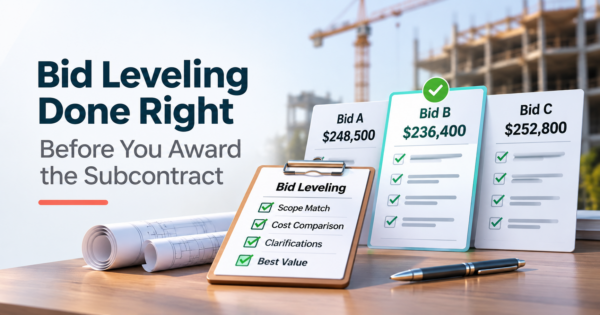
Bid leveling is the process of putting subcontractor bids on equal scope so they can be compared fairly. You list every item in the bid package, map each bid against that list, price whatever a bidder left out, and compare the adjusted totals instead of the headline numbers.
TL;DR
- The lowest bid is often the one that left something out. Bid leveling exposes the gap before you sign.
- Start from a written scope baseline, then record for every bid what is included, excluded and assumed.
- Price each gap, compare adjusted totals, then check the non-price items: schedule, insurance, safety, bonding and addenda.
- A worked example below shows a bid that was $35,500 below the next one ending up $14,000 above it once its scope gaps were priced in.
- A spreadsheet is enough for a few trades. Software and AI help when bids arrive as PDFs and emails in volume, but a person still makes the award decision.
- The leveled bid should flow into your commitment and job cost records, not stay in a spreadsheet nobody opens again.
What is bid leveling in construction?
Bid leveling is the step between receiving subcontractor bids and awarding the work. Procore’s guide to bid leveling describes it as organizing bids so they can be compared easily, with the goal of finding the lowest bid that still covers every requirement in the bid package (Procore, last updated September 6, 2024, read November 18, 2026). The phrase that matters is “still covers every requirement.” Two bids with different totals are not comparable until they describe the same work.
Many teams also use the term bid tabulation. In everyday use, tabulation lists each bidder’s number side by side, while bid leveling goes further and adjusts for differences in what each bid includes. The terms overlap, and some firms use them interchangeably, so agree on what your own team means. What matters is that the comparison happens against a scope baseline, not against each bidder’s own idea of the job.
For general contractors, the output is a bid leveling sheet: a table with the scope items down the side, the bidders across the top, and a clear mark for what each bidder included, excluded or assumed. The sheet ends with an adjusted total for each bidder and a short note explaining the award recommendation.
Why can the lowest subcontractor bid cost the most?
The lowest subcontractor bid can cost the most because it may leave out scope that you will pay for later, through a change order or by hiring someone else to finish the work. A low number is a promise to do some amount of work, and unless you checked which work, you do not know how much of the job it covers.
Procore’s guide gives an example of three concrete bids at $300,000, $345,000 and $315,000. In it, the lowest bidder omitted rebar, and another bidder did not meet the safety requirements, so the guide concludes that the highest bid offered the best value. The amounts are hypothetical, but the pattern is the one estimators describe: the gap between bids is often a difference in scope, not a difference in efficiency.
The same thing happens on every trade package. A mechanical bid that excludes controls, an electrical bid that assumes temporary power is by others, a drywall bid that leaves out blocking: each one makes the number smaller without making the job cheaper. Leveling is how you find those items while you can still ask the bidder to confirm them in writing.
How do you level bids step by step?
You level bids by comparing every bid against one written scope, recording what each bid includes, excludes and assumes, pricing the gaps, and then checking the non-price items before you recommend an award. The steps below combine the process in Procore’s guide, which starts with a clear scope of work and compares bids side by side, and the sequence in a guide from Beck Technology, which aligns each bid to the same plans and resolves gaps before contracts are signed (read November 18, 2026). The detail in each step is our own working method.
1. Write the scope baseline first
List every item the trade package must cover, taken from the drawings, the specifications and the bid invitation. Include quantities where you have them, and the items bidders often assume someone else will do: temporary power, hoisting, cleanup, permits, testing and commissioning, warranty. If the baseline is vague, every comparison after it is a guess.
2. Collect bids in a form you can compare
Ask every bidder to price against the same package, and note which addenda each bid acknowledges. A bid that answers an older set of drawings is not comparable to one that answers the current set. Normalize units and allowances so that a lump sum in one bid and a unit price in another can be read on the same basis.
3. Build the leveling sheet
Put the scope items in rows and the bidders in columns. For each cell record one of three states: included, excluded or assumed, plus the price if the bidder gave one. A bid leveling template is just this grid with space for adjustments and notes, and a plain spreadsheet handles it well. Our advice is to keep one row per scope item, not one row per bidder comment, so gaps stand out.
4. Price the gaps
For each excluded or unclear item, add an adjustment to that bidder’s total. Use the bidder’s own price when they will give one, and your estimate when they will not. Label every adjustment as the bidder’s number or yours, so the person approving the award knows how firm each figure is.
5. Check the non-price items
Beck’s guide lists scope differences, hidden exclusions, vague assumptions and alignment to the correct plans among the things to compare beyond price. Add the items your own risk review needs: schedule and crew availability, insurance and bonding, safety record where you track it, payment terms, how long the price is held, and whether alternates and unit prices are stated.
6. Clarify in writing and re-level
Send each bidder the list of items you could not read from their bid and ask them to confirm in writing. Update the sheet with their answers. Keep the original bid and the response together, so the file shows what was known when you decided.
7. Record the award decision
Write the recommendation on the sheet, including why you did or did not pick the lowest adjusted number. This record helps if a bidder questions the result and when the project team later asks why a package was bought the way it was.
What does a leveled bid look like?
This bid leveling example is an illustration with invented numbers for a hypothetical electrical package. It is not data from any real project. The adjustments are what the general contractor priced after asking each bidder to clarify, and each total is simply the bid plus the adjustments.
| Item (illustration) | Bidder A | Bidder B | Bidder C |
|---|---|---|---|
| Bid as submitted | $412,000 | $447,500 | $438,000 |
| Temporary power | +$18,500 | included | included |
| Fire alarm wiring | +$31,000 | included | included |
| Permits and inspection fees | included | included | +$9,200 |
| Adjusted total | $461,500 | $447,500 | $447,200 |
Read the table the way an estimator would. Bidder A looked $35,500 below Bidder B as submitted ($447,500 minus $412,000) and ends up $14,000 above it once temporary power and fire alarm wiring are added ($461,500 minus $447,500). Bidder C and Bidder B are $300 apart after adjustment, which is within the noise of the estimates. That is where the non-price checks decide: schedule, crew availability, insurance and past performance. The sheet does not pick the winner. It stops you from picking the wrong one for the wrong reason.
Is a spreadsheet enough, or do you need bid leveling software?
A spreadsheet is enough when you level a handful of trade packages a month and the bids arrive in a consistent format. Software becomes worth considering when you level many packages at once, when bids arrive as PDFs and emails in different layouts, or when several estimators need the same sheet.
Bid leveling software is a growing category, and vendors describe it in their own terms. Beck Technology promotes its DESTINI Bid Day tool on the guide cited above. Bridgeline says its product pulls trades and scope from drawings and levels every subcontractor bid side by side, and BidLevel describes a free tool that reads uploaded quotes and lines them up against a scope. We read those descriptions on the vendors’ listings on November 18, 2026 and did not test the products, so treat them as claims to verify in a trial, not as recommendations.
Whatever you choose, ask the same questions you would ask of an estimator. Can you see where each number came from in the source document? Can you override a figure and record why? Does the output keep the scope baseline, the bid, the clarification and the adjustment together? A tool that produces a clean total but hides those links is harder to defend than a plain sheet.
Where does AI help with bid leveling, and where should it not?
AI helps most with the clerical work around bid leveling: reading bids that arrive as PDFs and emails, pulling the line items into a standard grid, flagging scope items that a bid does not mention, and drafting the clarification questions to send back. AI should not decide the award, silently assume that a missing item is included, or replace the estimator’s check of the adjusted numbers.
A sensible way to use it is as a first pass. The model extracts and maps each bid against your scope baseline. A person then reviews every flagged gap, confirms the figures against the source pages, and signs off. Insist on a citation for every extracted number, such as the file and page it came from, because a figure you cannot trace is a figure you cannot defend to a bidder.
Before you rely on any AI bid leveling workflow, test it on a package you already awarded, where you know the right answer. Count how many scope gaps it found, how many it missed and how many it invented. That test costs a day and tells you more than a demo does. For the broader picture of where AI fits in estimating, see our guide to AI construction estimating software, and for the wider contractor picture, what works today for AI in construction.
Contract language is a related area where the same rule applies. If you also use AI to read subcontract terms, our guide to AI contract review covers what to check by hand.
How should leveled bids connect to your ERP?
Leveled bids should connect to your ERP because the awarded number becomes a commitment, and that commitment is what job cost reports compare against. If the leveling lives in a spreadsheet and the award is re-keyed into the ERP, you create two versions of the truth and a place for mistakes.
The practical goal is that the leveling sheet, the awarded amount and the cost codes all agree. When the sheet shows an adjusted total, the commitment in the ERP should match it, split across the same cost codes your estimate uses. That is also what makes the later comparison honest: estimate, buyout and actual cost, on the same codes. Our guide to construction job costing explains how cost codes and commitments feed the reports, and construction automation without replacing your ERP covers the pattern for moving data between systems without ripping any of them out.
Our own relevant work is the operations portal we built for CMES Inc., a heavy civil contractor, described on the CMES automation case study. According to that page, the portal includes a bid and pursuit module and an AI assistant that gives estimating teams read-only access to bid packages, item data and supplier information, with cited sources. The case study does not describe subcontractor bid leveling, so we do not claim it as a result here. What it does show is the same principle: bid data connected to the systems that hold cost and project records, instead of kept in separate files.
If you want that kind of connection between your estimating files and your ERP, our AI integration services and AI workflow automation teams build it, and field data such as the hours in HeavyJob can follow the same route into the ERP.
What mistakes make bid leveling fail?
Bid leveling fails most often when the scope baseline is vague, when bids answer different addenda, when adjustments are made without saying who priced them, and when the sheet ends at a total with no record of the reasoning. A few specific habits cause most of the damage.
- Comparing totals first. Leveling starts from scope, not from price. Looking at the lowest number first biases every later judgment.
- Treating silence as inclusion. If a bid does not mention an item, mark it unclear and ask. Do not assume it is covered.
- Skipping the addenda check. A bid priced on an older drawing set is a different bid.
- Pricing gaps without a label. Mark each adjustment as the bidder’s figure or your estimate.
- Losing the trail. Keep the bid, the clarification and the final sheet in one place.
- Sharing one bidder’s price with another. Pressing a bidder to match a competitor’s number is bid shopping, which damages trust and can breach rules on public work. Ask counsel what applies to your projects.
Frequently asked questions
What does bid leveling mean?
Bid leveling means adjusting and comparing bids so they cover the same scope of work. You map every bid against a written scope, note what each bidder included, excluded or assumed, and price the differences. The result lets you compare adjusted totals, not just the numbers bidders submitted.
What does leveling mean in construction?
In construction, leveling most often refers to bid leveling, which is the process of making subcontractor bids comparable. The word is also used for resource leveling in scheduling and for leveling a surface on site. In an estimating or preconstruction context, it means bid leveling.
What is the difference between bid leveling and bid tabulation?
Bid tabulation lists the bids side by side, usually by total or by line item. Bid leveling goes further by adjusting each bid for scope differences so the comparison is fair. Some firms use the two terms interchangeably, so define what you mean in your own process.
Is there a bid leveling template?
Yes, and you can build one in any spreadsheet. Put scope items in rows and bidders in columns, then record included, excluded or assumed for each cell, with a column for the price of each adjustment. Add rows for adjusted total, non-price checks and the award recommendation.
What are the main stages of bid evaluation?
One common way to describe them is three stages. First, confirm each bid is complete and responsive to the bid package. Second, level the bids for scope and compare adjusted prices. Third, evaluate the non-price factors, such as schedule, insurance and qualifications, and make the award decision. Your own process may split these differently.
Can AI level construction bids?
AI can do the first pass by extracting line items from bid documents, mapping them to your scope and flagging gaps. A person still needs to verify the figures against the source documents and decide the award. Test any AI workflow on a past package where you know the correct answer before you rely on it.
Do you have to award to the lowest leveled bid?
Not always. On private work you can weigh schedule, quality, capacity and past performance alongside the adjusted price. Public owners often have rules that favor the lowest responsible and responsive bidder, so check the rules for your project and ask counsel when in doubt.
Is bid rigging illegal?
Agreements between competitors to fix or coordinate bids are generally illegal under U.S. antitrust law, and public work adds its own rules. That is different from leveling, which is how you evaluate bids you received independently. This is general information, not legal advice, so ask counsel about your situation.
What is a scope gap?
A scope gap is an item the job requires that a bid does not clearly include. It may be excluded, assumed to be someone else’s work or simply not mentioned. Leveling finds scope gaps so you can price them, confirm them with the bidder or change who does the work.
Bottom line
Bid leveling is how you make sure the lowest number is also the most complete one. Write the scope baseline, record what each bid includes, price the gaps, check the non-price items and keep the reasoning with the sheet. Use AI to speed up the reading, not to make the call, and connect the awarded number to the ERP so the commitment matches the decision. If you want help connecting your bid files to your cost system, talk to our AI development services team.