Table of Content

What is a submittal in construction?
A submittal in construction is a document, drawing or sample that a contractor sends to the design team for review before something is bought, fabricated or installed. It proves that the product or method the contractor plans to use matches what the contract documents require. Typical submittals include product data, shop drawings, samples, mock-ups, test reports and certificates. The reviewer returns it with an action such as approved, approved as noted, revise and resubmit or rejected, and the work covered does not move ahead until the action allows it.
TL;DR
- A submittal is the contractor showing the design team what they intend to install, before they install it. The contract documents say what is required, usually in each specification section and in a general submittal procedures section.
- The common types are product data, shop drawings, samples, mock-ups, calculations, test reports and certificates. Each one answers a different question for the reviewer.
- The submittal log, sometimes called a register, is the working tool. A row for every required submittal, with due dates, status and who owes the next move, is what keeps long-lead items from stalling the job.
- Review actions have standard shapes but owner-specific wording. “Revise and resubmit” usually means the covered work should not proceed. Always read the action definitions in the project’s own submittal procedures.
- A worked example below counts backward from the date an item is needed on site to the date the submittal must go out, and shows how one rejection cycle moves that date by three weeks.
- Automate the log, reminders and aging. Leave the technical review and the decision to proceed with people.
- The weeks and dates in the worked example are illustrations built for this guide, not industry data. Your contract sets review times and procedures.
- CommercePundit builds tracking and reporting automation for contractors. See the last section.
Why do submittals exist?
Drawings and specifications describe what the owner wants. They rarely name the exact model of every door closer or the exact fabrication details of every steel connection. The contractor makes those choices, and the submittal is how the design team checks them before money is spent. A wrong choice caught on paper costs a day of someone’s attention. The same wrong choice caught after installation costs demolition, replacement and often a schedule claim.
That is also why submittals are a schedule risk and not just paperwork. Many items have to be reviewed, then ordered, then fabricated and delivered before they can go in the building. If the review slips, everything behind it slips.
What kinds of submittals are there?
Each type answers a different question. Product data shows the manufacturer information for a standard item, such as a catalog sheet with sizes, ratings and finishes, and answers whether this product meets the specification. Shop drawings are drawings prepared by the contractor, a subcontractor or a fabricator that show how a custom item will be made and fitted, such as steel connections, curtain wall or ductwork, and they answer whether the fabricator understood the design. Samples show real color, texture or finish. Mock-ups are full-size sections built on site to approve workmanship before the rest is built. Calculations and test reports prove performance, and certificates and warranties record compliance and coverage.
Specifications usually list the required submittals inside each technical section, under a heading for submittals, while the general procedures live in a section commonly numbered 01 33 00, Submittal Procedures, in the MasterFormat system. Those procedures say how many copies, how long the review takes, how resubmittals are handled and what each review action means. They are the first document to read on any project.
How does the submittal process work from start to finish?
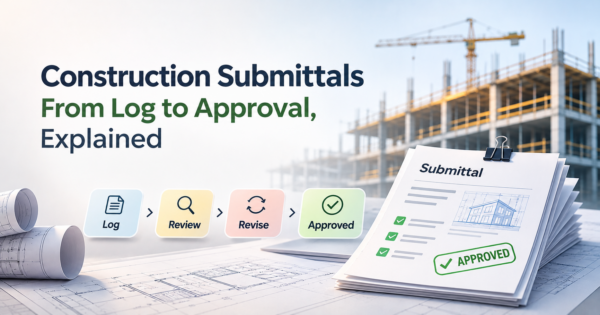
The path is easy to describe and easy to get stuck on. The specification requires a submittal. The subcontractor or supplier prepares it. The general contractor checks it for completeness and consistency with the contract documents and other trades, stamps it and sends it to the design team. The architect or engineer reviews it, often with consultants, and returns it with an action. The contractor distributes the result to the people who need it, and the work proceeds, or the item goes around again.
Most delays happen at the handoffs, not in the reviews. A submittal sits in a subcontractor’s inbox waiting for a missing data sheet. It sits with the general contractor because nobody owns the check. It sits with the design team because three consultants have to review it. Each of those waiting places is invisible unless the log shows who owes the next move.
A submittal also differs from an RFI in construction. A submittal asks whether a chosen product or method is acceptable. An RFI asks what the documents mean when they are unclear. The two often connect, because reviewing a shop drawing frequently uncovers a conflict that needs a question to the designer.
What do the review actions mean?
Review actions share a common shape across projects, but the wording and the consequences vary by owner. A scan of public 01 33 00 specifications shows labels such as approved, approved as noted, revise and resubmit, and disapproved or rejected, with some owners using their own codes. Treat the table below as typical, and check your own procedures section before you rely on it.
| Action | Typical meaning | What the contractor does |
|---|---|---|
| Approved | Conforms to the contract documents | Proceed with the work covered by the submittal |
| Approved as noted | Conforms if the reviewer comments are followed | Proceed in line with the comments; resubmission is often not required |
| Revise and resubmit | Does not conform or is incomplete | Hold purchasing, fabrication and delivery; correct and resubmit |
| Rejected or disapproved | Not acceptable | Do not proceed; submit a new proposal |
| For record only | Information, no approval needed | File it; proceed |
An approval is not a blanket one. Review is generally for conformance with the design intent and the contract documents, not a release of the contractor from responsibility for dimensions, quantities or means and methods. Read your contract language on that point.
What belongs in a construction submittal log?
A good construction submittal log starts as a list built from the specifications before anything is submitted, which is why some teams call it a submittal register. For every required submittal it records the specification section, a description, the responsible subcontractor, the date it is needed on site and the date it must be submitted to hit that date. As work proceeds it adds the date sent, the review due date, the date returned, the action and the resubmittal history. Add a priority flag for long-lead items, and a field for who holds the ball right now.
Building the log early is the single most useful habit. When it is complete before the first submittal goes out, the team can sort by need-on-site date and see at once which items need attention first. When it is built from submittals as they arrive, it only records the past.
Worked example: how early must a submittal go out?
Take a piece of switchgear that is needed on site in week 40 of the schedule, with a manufacturer lead time of 16 weeks from approved submittal to delivery. Assume the general contractor needs 1 week to check and send the package, the design team review takes 2 weeks each time, and a resubmittal takes 1 week to prepare. These are invented numbers to show the arithmetic.
If the first submittal is approved with no comments, the package must go out by week 21, which is week 40 minus 16 weeks of lead time, minus one week of processing, minus two weeks of review. If the reviewer returns it as revise and resubmit, a second cycle adds two weeks of review and one week to prepare, so the first package must have gone out by week 18. A second rejection moves it to week 15. Each rejection cycle costs three weeks of float.
The lesson is practical. Plan for one rejection on any complex long-lead item and send those submittals first, with complete data, so the review is a formality and not a negotiation. A log that calculates the latest submit date for each item and flags the ones that are already late is worth more than any template. Our guides to the reports worth automating in construction and the project management dashboard show how that kind of report gets built.
What can you automate, and what should stay with a person?
Most of the value is in tracking. Numbering, due dates, routing to the right reviewer, reminders before a review is due, and the aging list of what is overdue and with whom can all run automatically. So can the calculation of latest submit dates from need-on-site dates and lead times, and a weekly summary for the project meeting. AI can help in narrower ways: reading a specification section to draft the list of required submittals, or checking a product data sheet against the listed requirements and flagging mismatches for a person to confirm.
What should not be automated is the technical judgment. Whether a product conforms to the design intent is the reviewer’s decision, and whether to proceed on an approved-as-noted action belongs to someone who has read the notes. Use automation to make sure the right person sees the right item early, not to decide for them. Our construction automation guide describes the pattern of automating around your ERP, and our AI in construction guide covers where AI helps and where it should not decide. If you want submittal tracking connected to cost and reporting, see our AI workflow automation work and the construction reporting automation case study.
What mistakes cause submittal delays?
The usual cause is starting late. Teams wait for a complete set of drawings before building the log, then discover that three long-lead items should have gone out a month ago. A close second is sending incomplete packages: a missing data sheet or an unmarked option means the reviewer returns the whole thing, and a review cycle is lost on paperwork.
Other common problems include sending submittals for substitutions as if they were ordinary approvals, when the contract has a separate substitution procedure, letting a subcontractor hold a submittal for days without anyone noticing, and ordering material on an approved-as-noted action before reading the notes. Another is failing to check against other trades. A duct shop drawing that clashes with a beam is not the reviewer’s first job to find, and it is cheaper to find at the general contractor’s check than in the field. Finally, many teams never link submittals to cost: when an approved product costs more than the allowance, that is a change conversation, and it needs a record. Our guides to construction job costing and the construction WIP report show where those changes show up in the numbers.
Frequently Asked Questions
What is a submittal in construction?
A submittal is a document, drawing or sample a contractor sends to the design team for review before something is bought, built or installed. It shows that the planned product or method meets the contract documents.
What is a submittal log?
A submittal log, also called a register, is the list of every required submittal with its specification section, responsible party, need-on-site and submit dates, status, review action and history. It is the tool that keeps long-lead items on schedule.
What types of submittals are there?
Common types are product data, shop drawings, samples, mock-ups, calculations, test reports and certificates or warranties. Each answers a different question for the reviewer.
What is the difference between a submittal and an RFI?
A submittal asks whether a chosen product or method is acceptable. An RFI asks what the contract documents mean when they are unclear, conflicting or silent. Reviewing a submittal can lead to an RFI.
What does approved as noted mean?
It generally means the submittal conforms if the reviewer comments are followed, and the contractor may proceed in line with them. Many owners do not require a resubmittal, but check your own procedures section.
What does revise and resubmit mean?
It generally means the submittal does not conform or is incomplete, and the work covered should not proceed until a corrected submittal is returned with a better action. Purchasing and fabrication are usually on hold.
Who reviews submittals?
The general contractor checks for completeness and coordination, then the architect or engineer, often with consultants, reviews for conformance with the design. The owner or construction manager may also be involved.
How long does a submittal review take?
Your contract sets it. Many projects allow about one to three weeks per review, but it varies by owner and complexity, so read the submittal procedures section and plan for at least one resubmittal on complex items.
What is specification section 01 33 00?
In the MasterFormat system, 01 33 00 is commonly titled Submittal Procedures. It sets how submittals are prepared, sent, reviewed and resubmitted on a project, and what each review action means.
Can submittal tracking be automated?
The log, numbering, routing, reminders, aging and latest-submit-date calculations can be automated, and AI can help draft the required list or compare data sheets against requirements. A person still makes the technical judgments.
Bottom Line
A submittal is how the design team checks what the contractor intends to install, and the log is how the contractor keeps those checks from becoming delays. Build the log early, send long-lead items first with complete data, plan for a rejection and track who owes the next move. If you want submittal tracking, reminders and reporting connected to your job cost data, see our AI workflow automation and AI and ERP integration services.