Table of Content

What is the difference between MCP and an API?
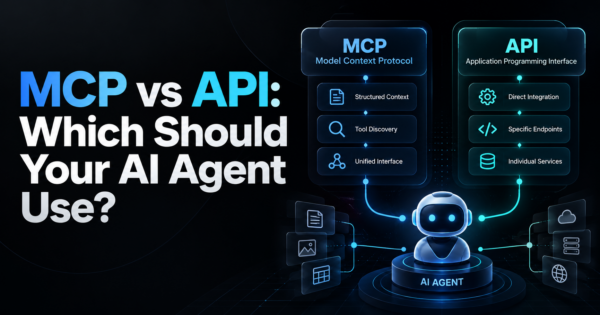
An API is an interface a specific service exposes so other software can call it. MCP (Model Context Protocol) is an open standard that lets AI applications discover and use many tools and data sources through one protocol. MCP servers usually sit on top of APIs, so the real question is whether your agent should call an API directly or reach it through MCP
- MCP is an open-source standard for connecting AI applications to external systems. Its docs compare it to a USB-C port: one standard connector instead of a custom cable for every system.
- An API is one service’s contract. MCP is a shared contract between AI hosts and any number of servers, built on JSON-RPC 2.0 with stdio and Streamable HTTP transports.
- MCP does not replace APIs. A typical MCP tool calls an API, a database, or a file system on the agent’s behalf.
- Use a direct API call for fixed, high-volume backend jobs. Use MCP when an agent must discover and choose among tools, or when several AI clients need the same integration.
- MCP supports bearer tokens, API keys, and custom headers over HTTP, and recommends OAuth for tokens. Security work still sits with you.
- CommercePundit builds MCP servers and agent integrations on top of your existing APIs.
What is the difference between an API and MCP?
An API (application programming interface) is a defined way for one piece of software to ask another to do something, such as “create an invoice” or “get order status.” Every API has its own endpoints, parameters, authentication, and error formats. A developer reads the documentation and writes code against it.
MCP solves a different problem. According to the project’s own documentation, MCP is an open-source standard for connecting AI applications to external systems: data sources such as files and databases, tools such as search engines and calculators, and workflows such as specialized prompts. Claude, ChatGPT, Visual Studio Code, and Cursor are listed among the clients that support it. Instead of writing a custom integration for each AI application and each system, you build an MCP server once, and any MCP client can use it.
MCP vs API: how do they compare?
Whether you search for MCP vs API or API vs MCP, the comparison is the same: one is a single service’s interface, the other is a shared protocol for AI clients.
| Question | Direct API call | MCP |
|---|---|---|
| What is it? | One service’s interface | A standard protocol between AI hosts and servers |
| Who calls it? | Code you write | An AI application, on the model’s behalf |
| How are capabilities found? | You read the docs and hard-code the calls | The client asks the server what it offers, for example with tools/list |
| Message format | Varies: REST, GraphQL, gRPC, SOAP | JSON-RPC 2.0 |
| Transport | Usually HTTPS | stdio for local servers, Streamable HTTP for remote ones |
| Authentication | Whatever the API defines | Bearer tokens, API keys, or custom headers over HTTP; OAuth recommended |
| Integration effort | One integration per API per application | One server, many compatible clients |
| Best for | Fixed workflows and backend jobs | Agents that choose among tools at runtime |
One more comparison comes up often: MCP vs function calling. Function calling is how a model asks its host application to run a tool. MCP standardizes how that application finds tools and runs them across many servers, so the two work together rather than compete.
Does MCP replace APIs?
No. The MCP documentation describes tools as executable functions an AI application can invoke, with examples such as file operations, API calls, and database queries. That means a common MCP tool is a thin, well-described wrapper around an API you already have. Your REST endpoints keep working for your web app, your mobile app, and your partners. MCP adds a second front door designed for AI clients.
MCP also works without a web API at all. The official filesystem server runs locally over stdio and exposes files on the same machine, with no network service involved.
How does MCP work?
MCP uses a client-server design with three participants. The host is the AI application, such as Claude Desktop or Visual Studio Code. The host creates one client per server, and each client keeps a dedicated connection to its server, the program that provides context. Servers in the Model Context Protocol can run locally (stdio) or remotely (Streamable HTTP), and a remote server can serve many clients.
Servers expose three core primitives: tools (functions the AI can invoke), resources (data that gives context, like file contents or database records), and prompts (reusable templates). Clients discover them with list methods such as tools/list and run tools with tools/call. Each tool carries a name, a description, and an input schema, which is what lets a model decide when and how to use it. In the current protocol version listed in the documentation (2026-07-28), every request carries its own protocol version and capabilities, so servers do not depend on earlier requests, and a server/discover request lets a client learn what a server supports.
When should you call the API directly?
- The workflow is fixed. If the steps never change, code that calls the API in order is simpler and cheaper than letting a model choose.
- Volume and latency matter. Batch jobs and high-throughput pipelines should not route every call through a model.
- You need strict control. Payments, deletes, and compliance steps are often better as deterministic code with a human approval.
- There is only one integration. MCP pays off as the number of tools or clients grows.
When does MCP make more sense?
- The agent chooses between many tools. Tool descriptions and schemas let the model pick at runtime, and the tool list can change.
- Several AI clients need the same access. One server can serve Claude, ChatGPT, and your own agent.
- You want a reusable integration. Teams build a CRM or ERP server once instead of rebuilding glue code per agent.
- Tools change often. Servers can notify clients when the tool list changes.
For examples of what agents do with these connections, see our AI agent examples, and for the wider picture of how agents coordinate tools, our AI agent orchestration guide. Our business guide to MCP covers the protocol from a buyer’s side.
MCP security: is MCP secure?
MCP is a protocol, not a security product. Its architecture notes say the protocol focuses on context exchange and does not dictate how an AI application uses language models or manages the context it receives. Over HTTP it supports bearer tokens, API keys, and custom headers, and the documentation recommends OAuth for obtaining tokens. The project also publishes security best practices.
Treat an MCP server like any API that can act on your systems: give it the narrowest credentials that work, separate read tools from write tools, log every call, and require human approval for actions that move money or change records. A model that can call a tool can also be tricked into calling it, so permissions matter more than prompts.
How do you turn an existing API into an MCP server?
- Pick the operations. Start with three to five read-only calls your agent really needs, not the whole API.
- Describe each as a tool. Write a clear name, a plain description of when to use it, and an input schema with types and required fields.
- Map tools to API calls. The server translates a tool call into your API request and returns a clean, short result.
- Add authentication. Use OAuth or scoped tokens, and never pass a master key to the model.
- Test with an inspector and a real client. The MCP project provides the MCP Inspector for testing servers.
- Deploy. Run locally over stdio for personal tools, or remotely over Streamable HTTP for shared ones, then add write tools one at a time.
Our guide to building an AI agent and AI agent builders comparison show where this step fits, and AI workflow automation tools covers the no-code alternative. Assistants that already support MCP are compared in our Claude alternatives guide.
MCP or API: which should your agent use?
| If this is true | Use |
|---|---|
| A fixed, repeatable backend job | Direct API call |
| An agent must choose between several tools | MCP |
| More than one AI client needs the same integration | MCP server over your API |
| You need exact, auditable control over a step | Direct API call with human approval |
| Tools or data sources change often | MCP |
| You are prototyping an assistant for your team | MCP server, read-only first |
If you want a team to design the server, scope permissions, and connect it to your CRM, ERP, or store, see our agentic AI development services, AI integration services, and AI development services.
Frequently Asked Questions
Will MCP replace APIs?
No. MCP tools commonly wrap APIs, databases, and file systems, so APIs stay in place underneath. MCP changes how AI applications find and call them, not whether they exist.
Should I use MCP or an API?
Use a direct API call for fixed, high-volume, or tightly controlled steps. Use MCP when an agent has to discover and choose between tools, or when several AI clients need the same integration. Many systems use both.
Is MCP just a REST API?
No. In an MCP vs REST API comparison, MCP uses JSON-RPC 2.0 messages over stdio or Streamable HTTP and defines primitives (tools, resources, prompts) and discovery methods. A REST API is one service’s own interface, while MCP is a shared protocol that can sit in front of one.
Does MCP use API keys?
It can. Over HTTP, MCP supports bearer tokens, API keys, and custom headers, and the documentation recommends OAuth for obtaining authentication tokens. Local stdio servers do not need network credentials by default.
How do I convert an API to MCP?
Wrap selected API operations as MCP tools, each with a name, a description, and an input schema, and let the server translate tool calls into API requests. Start read-only and add write tools later. The steps are listed above.
Can I use MCP without an API?
Yes. A local MCP server can expose files or a database directly over stdio. The filesystem server in the MCP project is an example of a server that needs no web API.
Is MCP like an API gateway?
Not really. An API gateway manages traffic, authentication, and policies for APIs. MCP is a protocol that tells an AI application what tools and data a server offers and how to call them. They can be used together.
Can I run my own MCP server?
Yes. The MCP project provides SDKs for several languages, reference servers, and an inspector. Local servers run over stdio, and remote servers run over Streamable HTTP so many clients can connect.
What is the difference between an MCP server and an API call?
In an MCP server vs API comparison, an API call is one request to one service. An MCP server is a program that advertises a set of tools, resources, and prompts and lets an AI client list and invoke them. The server may make API calls itself.
Bottom Line
MCP and APIs work at different layers. Keep your APIs, add an MCP server where AI agents need to find and use your systems, and keep deterministic code for steps that must never vary. Start with read-only tools, scope credentials tightly, and expand as you see how agents use them. If you want help building the server and the agent around it, talk to us about agentic AI development services.